Proven Precision Agriculture Tools for Farm Equipment Calibration
By Greta Lund • 27th Nov
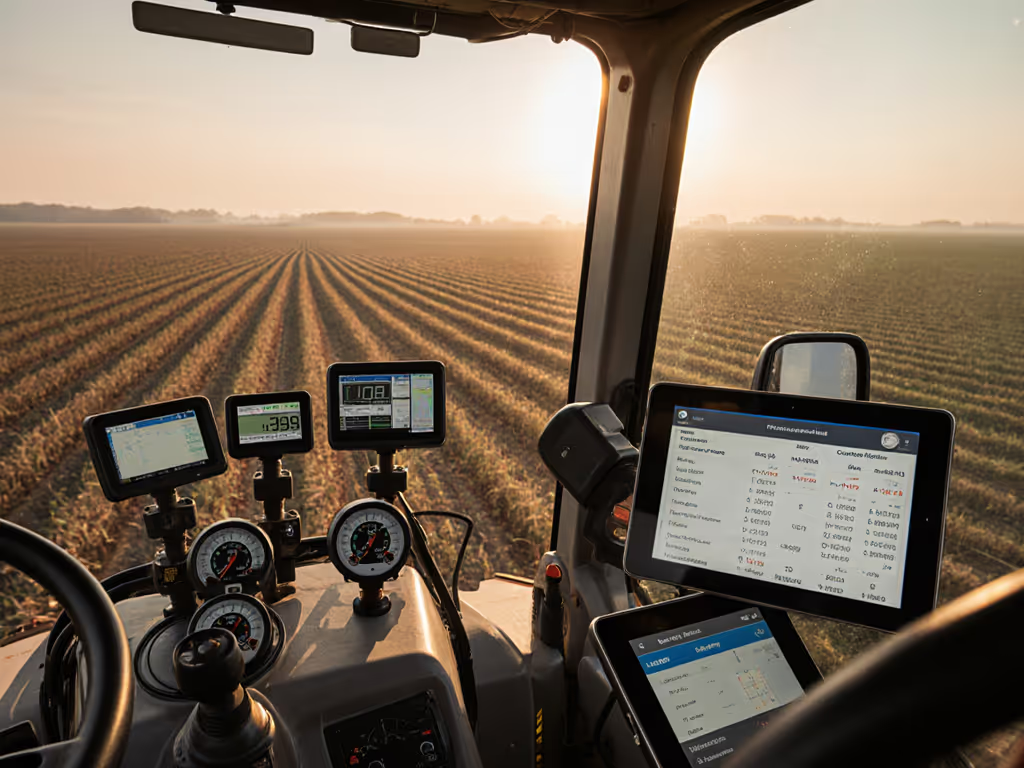
In today's precision agriculture landscape, farm equipment calibration isn't a luxury, it is the bedrock of reliable decision-making. When precision agriculture tools operate without proper calibration, even the most sophisticated GPS guidance systems and yield measurement systems deliver elegant fiction rather than actionable data. As someone who's navigated countless audits where measurement integrity made or broke production continuity, I can confirm that consistency in calibration protocols transforms theoretical accuracy into audit-proof evidence. Evidence beats memory every time when the auditor's pen hovers over your documentation.
This FAQ deep dive addresses the critical intersection of measurement science and agricultural execution, where poorly calibrated equipment turns cost-saving potential into regulatory risk. We'll cut through the marketing noise with standards-based guidance that survives audit scrutiny, focusing on what matters: repeatable processes that convert field data into trustworthy decisions.
Critical Questions on Precision Agriculture Calibration
Why does calibration matter beyond manufacturer specifications?
Manufacturers provide ideal-condition accuracy metrics, but real farms operate in variable environments where temperature fluctuations, vibration, and operator technique introduce uncertainty. If the difference between accuracy and precision isn't crystal clear to your team, align terminology before drafting procedures. Your ISO-compliant calibration program must account for these environmental factors in your uncertainty budget. Consider these interrelated risks:
- Revision control gaps: A single missing revision on a calibration procedure (as happened during one supplier PPAP I witnessed) can trigger a stop-ship, despite perfectly functional equipment.
- Measurement drift: Without documented calibration intervals, sensors degrade silently while reports show "stable" conditions.
- Traceability breaks: Data becomes meaningless without NIST-traceable calibration certificates showing measurement uncertainty.
Precision agriculture tools only deliver ROI when their uncertainty budgets align with your operational tolerance bands. For instance, a ±2-inch GPS guidance calibration might suffice for broad-acre planting but fail catastrophically for variable-rate fertilizer application where ±0.8 inches is the threshold.
Which farm systems demand the strictest calibration protocols?
Not all calibration points carry equal risk. Prioritize these systems where undocumented calibration directly impacts compliance and yield:
Yield measurement systems
Evidence links must show multi-point calibration across moisture ranges and crop types. Single-point calibration during dry conditions creates false confidence when harvesting wet fields.
GPS guidance calibration
- Document azimuth calibration against known monuments (not just field boundaries).
- Verify RTK correction stability through signal dropout simulations.
- Track horizontal/vertical accuracy differentials (many systems excel in one dimension while failing in the other).
Soil moisture mapping sensors
- Calibration must account for soil conductivity variables.
- Require site-specific validation against lab-tested samples.
- Demand seasonal recalibration as soil structure changes.
Crop health monitoring platforms often fail audit trails when:
- Spectral sensors lack dark-frame calibration records.
- NDVI algorithms aren't verified against ground-truth measurements.
- Time-stamping shows calibration gaps between morning/evening scans.
Each requires documented acceptance criteria beyond "working as expected", define quantifiable thresholds like "< 3% variance against reference standard under 25°C conditions."
How should farms document calibration to survive regulatory audits?
Audit readiness separates professional operations from those gambling with compliance. Your documentation must survive three scrutiny layers:
- Initial verification: Proof of baseline calibration against certified references.
- Ongoing monitoring: Records showing in-field verification checks between formal calibrations.
- Incident response: Documentation of corrective actions when deviations occur.
I've seen too many farms rely on equipment-generated calibration reports without:
- Revision-controlled work instructions.
- Environmental condition logs (temperature, humidity during calibration).
- Technician competency records.
- Cross-referenced asset IDs matching physical equipment.
Critical documentation components:
- Calibration certificates with measurement uncertainty values (not just "pass/fail").
- Acceptance criteria tied to specific operational requirements.
- Evidence of traceability to national standards.
- Controlled revision history showing who authorized changes.
- Risk notes identifying calibration failure consequences for each system.
Remember: If it isn't documented, it's hope, not evidence under pressure. During a recent audit, one operation sailed through 12 minutes of calibration questioning because their binders showed verifiable evidence (not just equipment logs but environmental conditions, technician certifications, and cross-referenced uncertainty budgets).
What common calibration mistakes create hidden yield risks?
Even well-intentioned programs falter through these preventable errors:
The "One-and-Done" fallacy Assuming factory calibration covers field conditions. Real-world vibration, dust, and electrical noise degrade sensor accuracy faster than manufacturers acknowledge. When tools face rain, mud, and washdowns, verify environmental protection using IP ratings for measuring tools. Your recalibration interval must be based on actual usage data, not arbitrary timelines.
Ignoring cross-system dependencies Calibrating yield monitors without synchronizing GPS time sources creates data gaps that invalidate seasonal comparisons. A sprayer's flow meter calibration means nothing if the rate controller's calibration lags behind.
Accepting "good enough" documentation Audit-ready calibration records require:
- Specific environmental conditions ("calibrated at 22°C ±2°C").
- Quantifiable uncertainty values ("±0.5% of reading").
- Traceable standard IDs (e.g., "NIST Certificate #XYZ").
Overlooking operator influence Handheld soil probes show 15-20% variation based on insertion technique alone. Your calibration program must include documented operator training records showing technique standardization.
How does proper calibration translate to measurable ROI?
| System | Calibration Failure Cost | Proper Calibration ROI |
|---|---|---|
| Variable Rate Applicator | 8-12% over-application of inputs | $18-$27/acre savings through precise input use |
| Yield Monitor | 5-7% yield data inaccuracy | 3-5% yield increase from accurate zone management |
| GPS Guidance | 2-4% overlap in field operations | 1.5-2.5% fuel savings + reduced compaction |
These numbers come from documented case studies where operations implemented calibration protocols meeting ISO 11783 standards. Note the critical pattern: ROI materializes only when calibration intervals align with documented measurement stability data, not arbitrary calendar schedules.
What's the minimum viable calibration program for audit readiness?
Start with this legally defensible framework that meets USDA, EPA, and ISO requirements:
- Create a Measurement Uncertainty Register Use this step-by-step measurement uncertainty budget guide to build a defensible register.
- List all critical measurement points (yield, application rates, positioning).
- Specify required accuracy for each operation (e.g., "<2% error for fertilizer application").
- Document current measurement uncertainty for each system.
- Implement Control Limits
- Set action thresholds at 70% of tolerance limits (e.g., if 5% error is maximum acceptable, recalibrate at 3.5%).
- Define verification methods between formal calibrations.
- Establish environmental constraints ("do not operate below -5°C").
- Build Evidence Chains
- Photograph calibration standards with serial numbers visible.
- Record technician certifications and environmental conditions.
- Maintain signed revision logs for all calibration procedures.
This approach transforms calibration from a technical task into a risk management system. The farms I've helped pass AS9100 audits didn't invest more in equipment, they invested more in documenting why their calibration intervals made sense for their specific operations.
Sustainable Calibration Practices for Long-Term Success
True calibration excellence moves beyond passing audits to enabling continuous improvement. The most resilient operations share these characteristics:
- Calibration intervals based on actual drift data rather than calendar time.
- Cross-trained technicians who understand both equipment operation and measurement science.
- Digital evidence management linking calibration records to specific field operations. For Industry 4.0 traceability, consider wireless measurement tools with SPC/IoT integration.
- Proactive uncertainty budgeting before adopting new precision agriculture tools.
When evaluating new technology, ask: Does this system generate audit-ready evidence, or just data? During a recent supplier assessment, I rejected a promising soil sensor because its calibration logs couldn't be exported in a revision-controlled format, no matter how accurate the readings, they lacked evidentiary value when documentation mattered.
Final Verification Checklist
- All critical measurement systems have documented uncertainty budgets
- Calibration intervals are justified by historical drift data (not manufacturer recommendations)
- Environmental conditions during calibration are recorded and controlled
- Acceptance criteria specify quantitative thresholds (not subjective "works properly")
- Revision-controlled procedures exist for every calibration activity
- Calibration standards show unbroken traceability to national standards
- In-field verification methods are documented for between-formal-calibration checks
Conclusion: Calibrating for Confidence, Not Compliance
Precision agriculture tools deliver transformative potential only when measurement integrity is non-negotiable. Farm equipment calibration isn't about checking audit boxes, it is about building an evidence chain that turns field data into trustworthy decisions. The operations that thrive long-term treat calibration as a strategic capability, not a maintenance task.
Evidence beats memory when harvest decisions hang in the balance. Those twelve-minute audit sign-offs happen when every calibration record tells a consistent story of control, not because documentation was perfect, but because the process for generating evidence was designed to survive scrutiny.
For further exploration: Review ISO 11783 standards for agricultural technology interoperability, examine NIST Handbook 44 for measurement tolerances, and analyze your calibration data for patterns indicating optimized interval planning. The most successful operations don't just calibrate equipment, they calibrate their entire evidence generation process to turn measurements into management confidence.
Related Articles