Space Tourism Metrology: Measure for Reusability
By Alejandro Ruiz • 31st Mar

The commercial spaceflight industry faces an unseen constraint that will shape its economics for the next decade: space tourism metrology and commercial spaceflight measurement standards. Unlike aircraft, which cycle hundreds of times per year with mature inspection playbooks, reusable spacecraft operate in extreme regimes (thermal extremes, vacuum, radiation, microgravity) and must be certified for safe reuse before each crewed flight. The measurement systems underpinning these inspections determine not just safety, but the viable turnaround time and maintenance cost per flight. For aerospace suppliers, quality managers, and precision fabrication shops already under ISO 9001 and AS9100 pressure, understanding the TCO math of spacecraft inspection capability (especially thermal protection system measurement, cabin safety verification, and the peculiar challenges of microgravity measurement) is becoming essential to bid and execute contracts.
This article breaks down how reusable spacecraft measurement strategies drive repeatability, reduce audit risk, and ultimately control the capability per dollar that makes commercial spaceflight economically viable.
1. Thermal Protection System (TPS) Measurement: Where Downtime Risk Lives
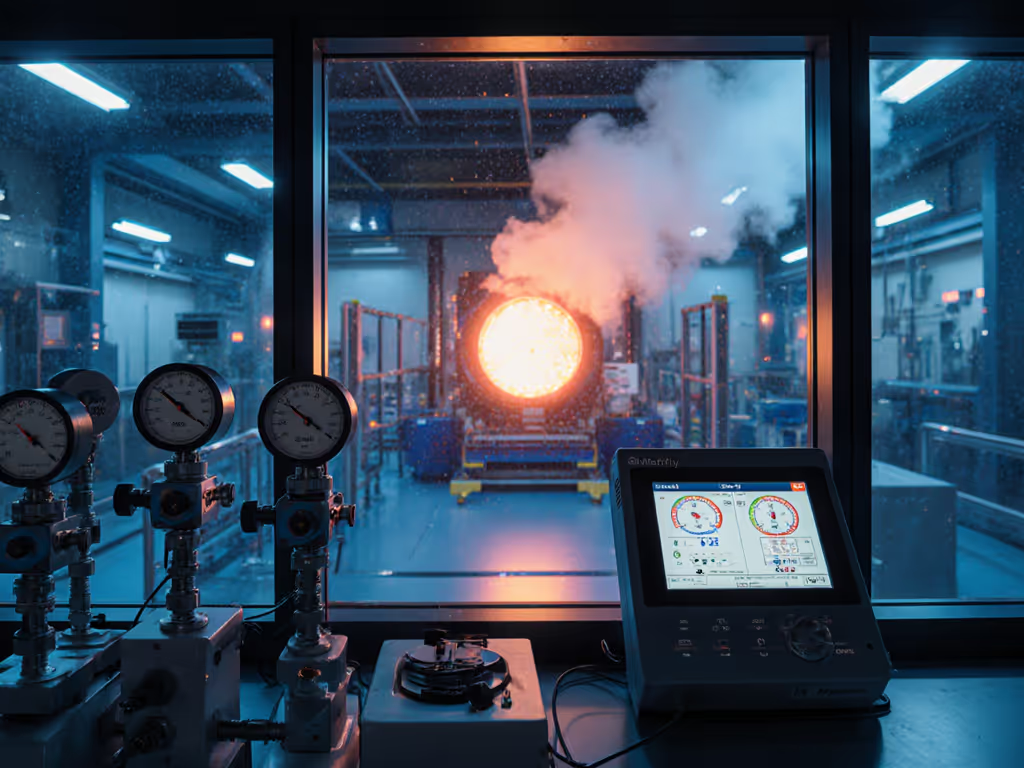
Reusable spacecraft depend on thermal protection tiles or coatings to survive re-entry. Unlike expendable rockets, these systems must be inspected, certified, and sometimes repaired between flights. The measurement challenge is profound: thermal properties degrade predictably, surface recession occurs, and small anomalies (delamination, cracks, thermal bridging) can cascade into catastrophic failures.
A procurement-focused approach begins with establishing downtime risk at the core. If a TPS inspection system fails to detect a flaw, the consequence is mission delay or worse. If the inspection itself is slow or unreliable, turnaround time suffers, and turnaround time directly costs mission cadence and revenue per vehicle. Thermal imaging, surface profilometry, and ultrasonic thickness mapping must be validated not just for accuracy, but for repeatability and on-orbit (or on-site) recalibration feasibility.
The TCO math must account for calibration intervals. Standard lab-grade thermal cameras may require return-ship calibration every 12 months, adding 2-3 weeks of downtime. A well-specified service terms clause includes loaner equipment and on-site calibration capability, eliminating the contingency that once halted a production line for weeks because a single probe vendor could not deliver parts quickly enough. That hidden cost of vendor responsiveness often dwarfs the instrument purchase price.
2. Structural Integrity Verification: Ultrasonic and Phased-Array Precision
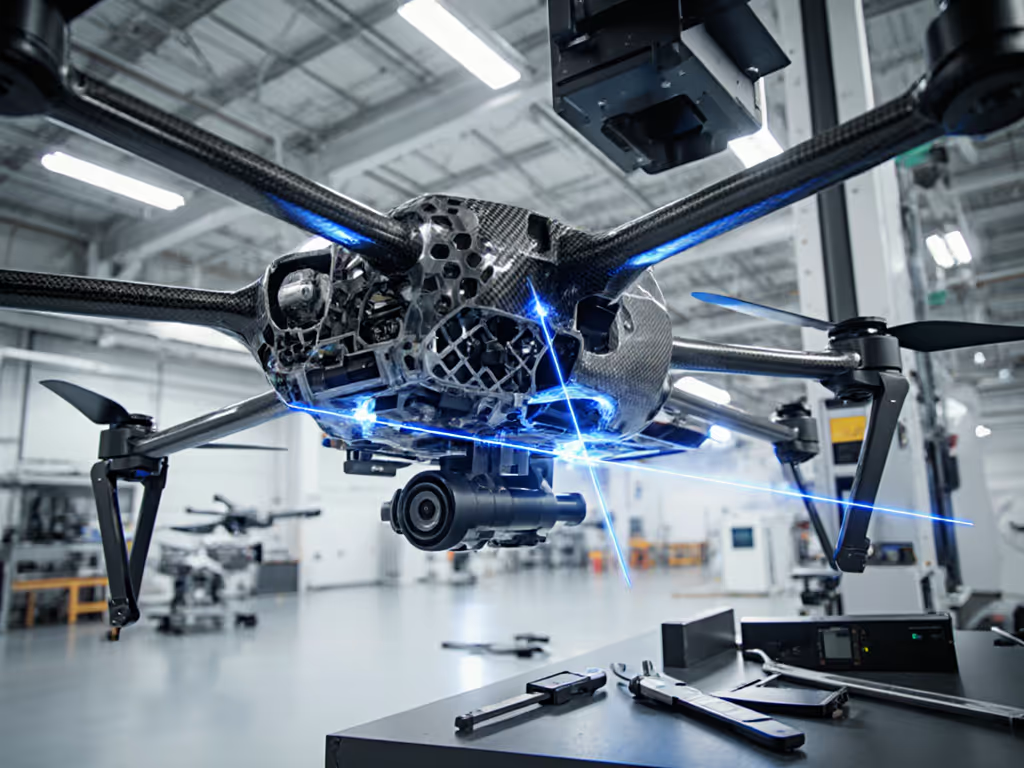
Re-entry exposes spacecraft to extreme thermal and mechanical loads. Composite structures, welds, and adhesive bonds must be validated nondestructively before each flight. Ultrasonic phased-array systems and advanced eddy current probes are the standard tools, but their measurement uncertainty cascades through the inspection decision.
A 4:1 test-accuracy ratio (TAR) is the aerospace standard: your inspection system must be four times more precise than the tolerance you are accepting or rejecting. For structural anomalies in spacecraft, tolerances can be tight (crack detection thresholds in the 1-2 mm range). That demands ultrasonic equipment with sub-millimeter resolution and proven traceability through gage blocks and standard reference materials.
The standardization notes here are critical. All inspection personnel must be certified to the same procedure (ASME E494 for standard and automated systems, ISO 12681 for phased-array). Gage repeatability and reproducibility (GR&R) studies must show that measurement variability is less than 10% of the tolerance (ideally <5% for safety-critical decisions). Equipment drift, probe wear, and couplant degradation all erode capability. Spares lists must include probe replacements, calibration wedges, and reference blocks, with lead times pre-negotiated, not discovered during a critical inspection.
3. Spacecraft Cabin Safety Verification: Pressure Boundary and Environmental Sealing
Crewed spacecraft cabins must maintain pressurization and environmental control over hours-long missions. The measurement challenge is verifying seal integrity, detecting micro-leaks, and certifying that life support systems will function reliably. This requires microgravity measurement challenges to be anticipated: sensors that worked perfectly on the ground may behave differently in weightlessness, and some failure modes (condensation, thermal stratification) are nearly impossible to replicate in a lab.
Leak detection is the primary measurable. Standard methods include helium mass spectrometry, pressure decay testing, and thermal imaging of evaporative cooling patterns. Each has uncertainty budgets. Use our uncertainty budget guide to structure contributors and avoid overconfidence in pass/fail thresholds. Helium is extremely sensitive (parts per billion) but slow and expensive per test. Pressure decay is faster but less sensitive and subject to temperature-driven error if the cabin is not at thermal equilibrium.
The procurement lever is service terms that lock in calibration frequency, replacement criteria for detection media (helium isotope purity, desiccant cartridges), and loaner kit availability. A cabin leak detection failure that goes unnoticed until in-flight represents mission loss and crew risk. Prevention, via redundant sensors, regular recalibration, and documented uncertainty budgets, is the only rational buying posture.
4. Reusable Spacecraft Inspection Data Management: From Measurement to Decision
Modern spaceflight operations integrate measurement data into digital twins, asset-tracking systems, and predictive maintenance models. A spacecraft that flew successfully 10 times has a known inspection history: where cracks have grown, where thermal stress concentrates, where secondary inspections were triggered. That data drives the next inspection plan and risk decisions. For implementation patterns and pitfalls, explore digital twins in metrology.
This integration demands spares lists for data management infrastructure: backup servers, redundant sensors, archival systems, and validated software. A corrupted database record is as dangerous as a missed defect. Cybersecurity and data integrity are unmet metrology requirements in many aerospace quality systems. The measurement instrument is not just the sensor; it is the entire chain from measurement to decision log.
TCO math for reusable spacecraft includes software maintenance, data scientist resources, and ongoing validation of predictive models (costs that dwarf the hardware purchase). Many organizations underestimate this; they buy the probe and the software license, then discover that three technicians and a data engineer are needed to run the program reliably.
5. Standardization Across Supplier Tiers: Avoiding the Bargain Trap
Commercial spaceflight vehicles are assembled from thousands of suppliers: avionics, structures, propulsion, life support. Each supplier inspects and certifies their work to an agreed spec. If suppliers use different measurement standards, different calibration intervals, or different procedures, the integrated vehicle audit becomes chaotic and audit risk explodes.
Standardization is not glamorous, but it is where capability per dollar lives. Specify a single ultrasonic system class for structural inspections across all suppliers, a single calibration provider with agreed turnaround, and a single data format for inspection records. This front-loaded work reduces variance, enables rapid audits, and cuts total lifecycle cost by 20-30% compared to heterogeneous vendor stacks.
A hard-won lesson from a bargain vision probe that cost three weeks in downtime: the initial savings evaporated instantly when a stage failed and spare parts were unavailable. Switching vendors, we demanded loaner equipment, 24-hour response, and standardized service across all our shops. The next time hardware failed, a loaner arrived the same day and production never stopped. The premium on vendor service terms was recouped in the first emergency. Pay for capability, not chrome. Count the lifecycle costs.
6. Traceability and Compliance: Building the Audit Trail
Every inspection that certifies a spacecraft component for flight must be traceable to primary standards (typically NIST calibration chains for electrical and dimensional reference standards). Traceability is not optional; it is a requirement of AS9100, NASA supplier agreements, and ultimately, crew safety. If you need a refresher, see our measurement traceability fundamentals.
Procurement should verify that all measurement equipment has current calibration certificates showing the uncertainty budget, environmental conditions during calibration, and the next calibration due date. Broken chains (out-of-calibration equipment used in inspection) are audit findings that force re-inspection of years of work.
The standardization notes for compliance include establishing a calibration management system: either in-house (high capex, recurring cost) or vendor-managed (outsourced, predictable). Many mid-size suppliers choose a hybrid: gage blocks, thread wires, and master parts calibrated annually by an accredited lab; working standards (hand gages, go/no-go fixtures) checked in-house with those calibrated masters weekly. This balances cost and risk.
7. Planning Reusability: Long-Term Measurement Capability Roadmap
Reusable spacecraft are designed for 10-100 flights per vehicle. Over that lifespan, measurement technologies will evolve, equipment will drift, and inspection procedures will be refined based on field experience. The procurement strategy must anticipate this.
A TCO model for spacecraft measurement infrastructure should span the full fleet life, not just the first vehicle. Include training cycles (new technicians every 2-3 years), technology refresh (sensors become obsolete, software support ends), and spares depletion (how many ultrasonic probes will wear out?). Build service agreements that include training updates and documented procedure revisions. Negotiate upgrade paths so that equipment purchased today can be enhanced or replaced without wholesale system redesign.
Capability sustained over time beats headline specs every flight.
Next Step: Audit Your Measurement Readiness
If your organization supplies, maintains, or audits aerospace hardware destined for reusable spacecraft, run a measurement system audit now. Inventory your calibration certificates, verify traceability chains, confirm that GR&R studies are current, and map supplier measurement capability to your specifications. Identify any out-of-calibration equipment, missing gage blocks or reference standards, and procedures that lack documented uncertainty budgets. Close those gaps before the next audit or major contract negotiation. In commercial spaceflight, downtime risk is existential. Measurement capability that sustains operations is not a nice-to-have; it is the foundation of every flight.
Related Articles