
Traceable Biomanufacturing Metrology: Living Cell Tools Compared
By Marcus O’Neal • 10th Jan
As regulatory bodies tighten requirements for biopharmaceutical manufacturing, biomanufacturing metrology becomes as critical as your pressure transducers and temperature sensors. When living cells are your production line, living cell measurement tools must deliver more than counts, and they must provide traceable, uncertainty-quantified data that stands up to audit scrutiny. Like that January audit where they asked for our environmental monitor chain-of-custody, your measurement validity will be questioned precisely when you're under production pressure. Let's build your audit-ready toolkit for cellular metrology. For life-science compliance context, see our medical metrology audit guide.
Why Traditional OD600 Fails Biomanufacturing's Audit Trail
Optical density measurements create a false sense of security in regulated environments. While OD600 provides rapid turbidity readings, it cannot distinguish between viable product-forming cells and dead biomass that complicates downstream processing. From an audit perspective, this creates three critical documentation gaps:
- No uncertainty budget for live/dead cell differentiation
- No traceability to viable cell concentration standards
- No environmental correlation between turbidity and actual metabolic activity
When dead cells comprise 30% of your culture (common in fed-batch processes), OD600 overestimates viable biomass by equivalent margins, creating process control errors that compound during scale-up.
The FDA's 2023 Process Validation Guidance specifically notes that "indirect measurements require documented correlation to critical quality attributes." To build defensible viability data, use our measurement uncertainty budget guide to structure your analysis. OD600 alone fails this requirement when cell viability directly impacts product quality.
How Flow Cytometry Solves Biomanufacturing's Traceability Gap
The Audit-Ready Viability Measurement
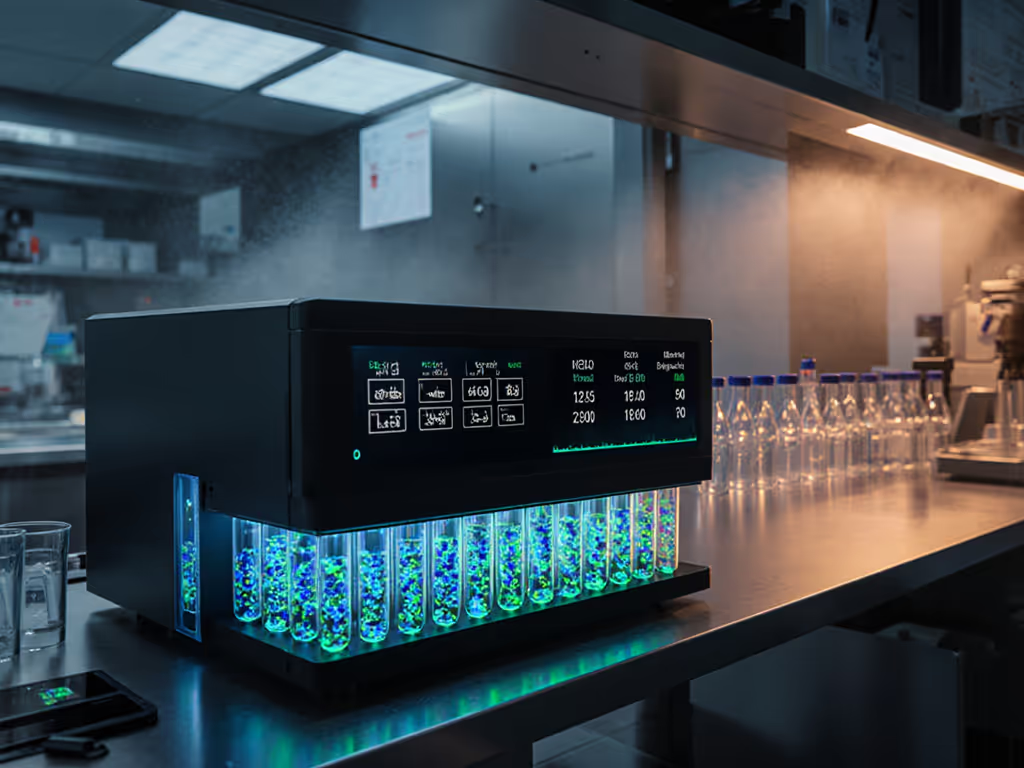
Flow cytometry with membrane integrity staining addresses the fundamental weakness of traditional methods by directly measuring intact cells (the ICC (Intact Cell Count) metric). Unlike plate counts requiring 24-48 hours, ICC delivers results in 30 minutes while providing:
- NIST-traceable particle sizing through calibration beads
- Documented uncertainty budgets for staining efficiency and instrument variability
- Digital audit trails with timestamped raw data files
During a recent audit at a CAR-T facility, the reviewer specifically requested our flow cytometry SOPs. When they saw our documented bead calibration protocol, staining validation data, and environmental controls for the analyzer room, they moved to the next item (no additional questions). This level of documentation transforms compliance from a hurdle to a competitive advantage. To harden chain-of-custody and data integrity, consider blockchain-backed traceability for calibration and audit records.
Critical Implementation Checklist
Before implementing flow cytometry for GMP environments, verify these traceability elements:
- Calibration against NIST-traceable polystyrene beads (document frequency)
- Staining protocol validation including lot-to-lot reagent testing
- Environmental controls for the analyzer room (±0.5°C, documented hourly)
- Uncertainty calculation covering all contributing factors
- Data integrity protocols meeting 21 CFR Part 11 requirements

The NIST SAC-IR Breakthrough: Label-Free Protein Conformation Measurement
NIST's recently launched SAC-IR (Spectral Analysis of Cells using Infrared) technology represents a paradigm shift for protein conformation measurement in living cultures. Unlike fluorescent tagging methods that alter cell behavior, this label-free approach:
- Measures absolute biomolecule mass without disrupting cultures
- Quantifies structural changes in therapeutic proteins during production
- Creates direct traceability to SI units through infrared spectral analysis
For monoclonal antibody manufacturers, this means correlating subtle protein folding changes to critical quality attributes, without extraction or labeling that alters the very conformation you're measuring. The method's ability to distinguish functional from misfolded proteins addresses a key FDA pain point in biosimilar development.
Building Your Bioreactor Monitoring System Audit Trail
Sterility-Preserving Measurement Requirements
Contamination risk makes traditional sampling methods problematic for bioreactor monitoring systems. Your audit documentation must demonstrate:
- Closed-system sampling with validated sterility maintenance
- Time-to-analysis metrics proving sample integrity
- Calibration traceability for in-line sensors
- Environmental monitoring during measurement procedures
Aseptic sampling ports with integrated sensors eliminate the biggest audit red flag we've seen: manual sampling introducing contamination risk. For system-level tradeoffs between integrated process checks and benchtop verification, see our in-line vs off-line metrology comparison. Document your sampling validation protocol with microbial challenge testing (it is the single item most auditors scrutinize).
Cell Viability Tracking: Beyond Simple Counts
True cell viability tracking requires multiparametric data that correlates with product quality. During a recent audit, I watched a reviewer reject a client's viability data because they only measured membrane integrity without linking it to specific productivity metrics. Your documentation should show:
- Correlation between viability markers and product titer
- Uncertainty budgets for each measurement parameter
- Environmental controls during sampling and analysis
- Traceability to reference standards for each biomarker

The Traceability Chain: Your Audit Insurance Policy
Remember that auditor who asked for the thermometer calibration behind our CMM room logs? He wasn't checking temperature (he was verifying our chain-of-traceability mindset). In biomanufacturing metrology, this means documenting every link: If you need a refresher on fundamentals, read our measurement traceability basics.
Sample → Sensor → Reference Standard → NMI
When your sterility-preserving measurement protocol shows this complete chain, auditors shift from compliance enforcers to process improvement partners. I've seen this transform audit outcomes from months of corrective actions to simple acknowledgments of best practices.
Environmental Control: The Hidden Metrology Factor
Most biomanufacturing metrology failures stem from uncontrolled environmental variables. Your measurement uncertainty budget must account for:
| Factor | Acceptable Range | Measurement Method |
|---|---|---|
| Temperature | ±0.5°C | NIST-traceable RTD with hourly logs |
| Vibration | <0.5μm displacement | Accelerometer with spectral analysis |
| Ambient Light | <10 lux during analysis | Calibrated photometer |
| Humidity | 40-60% RH | Hygrometer with NIST certificate |
Your environmental monitoring program should document these parameters at the exact moment of measurement, not just as room conditions. This level of detail prevented a 3-week production hold during a recent audit when reviewers questioned viability data; our environmental logs showed no excursions during analysis.
Uncertainty Budgeting for Living Cell Measurements
Building a comprehensive uncertainty budget separates adequate from audit-proof metrology. For flow cytometry-based ICC measurements, include these elements:
Total Uncertainty = √(u²(bead calibration) + u²(staining) + u²(counting) + u²(environment))
Where:
- Bead calibration uncertainty: 2.1% (from certificate)
- Staining efficiency: 3.7% (from validation data)
- Counting statistics: 1.5% (for >10,000 events)
- Environmental factors: 2.3% (validated range)
Total Combined Uncertainty = 5.4%
This documented calculation (specific to your process and equipment) provides the defensible metrology foundation regulators require. Generic "manufacturer's specifications" won't suffice during rigorous audit scrutiny.
Audit-Ready Documentation Checklist
Before your next regulatory review, verify these biomanufacturing metrology elements:
- Complete traceability chain documented for all living cell measurements
- Uncertainty budgets calculated for critical process parameters
- Environmental conditions recorded at time of measurement
- Validation data showing correlation to product quality attributes
- Calibration records with NIST-traceable reference standards
- Sterility preservation protocols validated during sampling
- Staff training records specific to metrology procedures
- Data integrity controls meeting regulatory requirements
Final Thought: Metrology as Business Enabler
When you treat biomanufacturing metrology as merely a compliance requirement, it becomes a cost center. But when you build traceability into your measurement systems from the start, it transforms into your most powerful process optimization tool. The audit that once threatened production shutdowns becomes a validation of your technical excellence, precisely because you chose tools where you can show your chain of traceability.
Trace it, budget it, then trust it under audit.
Further Exploration
Deepen your metrology expertise with these resources:
- NIST Special Publication 260-193: Reference Materials for Cell Counting
- USP Chapter <1033> Biological Assay Validation
- ISO 20395:2019 Biotechnology - Biobanking
- The recently updated ASTM E3250-23 Standard Guide for Flow Cytometry in Regulated Environments
What specific measurement challenge are you facing in your biomanufacturing process? I'd welcome your experiences in building audit-ready cellular metrology systems, especially how you've documented uncertainty for living cell measurements.
Related Articles