
Pin vs Pinless Moisture Meters: Practical Comparison
By Marcus O’Neal • 3rd Oct
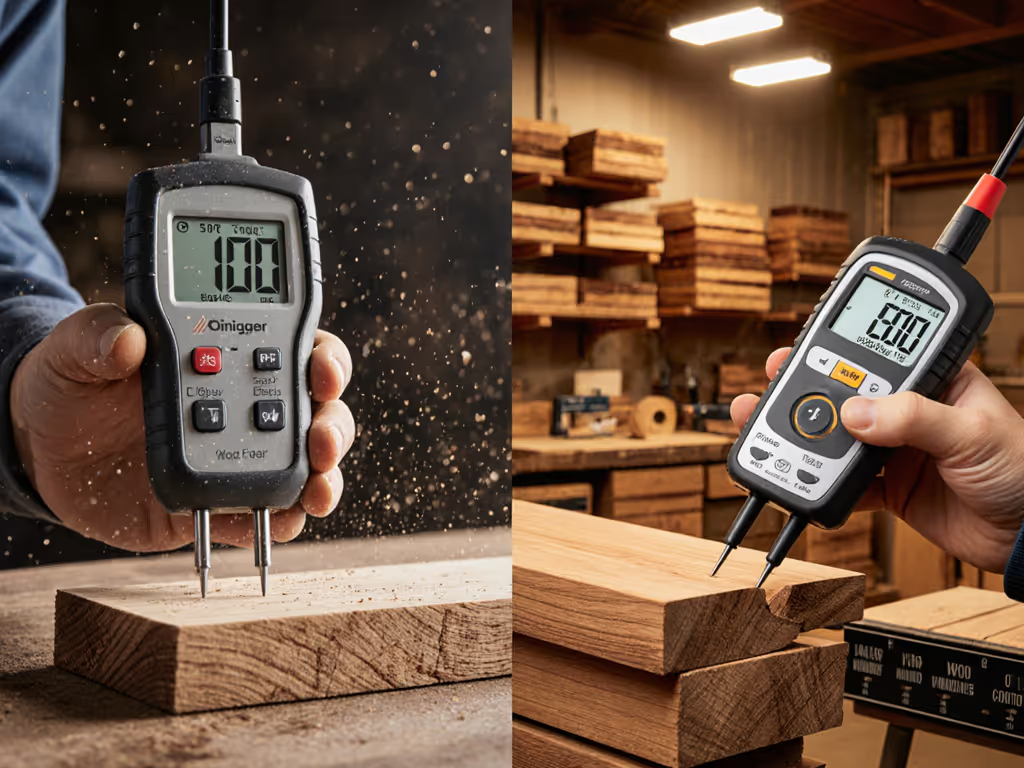
When your quality manager walks in with an ISO 9001 auditor next week, will your wood moisture meter comparison data hold up? I've seen too many teams scramble because they treated moisture measurement as a casual check rather than a traceable process. The core difference in pin vs pinless moisture meter technology isn't just about holes in wood (it is about how each handles uncertainty, species variation, and environmental drift under audit scrutiny). Let's cut through the marketing to build measurement systems that document before you defend.
Why Moisture Measurement Matters in Regulated Workshops
In aerospace component fabrication or medical device woodworking, moisture content isn't just about warping, it is a critical control point. A 2% moisture deviation can shift tolerances by 0.1 mm in fine cabinetry work. Unlike casual DIYers, your shop faces:
- Traceability requirements (AS9100 Rev D §8.5.1.3 mandates calibration chains for process monitoring equipment)
- Uncertainty budgets where ±1% moisture error cascades through your SPC system
- Species-specific chemistry affecting electrical resistance readings
I once audited a flooring installer whose pinless meter gave false "dry" readings on oak because they hadn't applied species correction factors. Trace it, budget it, then trust it under audit. That is why this comparison focuses on what matters in your calibration log, not just initial price.
How Pin and Pinless Meters Actually Work (Beyond the Brochures)
Core Technology: Electromagnetic vs. Resistive Measurement
Pinless meters use electromagnetic field sensors (typically capacitive or RF) that penetrate wood to preset depths (usually 1/4" or 3/4"). The meter measures dielectric permittivity changes caused by water molecules. Crucially:
- No surface penetration required (preserves finished surfaces)
- Measures average moisture across the entire sensor footprint (about 2 in^2)
- Environmental sensitivity: readings can drift ±0.5% MC for every 10°F deviation from a 70°F baseline
Pin meters inject a low-voltage current between two needles to measure electrical resistance. Wood chemistry directly impacts accuracy:
- Must physically penetrate the surface (leaving 0.05" to 0.1" holes)
- Reads only the small volume between pin tips
- Species calibration is non-negotiable (resistance in maple vs. pine differs by 40% at the same MC)
Both types require documented environmental compensation. I've had auditors demand the temperature correction charts used during a moisture survey. Document before you defend.
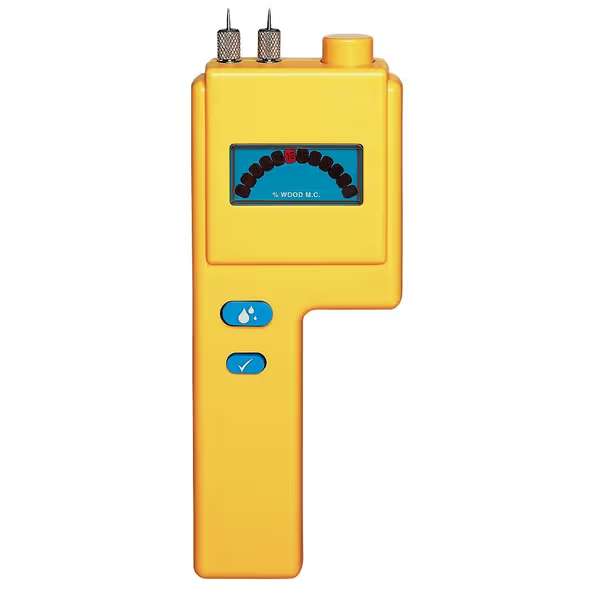
Delmhorst J-LITE 6-30% Pin Wood Moisture Meter
Accurate, reliable wood moisture readings for hobbyists and professionals alike.
$220
Moisture Content Range6% to 30%
Moisture Content Range6% to 30%
Pros
Precise readings via microcontroller for critical projects.
Bright LED display for clear readings in any light.
Cons
Battery life feedback is mixed among users.
Customers find the wood moisture meter well-built and easy to use, with accurate moisture content readings and reasonable pricing. They appreciate its functionality and usefulness, with one customer noting it's particularly helpful when buying wood. The battery life receives mixed feedback, though one customer mentions it lasts a very long time.
Customers find the wood moisture meter well-built and easy to use, with accurate moisture content readings and reasonable pricing. They appreciate its functionality and usefulness, with one customer noting it's particularly helpful when buying wood. The battery life receives mixed feedback, though one customer mentions it lasts a very long time.
Critical Comparison: Audit-Ready Performance Factors
Accuracy Comparison: More Than Spec Sheets Claim
| Factor | Pin Meters | Pinless Meters |
|---|---|---|
| True accuracy | ±0.1% MC (with species cal) | ±0.5% MC (at ideal depth) |
| Depth precision | Exact depth = pin length | Fixed depths (1/4"/3/4"); cannot isolate surface moisture |
| Species sensitivity | Requires manual correction charts | Built-in species tables (verify calibration method!) |
| Surface condition impact | Minimal (needs clean contact) | Critical, paint, coatings, or uneven surfaces can cause >2% error |
Key insight: Pin meters win for lumber moisture testing where you control wood surface prep (like CNC material staging). Pinless shines for in-place checks on finished products, but only if you document the surface condition and sensor pressure.
Environmental Control Realities
Your shop floor isn't a lab. Here's how conditions affect traceability:
- Temperature swings: Pin meters can drift 0.5% MC per 10°F without compensation. Always use meters with built-in thermistors like the Delmhorst J-LITE (calibrated at 70°F with a correction slide rule).
- Surface moisture: Pinless meters read high if condensation coats the wood. Pin meters require wiping surfaces first, adding steps to your SOP.
- Operator variability: Hand pressure on pinless sensors can cause a 1.5% MC swing. Pin meters need consistent insertion depth (mark pins at 1/4" with tape).
Remember the auditor who asked for our CMM room thermometer chain? Environmental controls for moisture measurement need identical rigor. Document your 72°F target and ±2°F allowable range in the measurement procedure.
Species Calibration: Where Many Fail Audits
Woodworking professionals face this daily: pine reads "dry" at 12% MC while oak remains unstable until 7%. Species calibration isn't optional, it is an uncertainty contributor:
- Pin meters: resistance varies by wood density and resin content. You must use correction charts (e.g., Delmhorst's built-in slide rule).
- Pinless meters: manufacturers embed correction factors, but verify if your species is included. Exotic woods often lack calibration data.
Pro tip: Keep a species log showing which correction chart you applied to each reading. During AS9100 audits, I've seen teams downgraded for missing this.
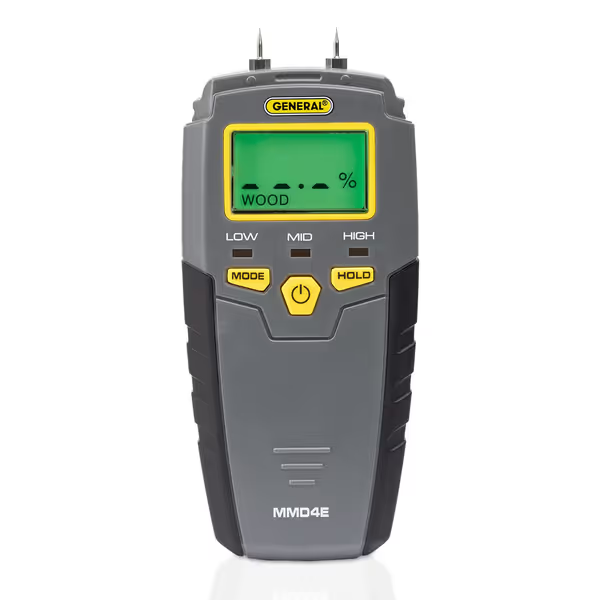
General Tools MMD4E Digital Moisture Meter
Quickly pinpoint hidden moisture to prevent costly damage and mold.
$38.32
Measurement Range5-50% Wood, 1.5-33% Building Materials
Measurement Range5-50% Wood, 1.5-33% Building Materials
Pros
Reliable, consistent readings prevent guesswork.
Easy-to-read backlit LCD with audio alerts.
Cons
Pin-type only, leaves small marks.
Limited to wood and basic building materials.
Customers find the moisture meter reliable and accurate, with consistent readings that eliminate guesswork. The device is easy to use and read, with a quick digital display, and customers consider it good value for money, with some reporting it saved them thousands of dollars. They appreciate its effectiveness in checking wood moisture levels and find it particularly useful for woodworkers and around the house.
Customers find the moisture meter reliable and accurate, with consistent readings that eliminate guesswork. The device is easy to use and read, with a quick digital display, and customers consider it good value for money, with some reporting it saved them thousands of dollars. They appreciate its effectiveness in checking wood moisture levels and find it particularly useful for woodworkers and around the house.
When to Choose Pin vs Pinless: Workflow-Driven Decisions
Choose Pin Meters If:
- Your process requires traceable moisture content (not just "wet/dry" indication)
- You are handling diverse wood species with documented calibration files
- You are working with rough-sawn lumber where surface holes are acceptable
- Audit compliance trumps speed (for example, aerospace component fabrication)
Real-world use: The General Tools MMD4E shines here with its 8 mm stainless pins for consistent penetration depth and on-screen species selection, critical for woodworking humidity tools in high-stakes environments.
Choose Pinless Meters If:
- You are inspecting finished surfaces (flooring, cabinetry) where holes mean scrap
- Need rapid scanning (>100 points per hour) for moisture gradients
- Environmental conditions are tightly controlled (±2°F, 45% RH)
- You can verify depth suitability (for example, 3/4" thick wood for deep-mode scanning)
Critical limitation: Never use pinless meters on wood thinner than the selected depth. A 1/2" maple board scanned at 3/4" depth will include subfloor moisture, invalidating results. Document the actual measurement depth in every report.
Building an Audit-Proof Measurement System
Traceability Chain Requirements
Your moisture data is only as good as its calibration pedigree. Demand:
- NIST-traceable certificate showing uncertainty at 95% confidence
- Environmental range statement (for example, "Calibrated at 70°F ±1°F")
- Species validation documentation for your common materials
I've rejected meters that only list "±1% accuracy" without stating test conditions. True professionals specify how that number was derived.
Uncertainty Budget Essentials
| Contributor | Pin Meter Impact | Pinless Impact |
|---|---|---|
| Calibration uncertainty | 0.3% MC | 0.5% MC |
| Temperature drift | 0.5% MC per 10°F | 0.7% MC per 10°F |
| Operator technique | 0.2% MC | 1.0% MC (pressure variance) |
| Total expanded uncertainty | 0.8% MC | 1.5% MC |
This is why pin meters often justify their cost in precision woodworking: They shrink your overall uncertainty budget, making Cp/Cpk calculations more defensible. For a deeper dive into error sources that drive uncertainty, scrap, and calibration costs, see our measurement error types guide.
Document Before You Defend: The Checklist
Before moisture checks go into your quality record:
- Verify meter calibration due date (no expired certs)
- Record ambient temperature and humidity at measurement
- Note wood species and applied correction factor
- For pinless: document surface condition and sensor pressure method
- For pin: confirm pin depth and cleanliness
- Take >=3 readings per location (GR&R requirement)

Final Recommendation: Match the Tool to Your Tolerance Stack
If your critical dimension has a ±0.5 mm tolerance, a pinless meter's ±1.5% MC uncertainty could consume 60% of your error budget. For tight-tolerance work, pin meters with species calibration provide the audit-ready rigor your quality system requires. But for rapid screening of structural lumber, pinless wins for speed, provided you document environmental controls and depth limitations.
The unspoken truth: Your auditor won't care about "cool features." They will ask for the calibration chain, uncertainty budget, and species correction logs. Document before you defend. That is how you turn moisture measurement from a compliance headache into a trust-building asset.
Related Articles