Torque Wrench Comparison: Click vs Beam vs Digital Calibration
By Rina Takahashi • 24th Oct
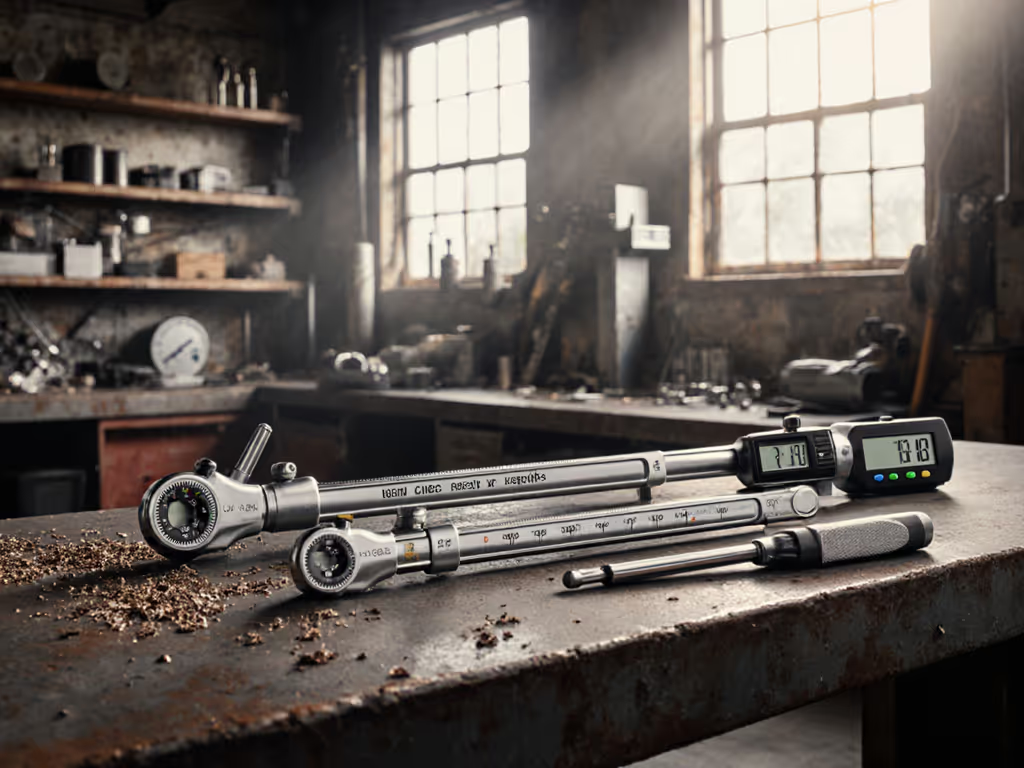
In the precision measurement world, torque wrench comparison isn't about flashy features - it's about matching precision torque tools to your explicit tolerance stack and environmental reality. I've seen teams waste six-figure budgets chasing 'high-resolution' specs while ignoring 3°C temperature swings that invalidated their entire assembly line. Measurement capability is engineered across tool, process, and environment, not purchased off a shelf. Let's dissect click, beam, and digital torque wrenches through the lens of real-world uncertainty budgets, not marketing brochures.
Why Spec Sheets Lie: Resolution ≠ Accuracy
Most torque wrench failure stems from confusing resolution (smallest display increment) with accuracy (deviation from true value). For a quick refresher, see our accuracy vs precision guide. A digital tool showing 0.1 Nm resolution may have ±4% accuracy - meaning a 50 Nm spec could actually apply 48-52 Nm. This gap becomes catastrophic in critical applications like aerospace fastening, where a 2% error risks joint failure. Your uncertainty budget must account for:
- Calibration requirements (traceable to NIST/ISO 17025 standards)
- Environmental drift (thermal expansion, vibration)
- User technique variation (cosine error, inconsistent pull speed)
Shop by tolerance stack, environment, and workflow - or accept drift.
Consider an automotive suspension bolt requiring 100 ±5 Nm (5% tolerance). A tool with ±3% accuracy at calibration seems sufficient - until you factor in 1.5% thermal drift from a shop floor ranging 15-30°C. Suddenly your uncertainty budget exceeds the tolerance band. This is where most teams fail: they audit the tool but ignore the system. To reduce hidden variation, review common measurement error types and how they inflate uncertainty.
Breaking Down the Contenders: Uncertainty Budgets First
Click-Type Torque Wrenches: Preset Precision With Hidden Costs
Click wrenches dominate workshops due to their tactile feedback and preset simplicity. When properly calibrated, they achieve ±3-4% accuracy (ISO 6789 standard). But three critical assumptions must be explicitly stated:
- Calibration traceability to national standards (e.g., NIST)
- Temperature stability (20±2°C per ASME B89.6.7)
- User consistency (steady pull rate below 10°/sec)
These assumptions collapse in reality. In a recent automotive assembly case I analyzed, a team using 3/4" click wrenches for wheel hubs saw 8% repeatability errors - not from the tool itself, but from lube variations and uneven socket engagement. Worse, most shops overlook that click mechanisms degrade after 5,000 cycles. The spring preload shifts, introducing hysteresis errors up to 2.5%. Regular recalibration (every 5,000 cycles or 6 months) is non-negotiable for traceability. For procedures and intervals, see our calibration guide for measuring instruments.
When to choose click: High-volume automotive assembly where speed matters and tolerance bands exceed ±5%. Avoid for aerospace or medical device joints under ±3% tolerance.
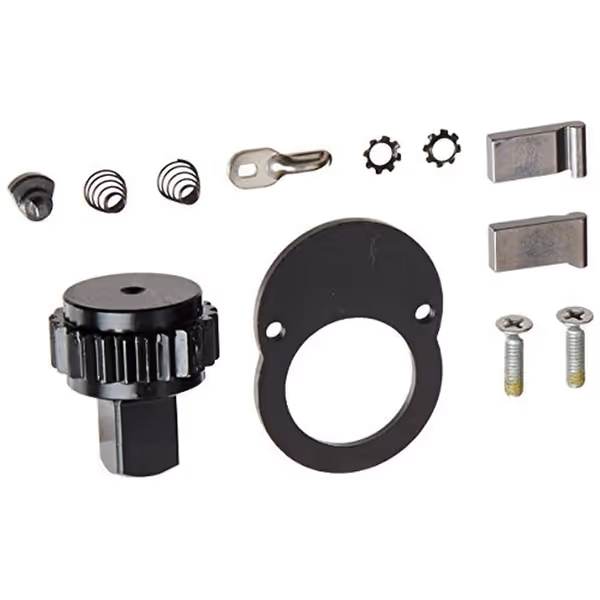
Stanley Proto Ratchet Head Repair Kit
Restore torque wrench precision and extend tool life with this repair kit.
$22.53
MaterialAlloy Steel
MaterialAlloy Steel
Pros
Saves expensive torque wrenches from replacement.
Easy field installation, fits perfectly.
Cons
Potential issues with lever tension mechanism.
Compatibility limited to specific Stanley Proto models.
Customers find the repair kit to be of good quality and say it fits perfectly. The product works well and is easy to install, with customers appreciating that it saved an expensive torque wrench. One customer mentions issues with the lever tension mechanism.
Customers find the repair kit to be of good quality and say it fits perfectly. The product works well and is easy to install, with customers appreciating that it saved an expensive torque wrench. One customer mentions issues with the lever tension mechanism.
Beam-Type Torque Wrenches: The Low-Tech Reliability Play
Beam wrenches - the oldest design - use a simple deflection principle: a pointer remains fixed while the beam bends under load. No moving parts mean no calibration drift from mechanism wear. Accuracy holds at ±3-5% indefinitely if the scale isn't damaged. But this simplicity trades off critical usability:
- Readability limitations: Parallax error adds 1-2% uncertainty in low light or awkward positions
- No preset capability: Requires constant visual monitoring, slowing workflow
- No data capture: Impossible to integrate with SPC systems If SPC/traceability matters, compare options in our wireless measurement tools for SPC integration roundup.
Their advantage? Immunity to environmental abuse. I've documented beam wrenches maintaining accuracy after 40°C temperature swings where digital tools failed. They're the only type I'd specify for emergency repairs in foundries or outdoor construction - where coolant, dust, or vibration would cripple electronic sensors. However, for aerospace applications demanding ±1.5% tolerance, their inherent parallax error makes them unsuitable despite their durability.
When to choose beam: Harsh environments (dust, coolant, extreme temps) where tolerance bands exceed ±4% and data logging isn't required.
Digital Torque Wrenches: Data-Rich But Environmentally Fragile
Digital wrenches offer killer features: angle measurement, Bluetooth data logging, and 0.5-1% accuracy. But their precision comes with stated assumptions:
- Requires warm-up time (5-15 minutes) for sensor stability
- Sensitive to electromagnetic interference (e.g., welders, CNC mills)
- Battery voltage fluctuations alter readings by up to 0.8%
- Calibration intervals shorten to 3-6 months under shop-floor use
In an aerospace client's case, digital wrenches passed lab calibration but failed on the floor due to 18°C ambient swings. The strain gauges' thermal coefficients introduced 2.3% drift - exceeding their 1.5% tolerance band. We solved it by adding local thermal stabilization (±0.5°C) around the tool storage area. Now, their data capture justifies the overhead with 37% fewer assembly reworks. But this only works because they engineered the entire system.
When to choose digital: Regulated industries (aerospace, medical) with tight tolerances (<±3%) and environmental controls. Never deploy without thermal mapping first.
The Environment Factor: My Heat Wave Reality Check
Last summer, while validating a new torque cell for an EV battery line, ambient temperatures spiked to 38°C. Our reference beam wrench (calibrated at 20°C) showed 1.8% low readings. I logged hourly temperature, humidity, and drift data - proving the beam's aluminum body expanded 0.08 mm/°C, skewing the scale. Management greenlit HVAC upgrades after seeing the correlation: 12°C shift = 2.1% torque error = 14% yield drop. Assembly specification matching isn't theoretical, it's physics.
This is why automotive vs aerospace torque requirements demand fundamentally different approaches:
| Application | Typical Tolerance | Critical Uncertainty Factors | Recommended Tool Type |
|---|---|---|---|
| Automotive (wheels) | ±5-10% | User technique, lube consistency | Click (±4% accuracy) |
| Aerospace (engine) | ±1-2% | Temperature, calibration traceability | Digital (±1% with thermal control) |
| Medical device | ±0.5-1% | Vibration, data audit trail | Digital (±0.5% with ISO 17025 cert) |
Making Your Tolerance-Driven Pick
Forget 'best' torque wrenches - there are only right-for-your-tolerance-stack tools. Start your calibration requirements with these non-negotiables: For a broader framework on matching tool class to tolerance, use our measuring tool selection guide.
- Map your tolerance band: If your spec is X±Y, your tool's total uncertainty (including environment) must be ≤Y/4 (per ASME B89.7.3.1)
- Quantify environmental influence: Measure temperature swings, vibration, and EMI in your actual workspace, not the lab
- Demand traceable calibration certs: With measurement uncertainty values (not just 'passed')
A shop I audited recently specified digital wrenches for a ±3% tolerance task but skipped thermal validation. They scrapped $83,000 in aircraft brackets because 25°C ambient shifts introduced 2.7% drift. Meanwhile, a motorcycle shop using beam wrenches for ±8% tolerance tolerates 30°C swings with zero issues - their tool's uncertainty never exceeded 2.5%.
Your tolerance-driven pick must answer: "Does this tool's real-world uncertainty budget fit within my tolerance band under actual shop conditions?" If not, engineer the environment or reconsider the tool class.
Final Calibration Reality Check
Torque tools aren't set-and-forget purchases. Each type has hidden lifetime costs:
- Click: $75-150/year calibration + $22.53 repair kits (like the Proto J6014RK for ratchet head rebuilds)
- Beam: $0 calibration costs but $150+ for replacements when bent
- Digital: $200-300/year calibration + $40 battery packs
Before buying, run this drill:
- Calculate your total uncertainty budget (tool + environment + user)
- Compare it to your tolerance band
- If uncertainty > 25% of tolerance, you're gambling with scrap
I've turned tolerance stacks and environment control into practical tool selections for 200+ job shops. The ones winning awards don't chase specs - they engineer capability. Start with your tolerance, design the environment, then select the tool. Anything else is just hoping for accuracy.
Related Articles