Energy-Efficient Metrology Tools: Slash Lifetime Costs
By Alejandro Ruiz • 23rd Feb
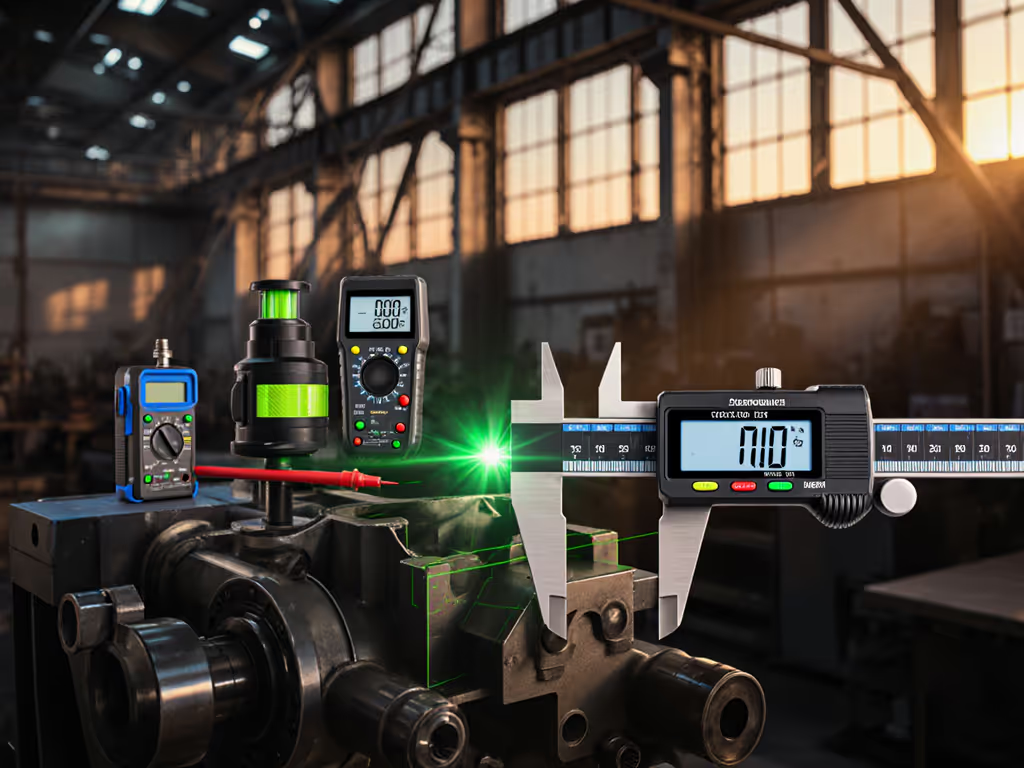
When procurement engineers ask about energy-efficient metrology tools, most vendors pivot to electricity consumption per measurement cycle. That's table stakes, not strategy. True sustainable measurement equipment lives in lifecycle economics: capital cost, power draw, calibration intervals, downtime risk, spare parts logistics, and service coverage. I've watched shops sink $50K into flashy optical systems that drifted out of calibration every quarter, then spent another $30K on emergency repairs and loaner rentals. Meanwhile, a standardized, less-sexy alternative would have paid for itself in avoided downtime alone. The math is simple: pay for capability, not chrome (count the lifecycle costs).
The Real Cost of Cheap Metrology: A Cautionary Foundation
Before we talk energy savings, let's dismantle the false dichotomy. Procurement often frames metrology choices as either low-cost or reliable. In reality, the cheapest tool isn't the one with the lowest sticker price, it's the one that minimizes total spend over five years, including power, maintenance, calibration, and downtime risk. That's where low-power measurement devices become truly economical.
Energy consumption isn't just an environmental feel-good; it's a TCO lever. A high-power coordinate measuring machine (CMM) running vision systems under continuous LED illumination burns money even when idle. Compare that to a robust, simpler contact-probe CMM with minimal electronics. Over 2,000 annual operating hours, the power delta alone can justify a tool switch, and if the contact system also offers faster setup, fewer environmental sensitivities, and tighter service SLAs, downtime risk drops too.
Downtime is a line item. A $200K system sitting broken for two weeks while waiting for a field technician costs far more than the electricity it would have saved.
1. Audit the Total Cost of Ownership Model, Not the Spec Sheet
This is where most plant managers fail. They compare headline accuracy ("±0.0005 in") and miss the systematic cost drivers. Build a real TCO model with these five boxes checked:
Capital investment: True installed cost, including freight, installation, training, and fixtures. A CMM listed at $80K might land at $110K on the floor.
Annual energy consumption: Multiply operating hours (typically 2,000-2,500 per year) by system power draw (watts), convert to kWh, apply your local utility rate. A 5 kW system running 2,000 hours at $0.12/kWh costs $1,200/year. Over five years, that's $6,000, meaningful enough to factor into tool selection, especially across a fleet.
Calibration and maintenance: ISO/IEC 17025 accredited calibration typically costs $1,500-$3,500 annually per CMM, depending on accuracy class and scope. Some vendors bundle in-situ calibration; others don't. Get the contract in writing before purchase. Preventive maintenance (belt replacement, probe tip swap, granite surface reconditioning) runs $2,000-$5,000 every two years.
Spare parts and consumables: Probe tips, anvils, fixtures, batteries, sensors, and calibration reference standards. Verify parts availability and cost. A 12-month lead time on a critical sensor is death; a 3-day reorder with onsite spare is breathing room. Build a spares list into your purchase agreement.
Downtime risk and service response: This is the killer nobody quantifies. If a metrology system fails and your vendor takes 10 days to field a tech, what's the cost of halted inspection? If your facility can't ship parts for IATF 16949 compliance, what's the liability? Demand to see service SLAs: 24-hour on-site support costs more upfront but saves tens of thousands when a production line grinds to a halt. A loaner guarantee is worth gold.
Sum these five over five years. The cheapest CMM on day one is rarely the lowest-cost tool on day 1,825.
2. Choose Eco-Friendly Test Equipment Designed for Minimal Environmental Sensitivity
Here's the paradox: advanced vision systems consume more power and demand tighter environmental control. Temperature-stabilized rooms, humidity buffers, vibration isolation tables (the infrastructure itself burns energy). A green metrology solution sometimes means stepping down in complexity. For a deeper comparison of non-contact options and when they actually save energy on the shop floor, read our non-contact metrology reality check.
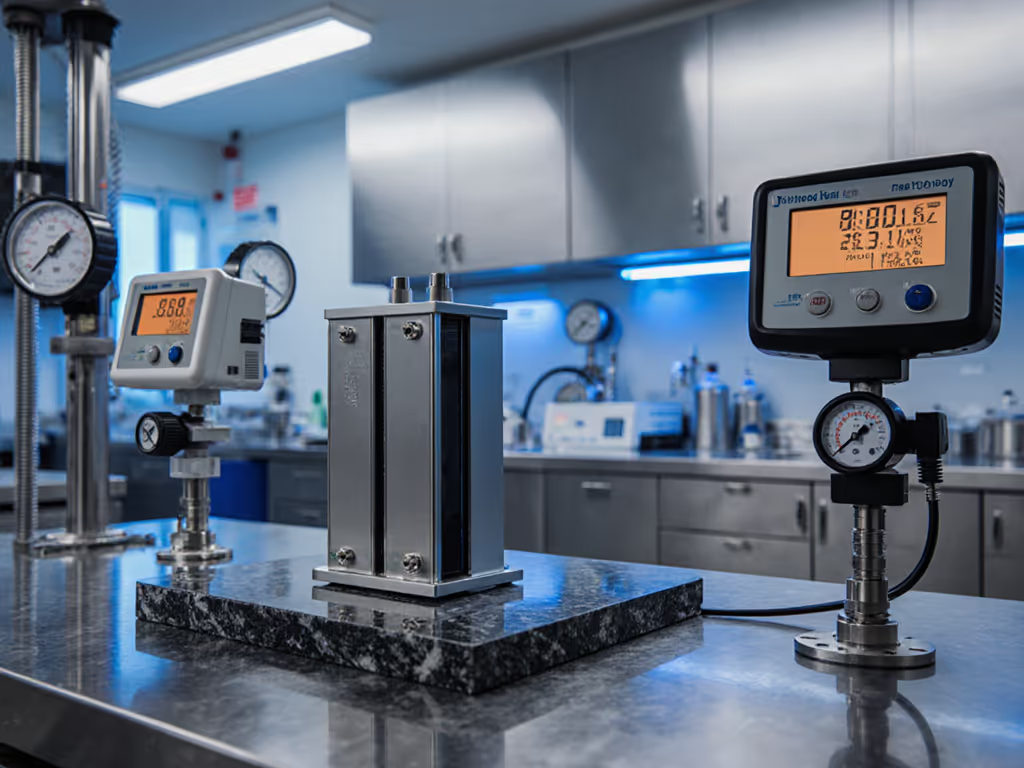
Contact-probe CMMs, for instance, are far less sensitive to ambient lighting, shop-floor vibration, and thermal swings than optical scanning systems. Mitutoyo's architecture for large part measurement (granite bridge design with minimal thermal drift) favors durability over raw speed. Mahr's production metrology instruments, built for shop-floor deployment rather than climate-controlled metrology labs, tolerate coolant spray, electrical noise, and temperature variance.
When evaluating vendors, ask:
- What's the temperature coefficient of accuracy? (±0.000X per °C is typical; worse coefficients mean you need climate control.)
- What operating environment is documented? (Lab-only specs hide true lifecycle costs.)
- Is thermal compensation built in, or do you rent a $40K chiller?
- What's the vibration tolerance for on-machine measurement or in-process inspection?
Sustainable measurement equipment often means accepting 10-15% less raw speed to gain 80% lower environmental overhead and 50% lower downtime risk. That trade is almost always worth it.
3. Standardize Across Your Fleet for Measurement Data Consistency and Simplified Logistics
Multi-vendor sprawl kills efficiency. You're juggling different probe geometries, calibration intervals, software ecosystems, and service contracts. Every technician needs retraining; every audit requires cross-vendor traceability proof; every spares purchase is a separate negotiation. For a defensible chain from standards to shop-floor checks, see our measurement traceability guide.
Fleet standardization (say, Mitutoyo SmartScope for large-part floor measurement plus a compact Mahr system for turning-cell in-process work) cuts training overhead, guarantees spare parts interchangeability, and gives you leverage on service terms.
When you consolidate volume with one vendor, negotiate:
- Bulk calibration discounts (10-15% savings across five systems).
- Flat-rate annual service retainers covering probes, preventive maintenance, and one emergency callout.
- Loaner availability pooled across your systems (if one CMM fails, a loaner is deployed within 24 hours).
- Training subsidies for new hires across the fleet.
The single-vendor bet requires due diligence on their financial stability and service infrastructure, but the lifecycle payoff is substantial.
4. Model Downtime Risk and Demand Transparent Service Terms Before Purchase
This is non-negotiable. A beautifully accurate CMM sitting dead for two weeks is useless, and expensive. Before signing a contract, extract concrete service terms from your vendor:
Response time: 24-hour technician arrival is standard for mission-critical equipment. Verify whether this includes weekends and shift variability.
On-site vs. depot repair: If your $150K CMM needs a new encoder board and the vendor ships it to a central depot for a 5-day turnaround, calculate the scrap/rework cost. On-site parts replacement is premium pricing but worth every penny.
Loaner availability: Best-in-class vendors (Mitutoyo, Zeiss, Hexagon) maintain loaner fleets. Codify this in writing: "In the event of unschedulable downtime exceeding 12 hours, vendor supplies equivalent metrology system within 24 hours, at no charge, for duration of repair."
Spare parts stock: Probe tips, cables, and reference artifacts should ship same-day from vendor inventory. Ask for a documented parts bin: "These 50 items are held in [warehouse] and ship within 24 hours."
Calibration certificate turnaround: After annual calibration, get a signed ISO/IEC 17025 certificate within 5 business days. Non-compliance voids your audit readiness.
I once watched a shop tie three production lines to a single CMM and lose three weeks of output when that system failed and the vendor's lead time ballooned. We built a TCO model afterward that justified a second system plus the service upgrade. Downtime is a line item.
5. Validate Energy Claims with Third-Party Data and Environmental Control Costs
Vendors publish "energy-saving measurement tools" specs in a vacuum. They'll tout a 2 kW power draw versus a competitor's 5 kW, but omit the chiller, humidity control, and isolation table the system requires.
Demand empirical data:
- True plug-to-measurement power draw, measured over a representative job cycle (not marketing cherry-picked samples).
- Documented operating environment: ambient temperature range, humidity tolerance, vibration limits.
- Annual energy cost at your facility's utility rate, calculated as (operating hours × system power × utility rate).
- Infrastructure power (climate control, isolation, UPS backup) added to the system total.
Third-party review sites and industry associations (NIST, ISO working groups) occasionally publish measured power profiles. Reach out to three installed users of the vendor's system and ask for actual utility bills or energy audits. Real data trumps brochures.
Often, you'll find that a modestly powered, robust floor system with minimal environmental overhead beats a lower-wattage lab system saddled with $8K/year in chiller and humidity-control costs.
6. Demand Explicit Uncertainty Budgets and Measurement System Analysis (MSA) Test Data
This filters out marketing posturing. A vendor claiming ±0.0001 in accuracy without documenting uncertainty budget and repeatability is hiding drift, hysteresis, and real-world variability.
Before purchase, require: If you're new to building one, start with our measurement uncertainty budget guide.
Written uncertainty budget: An ISO/IEC Guide 98-3 compliant breakdown showing calibration uncertainty, environmental influences, probe-force variation, and thermal effects. This tells you the true tolerance band of the system, often 2–3× the headline spec.
Gauge R&R data: Repeatability (6-10 measurement cycles on the same part, same operator, same setup) and reproducibility (different operators, different fixturing). A well-designed system shows ≤10% variation; anything above 15% indicates hysteresis or environmental sensitivity.
Drift monitoring protocol: How often does the system drift out of spec? Some vendors publish quarterly drift data; others hide it. Demand transparency. A system that drifts ±0.0002 in per quarter means calibration every 8-12 weeks, not annually, driving up maintenance cost.
Temperature influence: Measure and graph accuracy vs. ambient temperature over a 10°C swing. Steep curves mean environmental control is mandatory; flat curves mean the shop floor is viable.
When you see these numbers, audit them against your actual tolerance stack-up. A system with ±0.0003 in uncertainty is overkill for a 0.005 in bilateral tolerance; you're paying for unused capability. Conversely, ±0.0010 in might be marginal for a 0.002 in feature, pushing you into audit risk and potential scrap.
7. Integrate SPC and QMS Data Capture from Day One, Not as an Afterthought
A $120K CMM that spits out USB files requiring manual Excel upload is a productivity black hole. See our small business metrology software picks that prioritize native QMS/SPC integration to eliminate manual transfers. You're paying for automation and getting manual labor.
Before purchase, verify:
Software ecosystem: Does the vendor's native software (e.g., Mitutoyo MeasurLink, Great Lakes Metrology integration platforms) connect seamlessly to your existing QMS or SPC tool (Minitab, JMP, Hertzler Systems)? Or do you need a custom bridge?
Data structure: Are measurement results, uncertainty, date/time stamps, and operator ID automatically logged? Can reports be auto-generated and sent to a shared drive?
Traceability chain: From raw measurement through SPC trending, is there an unbroken, auditable record? Missing links kill ISO 9001 compliance.
Mobile and remote access: Can floor operators log data via a smartphone app, or is the CMM tethered to a desktop? This matters for in-process measurement workflows.
Test the software stack with your IT team before signing the capital lease. I've seen $200K CMM deployments stall for six months because firmware quirks broke QMS connectivity. Budget time and money for integration; it's not a vendor afterthought.
8. Request Field Trial Data and In-Service References
Marketing claims don't survive contact with reality. Before committing $100K+, demand proof from installed customers in similar industries and environments.
Specific questions for references:
- What's your actual annual downtime as a percentage of operating hours?
- Did the system meet specification after 18 months of shop-floor use? Any drift surprises?
- Did the vendor's service response match their SLA, or did you find workarounds?
- What was your biggest unplanned expense post-purchase? (Fixtures, software licenses, extended calibration.)
- Would you buy from this vendor again? Why or why not?
- What's your energy bill impact? Did the system deliver on power-consumption claims?
Talk to three references in your industry and region. Ignore testimonials from different sectors or vendors with financial relationships. You're building a de-risked buying decision, not a PR brochure.
Summary and Final Verdict: Total Cost of Ownership Cuts Through Hype
Energy-efficient metrology tools are not a marketing gimmick; they're a strategic lever for lifecycle cost reduction. But "energy-efficient" doesn't mean "lowest power draw." It means lowest total cost: capital, energy, calibration, maintenance, service, and downtime risk, amortized over five years.
The path forward is systematic:
- Build a real TCO model with all five cost drivers.
- Prefer robust, standardized systems over complexity-heavy point solutions.
- Demand transparent service SLAs, downtime insurance, and spare parts guarantees.
- Validate energy claims against third-party data and true environmental cost.
- Require explicit uncertainty budgets and MSA evidence, no marketing posturing.
- Integrate SPC/QMS from day one; don't bolt it on later.
- Get field references and talk directly to in-service users.
When you apply this discipline, you often find that a mid-tier system from a vendor with proven service infrastructure (think Mitutoyo's granite-based floor CMMs or Mahr's modular production metrology) beats an expensive lab system every time. You trade 10% of raw speed for 50% lower downtime risk and 40% lower lifecycle cost. That's the deal that justifies the purchase to finance and sustains confidence on the shop floor.
Skepticism is your ally. Vendors can't hide TCO math. Demand the numbers. Negotiate service terms harder than capital price. Standardize across your fleet. And remember: downtime is a line item. Measure the lifecycle, not the headline spec.
Related Articles