Off-Grid Metrology Tools: Rugged Solutions for Remote Sites
By Marcus O’Neal • 19th Nov
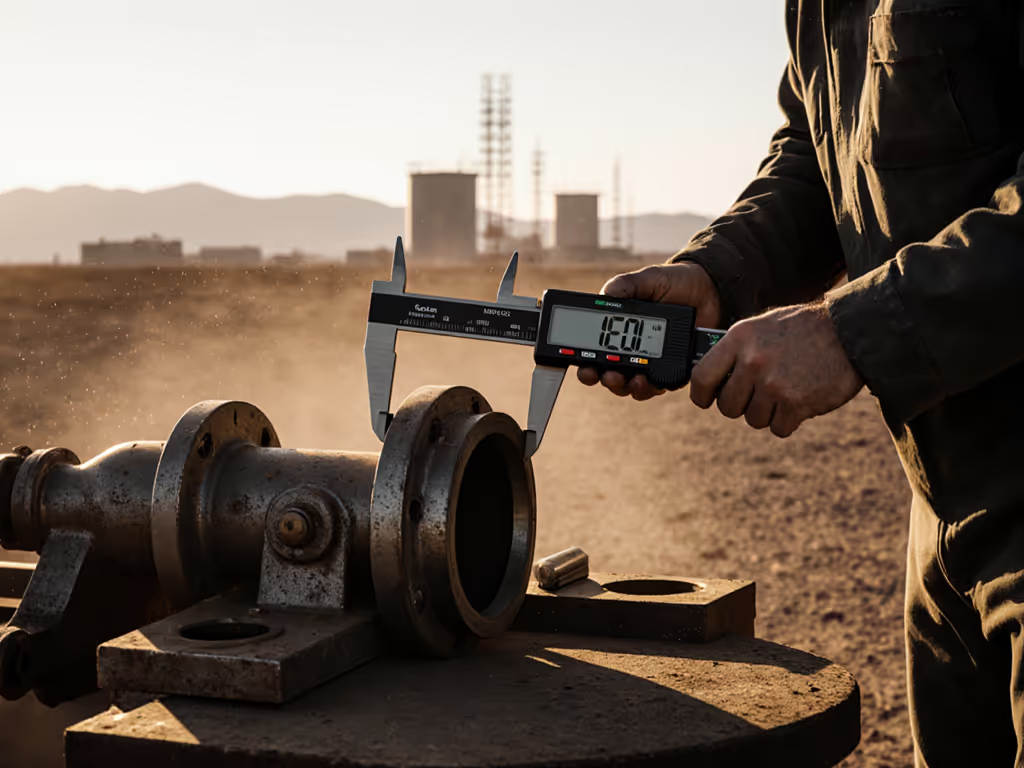
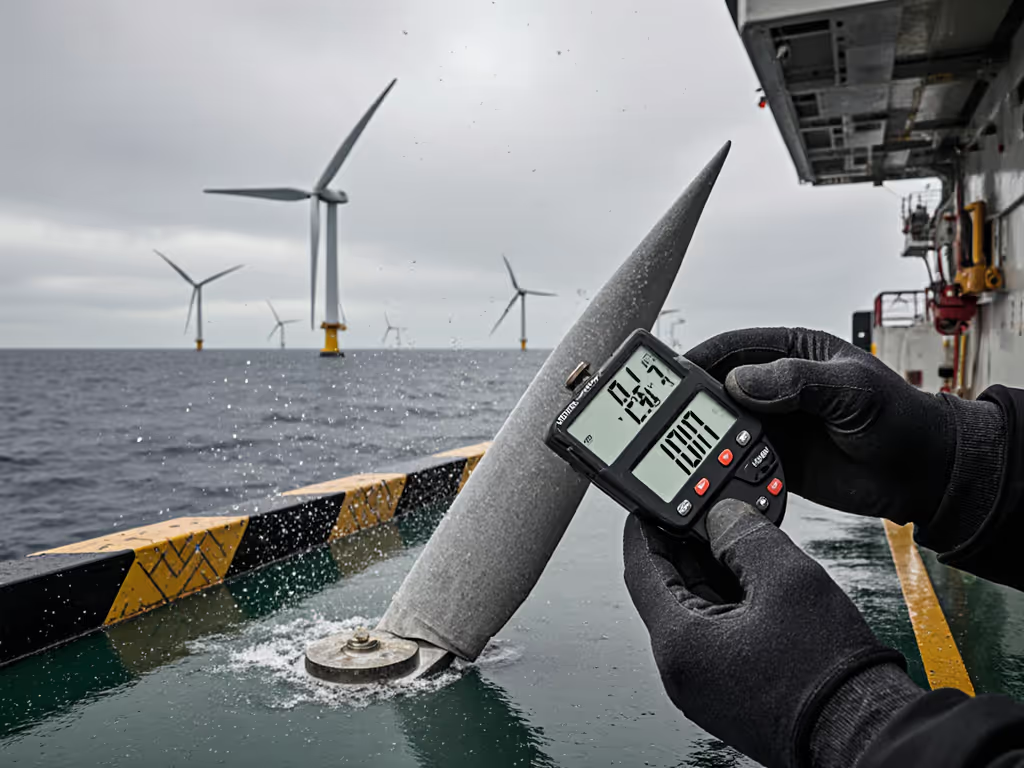
When conducting metrology tools verification in field locations far from controlled laboratory environments, remote location measurement demands a specialized approach that prioritizes environmental resilience without compromising measurement integrity. As a former calibration technician turned quality advisor, I've witnessed how seemingly robust equipment fails under the compounded stressors of remote sites (temperature excursions, moisture exposure, and physical handling) while simultaneously needing to maintain traceability chains that withstand auditor scrutiny. The right rugged measurement equipment becomes not merely convenient, but essential for maintaining measurement confidence where failure could mean costly project delays or compliance gaps. Today's remote operational environments (from offshore platforms to field manufacturing cells) require purpose-built instrumentation that documents not just what you measured, but how and why you can trust those measurements when an auditor asks for your uncertainty budget.
The Reality of Remote Metrology: Beyond Laboratory Conditions
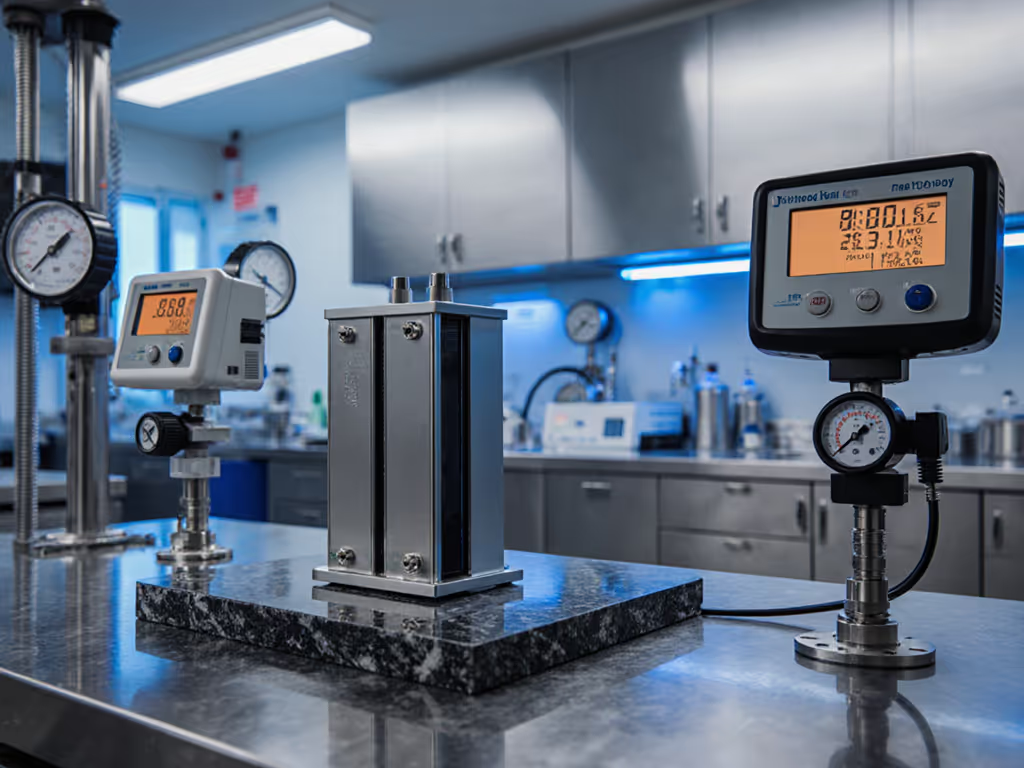
Field metrology presents unique challenges that standard benchtop instruments cannot address. Unlike controlled laboratory environments where temperature stabilization and vibration isolation are routine, remote sites often expose metrology to conditions that directly impact measurement uncertainty. A 5°C temperature shift can induce dimensional changes exceeding tolerance limits in precision components, while humidity variations affect electronic measurement stability. These environmental factors must be explicitly documented in your uncertainty budget, not as theoretical considerations but as measured, recorded variables.
For remote applications, environmental protection ratings form the first line of defense against measurement degradation. IP ratings (Ingress Protection) indicate an instrument's resistance to solids and liquids, but their metrological implications are frequently misunderstood. An IP54 rating (as found on the Bosch GLM165-40) protects against limited dust ingress and water splashes from any direction, sufficient for indoor construction but inadequate for coastal environments where salt spray accelerates corrosion. Higher IP ratings like IP67 (achieved by the Fluke 87V MAX) seal against complete dust ingress and temporary water immersion, crucial when environmental conditions shift unexpectedly.
Trace it, budget it, then trust it under audit.
Consider this critical checklist before deploying any metrology equipment to remote locations:
- Verify instrument's specified operating temperature range against expected site conditions
- Document environmental monitoring protocol (minimum: temperature, humidity, and barometric pressure)
- Confirm storage conditions for reference standards during transport
- Establish time between environmental exposure and stabilization before measurement
- Implement redundant data recording (physical and digital logs)
- Validate calibration certificate covers environmental conditions you'll encounter
Without these protocols, your measurement system becomes a hidden liability, passing field checks but failing to connect to national measurement standards through an unbroken chain of traceability. If you're new to traceability chains, start with our foundational guide to measurement traceability.
Evaluating True Ruggedness in Measurement Equipment
'Rugged' has become a marketing buzzword, often conflating physical durability with metrological integrity. True ruggedness for metrology applications requires evaluating three interdependent factors: environmental protection, measurement stability, and traceability maintenance. Environmental protection ratings provide foundational assurance, yet they're only meaningful when correlated with documented performance data under those conditions.
When selecting mobile service tools for remote work, consider these often-overlooked aspects:
| Evaluation Factor | What to Verify | Common Pitfalls |
|---|---|---|
| Environmental Protection Ratings | Actual test conditions of IP rating | Ratings based on dry testing only |
| Temperature Coefficient | Performance data across full operating range | Spec sheets showing only 20°C performance |
| Battery Life | Runtime under continuous measurement load | Battery claims based on sleep mode |
| Vibration Resistance | Calibration stability after specified shocks | No data on post-impact verification |
| Traceability Documentation | Calibration certificate scope matching field conditions | Certificates limited to laboratory environments |
Battery life comparison requires particular attention, as it directly impacts operational continuity. Many specifications list "up to X hours" based on intermittent use, but continuous measurement operations (common in field metrology) can reduce actual runtime by 30 to 40%. The thermal management of lithium batteries becomes critical in extreme temperatures; performance typically degrades by 20% below 0°C and accelerates degradation above 40°C. Documented battery performance curves across temperature ranges (not manufacturer's best-case scenarios) should inform your equipment selection.
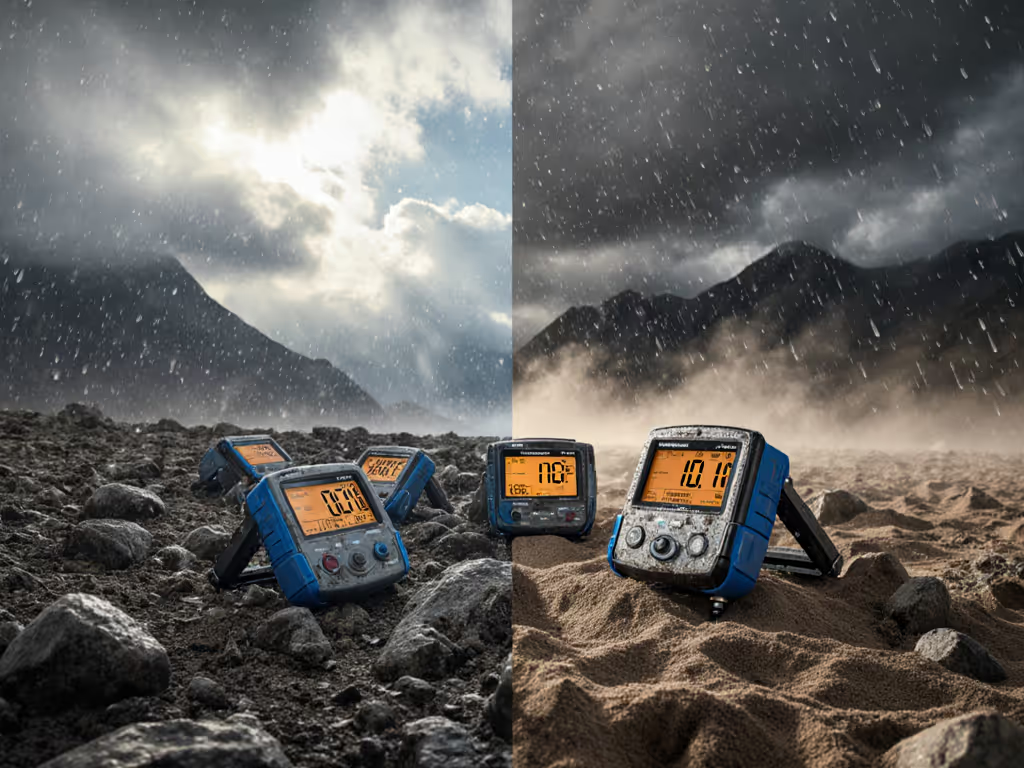
Fluke 87V MAX: Precision Multimeter for Extreme Conditions
The Fluke 87V MAX exemplifies purpose-built rugged measurement equipment designed specifically for metrology-limited environments where standard instruments fail. This True-RMS multimeter combines IP67 certification (complete dust protection and 30-minute submersion at 1m depth) with 4-meter drop resistance (tested against MIL-STD-202G standards) while maintaining its core metrological functions. Unlike promotional materials that emphasize "toughness" without metrological consequences, Fluke documents the instrument's performance characteristics across environmental extremes.
What makes this instrument particularly valuable for quality professionals is its documented temperature coefficient (0.1×(specified accuracy)/°C) across its full operating range (-20°C to +50°C). This allows you to calculate explicit environmental contributions to your uncertainty budget rather than guessing. The built-in thermometer functions as both a measurement tool and environmental monitor, providing direct data for your field documentation. With 800-hour battery life under continuous measurement load (verified at 25°C), it outperforms competitors in extended operations where battery replacement isn't feasible.
From an audit perspective, the Fluke 87V MAX brings significant advantages. Its calibration certificate explicitly covers performance verification across environmental conditions, not merely benchtop stability. The durable asset tag system allows for permanent identification that withstands field conditions (addressing the common audit finding of "unidentifiable measurement equipment"). I've seen auditors shift focus dramatically when presented with calibration documentation showing environment-specific verification data rather than generic laboratory certificates.
When preparing for remote work, I recommend creating a specific uncertainty budget for the Fluke 87V MAX that includes: Need a refresher? See our audit-ready measurement uncertainty budget guide.
- Environmental contribution based on documented temperature coefficient
- Battery voltage stability impact at low charge levels
- Humidity effects on insulation resistance measurements
- Vibration effects on probe contact resistance
This detailed approach transforms what could be a simple field tool into an audit-ready measurement system that explicitly connects your field data to your quality management system.
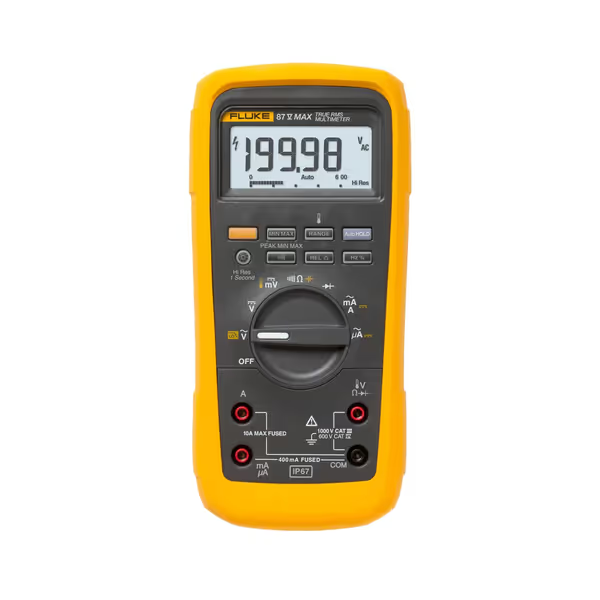
Fluke 87V MAX Multimeter
Rugged, waterproof multimeter for extreme environments & critical measurements.
$547.81
IP Rating/DropIP67 / 13 ft
IP Rating/DropIP67 / 13 ft
Pros
Extreme durability: waterproof, dustproof, 13 ft drop-tested.
True-RMS accuracy for reliable readings in tough conditions.
Cons
Accuracy for DC ranges receives mixed user feedback.
Larger size than other multimeters, impacting portability.
Customers find this multimeter to be a high-quality, reliable tool that works as intended and is as durable as their old 77 model. They consider it worth the money and appreciate its well-made construction.
Customers find this multimeter to be a high-quality, reliable tool that works as intended and is as durable as their old 77 model. They consider it worth the money and appreciate its well-made construction.
Bosch GLM165-40 Blaze Pro: Laser Metrology for Challenging Sites
For dimensional metrology in remote locations, the Bosch GLM165-40 Blaze Pro laser distance meter provides capabilities that bridge the gap between construction tools and precision measurement instruments. With its IP54 rating (protection against limited dust ingress and water splashes from any direction), it performs reliably in typical field conditions while offering accuracy of ±1/16 inch up to 165 feet, sufficient for many industrial applications when properly applied. For selecting the right technology by environment, compare indoor ultrasonic vs outdoor laser accuracy.
Unlike many consumer-grade laser measures that omit environmental considerations, the Blaze Pro documents its temperature coefficient (-0.006% of measurement per °C), allowing quality teams to include environmental effects in uncertainty calculations. Its real-time measurement mode proves particularly valuable in confined or hazardous spaces where traditional measurement methods would require multiple personnel. The 10-measurement memory function enables building complex uncertainty chains directly in the field, though I recommend supplementing this with dedicated environmental logging.
For remote location measurement requiring height differentials or slope calculations, the Blaze Pro's indirect measurement functions provide significant time savings. However, be aware that these derived measurements compound uncertainty, as each additional angle introduces its own error component. When using indirect measurement modes, expand your uncertainty budget to include:
- Angular measurement uncertainty
- Target surface reflectivity effects
- Atmospheric refraction effects at longer distances
- User alignment errors
In one project documenting a remote fabrication facility, I required measurements in a partially completed structure where conventional surveying equipment couldn't reach. The Blaze Pro's compact size (fits in a pocket) allowed measurements where tripods couldn't be deployed, while its water resistance handled unexpected rain showers. The critical factor was documenting the environmental conditions during each measurement series and applying the appropriate correction factors, and this documentation became the foundation for our audit defense when questioned about measurement validity under non-ideal conditions.

BOSCH GLM165-40 Blaze™ Pro 165 Ft. Laser Measure
Accurate, portable laser measure for diverse jobsite calculations up to 165 ft.
$81.99
Accuracy±1/16 in.
Accuracy±1/16 in.
Pros
Precise measurements up to 165 ft. range, even in low light.
Calculates distance, area, volume, and indirect measurements.
Cons
Small display numbers can be hard to read, especially fractional parts.
Display size receives mixed user feedback.
Customers find the laser measurer extremely accurate, measuring to a 32nd of an inch, and appreciate its many functions, with one noting it works well even at full 65 ft indoors.
Customers find the laser measurer extremely accurate, measuring to a 32nd of an inch, and appreciate its many functions, with one noting it works well even at full 65 ft indoors.
Building Audit-Ready Metrology Processes for Remote Operations
The most sophisticated metrology tools become liabilities without proper documentation protocols. My experience preparing teams for AS9100 and ISO 17025 audits reveals a consistent pattern: field measurement systems fail not because of equipment limitations, but due to incomplete traceability documentation. When working off-grid, you must establish processes that maintain metrological continuity despite environmental challenges.
A critical technique I've developed through years of audit preparation involves creating "environmental cross-references" (simultaneous documentation of both measurement values and environmental conditions at the moment of measurement). This creates an explicit connection between your field data and the conditions that affect your uncertainty budget. For example, when using the Fluke 87V MAX in a remote welding facility, record not just the electrical measurement but the ambient temperature, humidity, and any nearby equipment generating electromagnetic interference.
Remote Site Metrology Verification Protocol
Follow this protocol to ensure your field measurements withstand audit scrutiny:
- Pre-Deployment Verification
- Verify instrument calibration covers expected environmental conditions
- Document baseline performance at lab conditions before field deployment
- Create customized uncertainty budget accounting for expected field conditions
- Field Measurement Protocol
- Record environmental conditions at start, during, and end of measurement session
- Document measurement technique (positioning, operator, duration)
- Post-Measurement Verification
- Perform quick verification against portable reference standard
- Document any environmental changes during measurement period
- Preserve raw data with timestamps and environmental metadata
This systematic approach turns field measurements into auditable evidence rather than questionable data points. During an audit of a remote aerospace component repair facility, I implemented this protocol when documenting weld measurements. When the auditor questioned our dimensional verification process, we produced not just the measurement values but the environmental logs, technique documentation, and uncertainty budget showing how we accounted for temperature variations in the hangar. The auditor's demeanor changed immediately; they were no longer questioning our process but documenting it as a best practice for their other clients.
Show your chain of traceability at every stage (from the national measurement institute to your field location) and you'll find audits become verification exercises rather than interrogation sessions. This is where preparation pays dividends: comprehensive documentation transforms routine measurements into auditable evidence that withstands scrutiny even when conducted miles from your quality lab.
Conclusion: Confident Measurement in Isolated Environments
Selecting appropriate rugged measurement equipment for remote sites requires balancing environmental protection, measurement capability, and documentation requirements. The Fluke 87V MAX and Bosch GLM165-40 Blaze Pro represent thoughtful approaches to off-grid metrology, each with documented performance characteristics that enable explicit uncertainty budgeting rather than guesswork. Their environmental protection ratings provide baseline assurance, but the real value emerges when you integrate them into a comprehensive measurement system that documents not just what you measured, but how you ensured its validity.
For quality professionals managing remote operations, the path to audit confidence begins with understanding that environmental conditions aren't obstacles to measurement; they are measurable variables that must be explicitly included in your uncertainty budget. By adopting tools with clear environmental specifications and implementing protocols that document the measurement context, you transform field verification from a compliance risk into a strategic advantage.
Further exploration of off-grid metrology best practices should focus on developing organization-specific uncertainty templates for common field scenarios. Document your environmental influences systematically, connect them to your measurement results, and maintain an unbroken chain of traceability from your reference standards to your most remote measurement point. When you can demonstrate this level of measurement integrity during an audit, you'll find yourself not just passing compliance checks but establishing credibility that opens opportunities for more complex remote work.
Related Articles