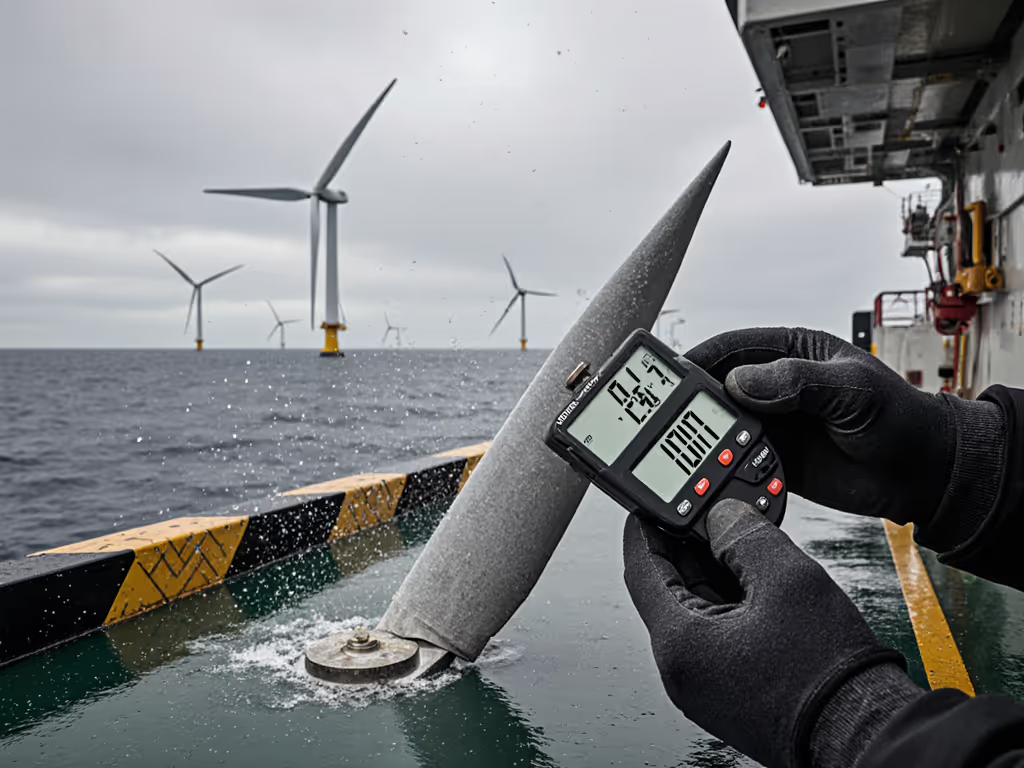
Pipeline Surface Roughness Testers: ROI Comparison
By Alejandro Ruiz • 7th Mar

Pipeline surface roughness testers and field service surface measurement tools are not commodities; they're capability investments that either protect margins or erode them over time. In manufacturing, oil and gas operations, and field inspection work, buying the cheapest portable roughness gauge often feels prudent until downtime hits. Then the real cost emerges.
The gap between headline specs and sustained performance is where procurement decisions either pay or fail. This article walks you through ROI comparison logic using total cost of ownership (TCO) math, service terms, and downtime risk accounting, the factors that separate tools that hold up under pressure from bargains that arrive as cheap and leave as expensive.
1. The Hidden Cost: Why Downtime Beats Upfront Price
A few years back, I specified a low-cost vision probe for dimensional verification on a precision job. The unit was half the price of the incumbent brand, and procurement approved the shift. Twelve months in, the probe drifted out of calibration during a production run. The replacement took three weeks to source and re-certify. Our customer's tolerance stack required re-inspection of three weeks' worth of parts - 16,000 units that couldn't ship. The downtime cost eclipsed the savings from the first five years of unit purchase discounts.
Surface roughness testing carries the same pattern. A pipeline corrosion measurement or in-process finish check that relies on a tool without fast service coverage is an unmanaged risk. When a portable roughness gauge fails on the job site or drifts out of spec, the production line doesn't pause politely, it stalls. Waiting for a replacement or calibration can suspend coating verification, pipe wall assessment, or material traceability in regulated environments. To keep audits clean, review the measurement traceability basics that underpin compliant field measurements.
TCO math must account for:
- Acquisition cost (unit price)
- Calibration intervals and certification costs
- Expected downtime per failure (days x production loss)
- Spare tips, probes, batteries, and consumables
- Service coverage and loaner availability
- Training and documentation
- Data capture, software, and integration overhead
A tool that costs 40% more upfront but guarantees a 24-hour loaner and documented spares availability often delivers lower TCO over three years than the bargain option with a six-week lead time on parts.
2. Contact vs. Non-Contact: A TCO Breakdown
Roughness testing splits into two camps: contact-type testers and non-contact methods (laser, white light interferometry). Each has different lifecycle implications.
Contact-Type Testers (Stylus Instruments)
Contact testers, the most common field tools, use a tracing stylus to map surface peaks and valleys. They measure parameters like Ra (mean roughness), Rz (maximum height), and Rt (total height), providing data in micrometers or microns (µm).
Advantages from a TCO perspective:
- Robust, portable, economical to purchase
- Minimal calibration infrastructure required
- Spares (tips, anvils) are inexpensive and stockable
- Work reliably in harsh field environments
- Tolerant of vibration and temperature swings
TCO risks:
- Stylus tips wear and require frequent replacement
- Probe force drift affects repeatability; misalignment causes cosine error
- Calibration intervals (often 12-24 months) are mandatory for audit compliance
- Environmental factors (coolant, dust, temperature) degrade accuracy if not controlled
- Data storage and integration can be weak; many portable units lack robust SPC links
Standardization notes: Contact testers align with ASTM D 7127 and ISO 21920 standards, making them audit-friendly. If your team standardizes on contact testers across multiple sites, training is simpler and spare parts (tips, batteries) consolidate.
Non-Contact Methods (Laser, White Light, AFM)
Non-contact techniques use optical or laser methods to measure surface geometry without touching the part. They avoid probe wear and are preferred for soft, delicate, or coated surfaces.
Advantages:
- No surface damage; ideal for finished goods and coatings
- Higher resolution for ultra-smooth surfaces (< 10 μm range)
- Deterministic measurement; no user technique variance
TCO risks:
- Higher acquisition cost (2-5x contact testers)
- Sensitive to reflectivity, dust, and ambient light; more calibration and environmental control required
- Repair costs are steep; spares availability is limited
- Requires benchtop setup in many cases; field portability is limited
- Integration with shop-floor workflows is awkward; data capture is often proprietary
- Technician training burden is significant; drift diagnostics are non-obvious
When non-contact makes TCO sense: High-volume inspection of coated pipelines or soft polymers where contact testers risk scratching and rework. If rework cost per false rejection exceeds the tool premium, non-contact can win on ROI. Otherwise, contact testers dominate field roughness work. For a deeper dive into surface roughness measurement, see our technical guide.
3. Measurement Parameters and Compliance: What You Actually Need
Not all roughness parameters are created equal. Specification confusion is a major driver of wrong-tool purchases.
Key Parameters
Ra (Arithmetic Average Roughness): The mean deviation of peaks and valleys from center line. Most widely used and easiest to interpret. Ra = 1.6 µm means an average texture suitable for sliding fits. Ra = 0.4 µm means a finely finished surface (common in aerospace precision bearing seats).
Rz (Maximum Height): Peak-to-valley distance of the roughness profile. More sensitive to outlier spikes than Ra; useful for detecting scratches or chatter.
Rt (Total Height): Includes the full measured profile range. Often larger than Rz; less commonly used but important for defining coating thickness and surface damage limits.
Rq (RMS Roughness): Root mean square method, more common in optical specs and European standards. Different calculation than Ra but often correlates closely.
Compliance Reality
Oil and gas, aerospace, and medical device standards mandate specific parameters and traceability. ISO 21920 (formerly ISO 4287) and ASME B46.1 define measurement methods and calibration requirements. If your contract specifies "Ra per ISO 21920 with Gaussian filtering," your tool must support that filter and provide certificates traceable to NIST.
Audit failures often stem not from bad measurements but from missing calibration certificates, wrong filter settings, or measurement uncertainty not documented. For implementation details, see our uncertainty budget guide. A tool that displays Ra but uses the wrong filter is less useful than no measurement.
Buy decision rule: Verify that your candidate tester meets the specific standard your customer requires. Confirm the tool can generate compliant reports; don't assume the vendor's generic PDF template covers your audit.
4. Field Deployment: Service Terms and Spares Strategy
Downtime risk is engineered through service terms. A low-cost tool with a six-week recalibration wait is a liability, not an asset.
Spares Lists and Availability
Contact testers require:
- Replacement stylus tips (wear items; expected life 50-500 hours depending on surface)
- Calibration specimens or calibration kits
- Batteries (AAA, lithium, or rechargeable; check battery life in cold or high-use scenarios)
- Anvils (contact surfaces wear; parallelism drift causes hysteresis)
- Protective cases and transit batteries
Procurement strategy: Before buying, request a spares list and pricing from the vendor. Then price local availability (distributor, Amazon Business, industrial supply chains). A tool whose spare tips cost $150 and take three weeks to order is a trap. A tool with $20 tips in stock at your local distributor is a winner.
Standardization notes: If you operate multiple sites, standardize on testers that share spares. Mahr, PHASE II+, and other major brands offer platform compatibility; buying across brands fragments your spares inventory and increases downtime risk.
Service Coverage and Loaner Agreements
Ask your vendor:
- Calibration turnaround: Can they calibrate in-house or do they outsource? (In-house = 3-5 days; outsource = 2-4 weeks)
- Loaner availability: Do they loan a calibrated unit while yours is in service? (Best-in-class: yes, included; worst: no, $500/week)
- Out-of-warranty repair costs: What if you drop it or the electronics fail at month 25? (Budget $300-800 for depot repair; some vendors charge extra for expedited return)
- Service territory: Does their network cover your plants? (Rural areas often have limited service; ask for a list of authorized service centers near you)
A 24-hour loaner agreement beats a six-week wait by a factor of weeks of production. That's TCO, not marketing.
5. Integration and Standardization: The Multiplier Effect
Downtime risk doesn't just come from tool failure, it comes from fragmented workflows and retraining overhead.
SPC and Data Capture
Modern roughness testers offer Bluetooth, USB, or direct cloud integration to capture data into SPC/QMS systems. If you're building real-time collection, start with our wireless SPC tools roundup. But this is where many tools fail in practice:
- Proprietary software that doesn't integrate with your existing gage database
- Bluetooth that drops in humid shop-floor environments
- Firmware updates that break backward compatibility
- No offline mode; tool is useless if your network is down
Buy decision rule: Test the data-capture workflow with your QMS (eMES, SAP, custom database, SPC package). Don't rely on vendor promises; have them demonstrate it on your systems in a trial.
Standardization Where It Helps
If you operate a turning cell, an assembly line, and a final-inspection lab, and you specify the same roughness tester model for all three, you realize:
- Single training program for all operators and metrology staff
- Shared spares and calibration logistics
- No confusion about which tool to use when
- Simpler audit trails; all measurements traceable to the same device type and calibration certificate template
This isn't paranoia; it's systems thinking. A large job shop with fragmented tool choices often runs higher GR&R (gage repeatability and reproducibility) failures, rework, and audit findings because technicians aren't trained consistently and tools drift at different rates.
Standardize where it helps: core measurement workflows. (Leave flexibility for specialty tools, e.g., a non-contact laser for ultra-fine finishes in one lab.)
6. Calibration and Drift: The Silent Budget
Calibration is where many TCO models fail. It's boring, it's hidden, and it's mandatory.
Calibration Intervals
Contact-type roughness testers typically require calibration every 12-24 months, depending on:
- Frequency of use (high-volume inspection = more drift)
- Environment (humid, temperature-swinging shops accelerate drift)
- Regulatory requirement (ISO 9001 = 12 months; some aerospace specs = 6 months)
Non-contact testers often require more frequent calibration (6-12 months) because optical alignment and laser output drift faster.
Calibration Cost and Uncertainty
Typical costs:
- In-house calibration (if you have certified blocks): ~$50 labor, consumables included
- Vendor calibration: $150-400 per instrument, 2-4 weeks turnaround
- Third-party NIST-traceable calibration: $300-600, 3-6 weeks, but audit-proof
Over a 5-year lifecycle, budget:
- Contact tester: 5 x $200 (mid-tier) = $1,000 in calibration alone (18-25% of TCO)
- Non-contact laser: 5 x $400 = $2,000 (30-40% of TCO)
Uncertainty budgets are equally critical. If your roughness spec is Ra = 1.6 ± 0.2 µm, and your tool has ±0.3 µm uncertainty, you're in trouble - parts that measure 1.5 µm (spec okay) might actually be 1.2 or 1.8 µm (reject-risk). Confirm the tool's published uncertainty and ensure your tolerance stack accounts for it.
7. Pipeline Corrosion Measurement: Real-World Scenario
Let's apply this to a concrete use case: pipeline corrosion measurement and field verification.
The Challenge
You maintain 50 miles of carbon-steel pipeline carrying hydrocarbon product. Every two years, you inspect for wall thickness loss and pitting. Ultrasonics give you thickness; surface profile measurement reveals corrosion patterns and determines whether local coating repair is needed or the section requires replacement. For a full toolkit comparison, see our pipeline inspection tools guide.
Corrosion pits create Rz (peak-to-valley) roughness. A pit 0.5 mm deep registers as Rz ≈ 0.5 mm (500 µm) - far above bare-metal baseline (Rz ≈ 50-100 µm for mill scale). By trending Rz at fixed survey points, you detect corrosion acceleration and forecast maintenance intervals.
Tool Requirements
Portability: Testers must survive field travel, truck-based inspection teams, harsh weather, salt-air environments, vibration. Contact testers win here; robust, weatherproof, no optics to fog.
Measurement range: Pipeline bare steel and coating roughness span 10 µm (smooth epoxy) to 500+ µm (heavy pitting). Ensure your tool's range is adequate. Most contact testers measure up to 1 mm; plenty for corrosion work.
Compliance: API 570 (piping inspection code) doesn't mandate roughness measurement, but corrosion assessment often references ASTM G48 or NACE standards. Confirm your tester's calibration certificates satisfy customer audit.
Service coverage: Inspection teams deploy across regions. Specify a vendor with regional service centers or a nationwide loaner network. Downtime in the field is expensive; a failed tool can halt a three-week inspection campaign.
Recommended TCO Model for Pipeline Work
- Primary tool: Contact-type portable roughness tester (e.g., PHASE II+ platform or equivalent) with ±5 µm accuracy and 1 mm range
- Quantity: 3 units (two active, one in calibration or spare)
- Spares: 10 replacement stylus tips, 2 battery sets, 1 calibration kit
- Annual calibration cost: 3 x $200 = $600
- Service: Negotiate 24-hour loaner or expedited return
- Training: 2 technicians, 4-hour workshop; certification traceable
- Expected 3-year TCO:
- Units: 3 x $800 = $2,400
- Calibration: 3 years x $600 = $1,800
- Spares (replacements): $400
- Training and documentation: $500
- Total: ~$5,100 for capability that prevents missed corrosion detection and audit findings
If one tool failure causes a one-week inspection delay (loss of survey data, rescheduling logistics, potential compliance miss), the cost is $10,000+ in operational impact. The TCO investment pays for itself in risk mitigation alone.
8. Lifecycle ROI: 3-Year and 5-Year Models
Let's compare three fictional scenarios - Bargain Buy, Mid-Tier Standard, and Premium Service - over a production-critical workflow.
Scenario: In-Process Finish Verification (1,000 parts/week, tight Ra spec)
Bargain Buy
- Unit cost: $600
- Estimated failures/3 years: 2 (cost: $800 repair + 2 weeks downtime each = $1,600 lost production)
- Calibration: $150/year x 3 = $450
- Spares: $200
- 3-year TCO: ~$3,850; downtime cost: $1,600
- 5-year TCO: ~$5,200 (adding 2 more failures)
Mid-Tier Standard
- Unit cost: $1,200
- Estimated failures/3 years: 0.5 (one minor issue; loaner available; 1 day downtime = $200 lost)
- Calibration: $250/year x 3 = $750
- Spares: $300
- 3-year TCO: ~$2,650; downtime cost: $200
- 5-year TCO: ~$4,200
Premium Service
- Unit cost: $2,000 (includes on-site demo and 6-month warranty extension)
- Estimated failures/3 years: 0 (rock-solid track record)
- Calibration: $300/year x 3 = $900 (expedited, in-house loaner included)
- Spares: $150 (prepaid spares plan)
- 3-year TCO: ~$3,150; downtime cost: $0
- 5-year TCO: ~$5,000
Analysis: Over 3 years, the Mid-Tier option wins on pure TCO ($2,650 vs. $3,850 and $3,150). Over 5 years, Mid-Tier and Premium converge, but Premium's zero downtime cost and audit readiness (included documentation, certified training) deliver hidden ROI in compliance risk reduction and technician confidence.
The Bargain Buy fails the risk test: $1,600 in downtime cost over 3 years erases the upfront savings, and future failures compound the risk.
Pay for capability, not chrome. Count the lifecycle costs. That's the discipline.
9. Practical Checklist: Comparing Candidates
When evaluating roughness testers for field or in-process work, demand answers to these questions:
-
Measurement range and accuracy: Does the tool's range (µm or mm) and uncertainty (±X µm) fit your tolerance? Request uncertainty documentation, not just spec-sheet claims.
-
Measurement parameters: Does it measure Ra, Rz, Rt? Can it apply the correct filter (ISO Gaussian, profile, waviness)? Does it generate compliant reports for your standard (ISO 21920, ASME B46.1, etc.)?
-
Spares and lead times: What's the cost and availability of replacement tips, batteries, and anvils? Can you buy online or do you need a distributor relationship?
-
Calibration and service:
- What's the recommended interval (12, 24 months)?
- Can they calibrate in-house, or do they outsource?
- What's the turnaround?
- Do they offer a loaner?
- What's the out-of-warranty repair cost and time?
-
Data capture and integration: Does it export to your QMS/SPC system? Is there an offline mode? What's the software support and firmware update policy?
-
Environmental tolerance: What's the operating temperature range? Humidity rating (IP rating)? Does it survive coolant spray and vibration?
-
Training and documentation: Do they provide technician certification? Is there a manual and technical support line? How much does extended training cost?
-
References and warranty: Ask for three customer references in your industry. Get warranty terms in writing; clarify what's covered and what voids coverage.
-
Pricing transparency: Request an itemized quote including calibration costs, spares bundle, and any service fees. Compare apples to apples (don't let one vendor include training and another not).
10. Summary and Final Verdict
Pipeline surface roughness testers and field service surface measurement tools are not one-size-fits-all purchases. The right tool depends on your workflow, compliance burden, service infrastructure, and downtime risk tolerance.
Key Takeaways
-
Contact-type portable testers dominate field and in-process work. They're robust, economical, and backed by rich spares and service ecosystems. Budget for stylus wear, frequent calibration, and environmental controls.
-
Non-contact methods excel for delicate surfaces and ultra-fine finishes but carry higher acquisition, calibration, and repair costs. Reserve them for high-rework-cost scenarios.
-
Downtime risk beats upfront price. A tool that costs 40% more but includes 24-hour loaner and stockable spares often delivers 50% lower TCO over 5 years.
-
Service terms and spares availability are undervalued in most buying decisions. A six-week calibration lead time or unavailable replacement tips turn a cheap tool into a liability.
-
Standardize where it helps. Running the same roughness tester model across multiple workflows simplifies training, consolidates spares, and reduces GR&R risk.
-
Calibration is TCO; don't ignore it. Budget 15-25% of total lifecycle cost for calibration intervals, uncertainty validation, and compliance documentation.
-
Measurement uncertainty must be explicit and traced. A cheap tool with ±0.5 µm uncertainty can reject good parts and accept bad ones if your tolerance is tight. Know your uncertainty budget before you buy.
Final Verdict
For most manufacturing and field-service teams, a mid-tier contact-type portable roughness tester with documented service coverage and standardized spares delivers the best risk-adjusted ROI. Avoid bargain tools unless your downtime cost is negligible; avoid premium non-contact unless surface damage risk or specification requirements justify it.
Before committing to any tool, run TCO math using your own downtime costs, calibration frequency, and warranty history. Make the vendor provide references and service-level agreements in writing. Then buy confidence, not chrome.
In the shop, when the tool works reliably and parts flow, nobody remembers what you paid. When it breaks and a customer waits, everyone remembers the downtime. Plan for the latter, and your decision was sound.
Related Articles