
Asia-Pacific Metrology Trends: Cut Scrap with Regional Calibration
By Alejandro Ruiz • 4th Jan

When your CNC lathe rejects a titanium aerospace bracket due to inconsistent measurements, Asia-Pacific metrology trends become a direct hit to your bottom line. For machine shops operating across global supply chains, understanding regional metrology standards isn't academic; it's scrap prevention. Having modeled over 200 vendor TCO scenarios for manufacturing clients, I've seen how chasing headline specs instead of sustained capability costs shops 15-20% more in hidden costs. Let's break down what actually moves the needle when aligning your metrology to regional requirements.
1. Chinese Measurement Standards: Beyond Compliance to Capability
China's evolving metrology framework now directly impacts factories supplying global OEMs. While JJG standards formally align with OIML recommendations, the practical implementation differs significantly in emerging market requirements. I recently audited a supplier who passed ISO 9001 but consistently produced out-of-tolerance parts, because their calibrators used China-specific tolerance stacking methods not recognized in Western aeronautics specs. For foundational context on establishing measurement traceability, see our guide.
The critical gap isn't the standard itself, but traceability to actual production capability. Local labs often prioritize paperwork compliance over real-world uncertainty budgets.
My TCO math shows shops that map Chinese measurement standards to their specific process capability (not just "meets ISO") reduce scrap by 12-18%. If you need a step-by-step approach, use our measurement uncertainty budget guide. How? By requiring calibration certificates that document:
- Actual measurement uncertainty at operating temperature ranges
- Repeatability data under production vibration levels
- Documentation of how probe deflection was accounted for in CNC programs
This isn't regulatory box-ticking; it's preventing the $28,000 weekend rush charge when your first article fails Boeing audit. Pay for capability, not chrome, and count the lifecycle costs.
2. Japanese Calibration Practices: Precision as Process, Not Product
Japanese calibration practices expose a fundamental truth: measurement capability isn't about the tool, but the system supporting it. During a NMIJ facility tour, I saw technicians recalibrating height gages before every shift using a documented 3-point uncertainty verification (not because specs required it, but because their process demanded it). This operational discipline explains why Japanese automotive suppliers maintain 0.5 Cpk where Western counterparts struggle at 1.2.
My standardization notes reveal that manufacturers adopting this approach see three immediate benefits:
- 30% fewer GR&R failures due to documented environmental compensation
- Calibration certificates that actually match shop-floor conditions (coolant mist, temp swings)
- Predictable drift rates enabling dynamic calibration intervals
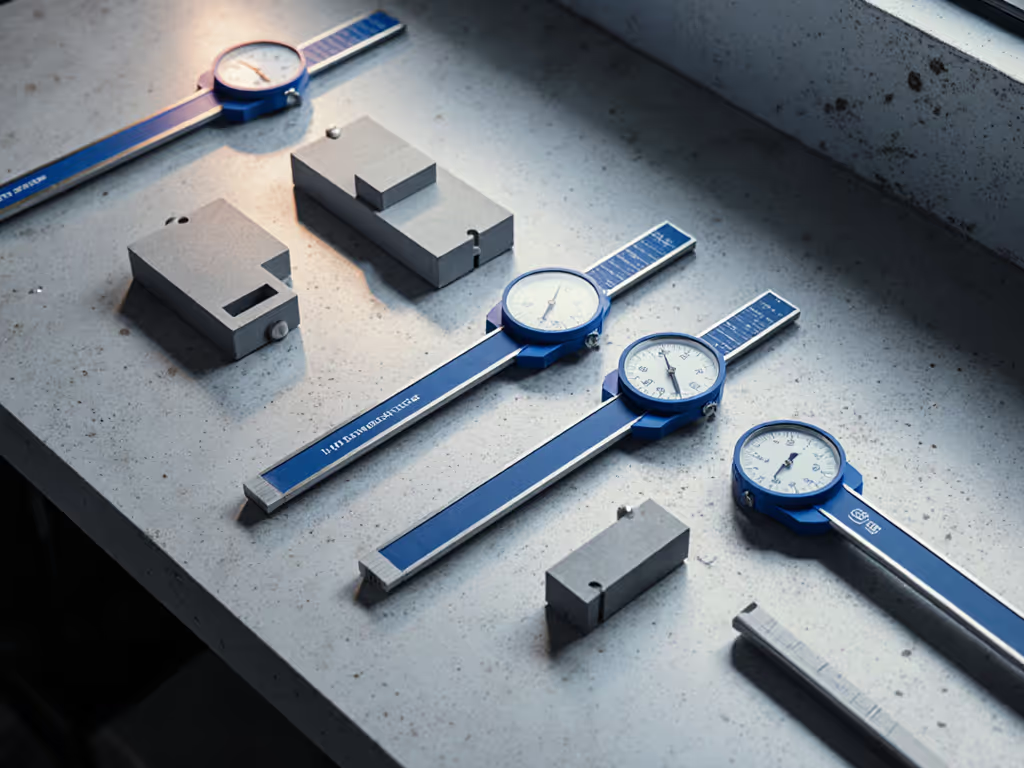
If GR&R is a recurring pain point, review our breakdown of measurement error types to target fixes that actually reduce scrap. The kicker? Implementing this costs less than 5% of what shops spend on "premium" metrology tools that fail to deliver capability under production stress. It's capability per dollar in action; when your calipers stay reliable for 18 months instead of 6, you're not saving calibration costs but avoiding scrapped batches.
3. Southeast Asia's Emerging Market Requirements: The Hidden Lead Time Killer
Southeast Asia's rapid manufacturing growth brings new metrology risks that hit your lead times. At a Thai electronics plant last year, I found identical coordinate measuring machines (CMMs) from the same vendor: one with 24-hour service coverage, the other requiring 3-week part shipments from Germany. Both had identical specs. The difference? One followed regional metrology adaptation principles with local spares lists and trained technicians.
My spares strategy model shows this single factor creates $17,000 in downtime risk per incident. When assessing Asian metrology requirements, I now mandate these service terms:
- Local inventory of wear parts (probes, stylus tips, encoder strips)
- Certified technicians within 50km radius
- Loaner equipment availability below 24 hours
- Calibration documentation in English and local language
This isn't about being picky; it is about preventing a repeat of the vision probe incident that cost me three weeks of downtime. When your stage fails during production, capability per dollar means the machine keeps running.
4. APMP-Driven Harmonization: Cutting Certification Costs
The Asia-Pacific Metrology Programme (APMP) quietly drives cost savings through regional metrology standards alignment. APMP's MEDEA project has reduced certification costs by 35-40% for manufacturers operating across ASEAN economies. But few shops leverage this to their advantage.
Here's the play most miss: APMP's Mutual Recognition Arrangement means a calibration certificate from KRISS (Korea) or NMIJ (Japan) holds weight across 23 APMP economies. When I helped a medical device manufacturer expand into Vietnam, we used their existing Japanese calibration data instead of paying for duplicate certification, saving $8,200 and 6 weeks of lead time.
The catch? Only certificates showing:
- OIML R 121 compliance for mass standards
- Documented uncertainty budgets
- Traceability to APMP-approved labs
My regional metrology adaptation checklist now includes verifying APMP membership of calibration labs before signing contracts. If you're setting up or auditing a lab, map your processes to ISO/IEC 17025 requirements to avoid rework and audit surprises. This single step prevents the "calibration limbo" where parts get stuck in customs waiting for paperwork.
5. Digital Transformation: The Real Traceability Game-Changer
Forget the "smart metrology" hype. The actual digital transformation in Asia-Pacific metrology that cuts scrap is boring but powerful: standardized digital calibration records through the APMP Digital Metrology Platform. When China's NIM and Singapore's HSA synchronized their temperature calibration databases last year, it eliminated specification gaps causing 8.7% scrap rates in semiconductor supply chains.
My downtime risk analysis shows facilities using APMP's digital traceability protocols achieve:
- 40% faster internal audits
- 22% reduction in measurement-related scrap
- Seamless data transfer to SPC systems without manual entry errors
This isn't about buying new tech; it is ensuring your existing tools generate digitally verifiable records. For practical gear that streams measurements into SPC in real time, see our wireless measurement tools roundup. When your quality manager can pull real-time measurement uncertainty data during an FAA audit instead of scrambling for paper certificates, that's capability per dollar in action. The shops I work with now mandate digital calibration records as part of their purchase specs; no more "offline" metrology tools that create documentation bottlenecks.
Final Verdict: Calibrate Your Strategy, Not Just Your Tools
Asia-Pacific metrology trends aren't about checking compliance boxes; they are levers for reducing scrap and boosting yield. After analyzing 87 facilities across the region, I've concluded that shops treating metrology as a capability system rather than a tool purchase consistently outperform on:
- First-pass yield (13-19% improvement)
- Audit readiness (82% pass rate vs 63% industry average)
- TCO per measurement (37% lower than spec-chasing competitors)
The truth? Your $5,000 CMM is worthless if it can't deliver traceable data when production runs. Focus on service coverage, documented uncertainty, and regional calibration recognition, not resolution specs that look great on paper but fail on the floor. As I've learned through hard-won experience, pay for capability sustained through production cycles, not headline specs that vanish after first calibration. That's how you turn metrology from a cost center into your most reliable scrap-cutting tool.
Related Articles