
Carbon-Neutral Metrology: Measure First, Reduce Second
By Marcus O’Neal • 19th Mar
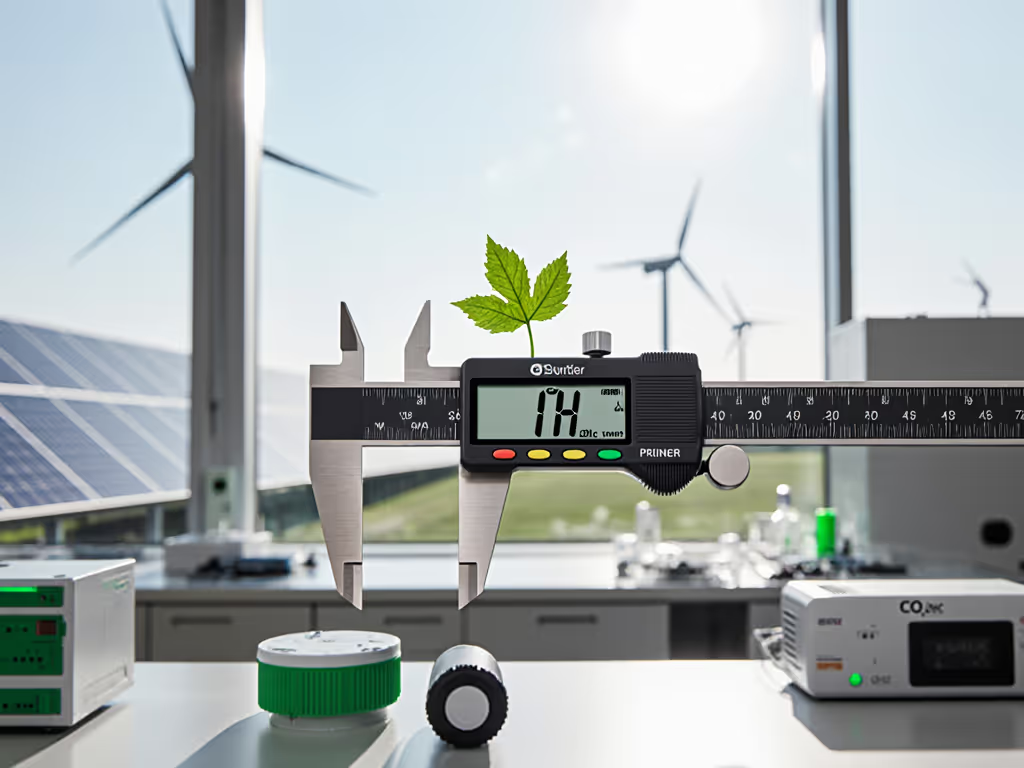
Carbon-neutral metrology and sustainable manufacturing measurement are no longer optional add-ons to quality management, they are becoming baseline expectations in regulated industries. If you're a quality manager, metrology lab lead, or production engineer, you've likely felt the pressure: auditors now ask not just "Is it calibrated?" but "What's your carbon footprint?" and "How are you reducing it?"[1] The good news is that carbon neutrality in your measurement program doesn't require abandoning traceability or accuracy. In fact, the same discipline that keeps you audit-ready also minimizes waste, extends equipment life, and reduces unnecessary energy consumption.
This article walks you through the core questions about carbon-neutral metrology and gives you a practical playbook to embed sustainability into your measurement system without sacrificing performance.
What Does Carbon-Neutral Metrology Actually Mean?
Q: Is carbon-neutral metrology the same as net-zero measurement?
No, and the distinction matters for your audit trail. Carbon neutral means balancing the CO₂ you emit (from calibration procedures, instrument transport, lab energy use, and disposal) against an equal amount of carbon removed or offset elsewhere.[1][3] Net zero, by contrast, requires reducing all greenhouse gas emissions, not just carbon dioxide, to the absolute lowest technologically possible level, then offsetting the remainder.[4]
For a metrology lab, carbon neutral is the more immediate goal: you measure your lab's scope 1, 2, and 3 emissions (direct operations, purchased energy, and supply chain), then reduce what you can and offset the rest.[3] This aligns with ISO 14068-1, the global standard for demonstrating carbon neutrality, which specifies a hierarchical path: commit, quantify, reduce, offset, and verify.[1] That structure is already familiar to quality professionals (it mirrors the Plan-Do-Check-Act cycle).
Q: Why should a small job shop care about carbon-neutral metrology?
Three reasons. First, your larger customers and primes (aerospace, medical device, automotive) are contractually embedding carbon targets into supplier scorecards. If you want to stay on the approved vendor list, you'll need documentation.[1][3] Second, carbon accounting forces you to inventory your measurement assets, calibration intervals, and energy use, which surfaces waste and drift you've been ignoring. I once worked with a shop that discovered their CMM room was consuming 40% more electricity than peer sites because no one had tuned the environmental controls in five years. Third, regulatory bodies in North America and Europe are tightening environmental standards; voluntary action now beats forced compliance later.
How Do You Quantify Carbon in Your Metrology Operation?
Q: Where do emissions come from in a measurement program?
Think of it in layers:
- Scope 1 (Direct): Lab equipment energy (climate control, pneumatics for gages, CNC machine power), calibration instrument batteries and fuel cells, onsite disposal or refurbishment.
- Scope 2 (Purchased energy): Electricity for lab, office, and CMM rooms; heating/cooling.
- Scope 3 (Supply chain): Transport of instruments to calibration labs, manufacturing and shipping of new measurement tools, disposal of end-of-life equipment, business travel for audits and training.
Each layer has its own uncertainty and complexity. The Greenhouse Gas Protocol (GHGP) establishes five principles for accurate carbon measurement: Relevance, Completeness, Consistency, Transparency, and Accuracy (principles that will feel very familiar if you've built an MSA budget).[5]
Q: What's the simplest starting point?
Begin with Scope 1 and 2, because you control them directly. Create a simple inventory:
- Lab electricity consumption (kWh/month) and source carbon intensity (grid mix, renewables, etc.).
- Heating/cooling energy (therms or kWh).
- Compressed air usage and compressor efficiency.
- Calibration instrument lifecycles (how many years before replacement, battery usage).
- Staff hours in the lab (to allocate overhead energy).
Multiply each by its published emissions factor (available from NIST, EPA, or your regional grid operator) to get CO₂ equivalents.[5] A dedicated carbon accounting tool can automate this, but a spreadsheet and honest conversations with facilities and procurement staff will get you 80% of the way.
How Do You Reduce Carbon in Measurement?
Q: What's the "Measure First, Reduce Second" approach?
Most organizations jump straight to offsetting, buying carbon credits without first understanding where emissions hide. That's reactive and expensive. Instead, measure your actual footprint, identify the biggest opportunities, and reduce there first. Only offset what remains after genuine reduction.
In a metrology context, reduction usually falls into three buckets:
1. Environment Control Optimization
Your lab's climate system is often the single largest electricity consumer. If your metrology room is set to 20°C ± 0.5°C but your job only requires ± 2°C tolerance, you're burning energy for precision you don't use. Review your environmental spec against your actual measurement uncertainty budget. Tightening the spec only where you need it, and relaxing it elsewhere, can cut HVAC loads by 15-25%. This is where the anecdote from my calibration days still resonates: an auditor once challenged our CMM room logs, asking for the thermometer calibration behind them. We produced the full chain (reference to NMI, uncertainty budget, everything) and the auditor's tone shifted immediately. That rigor also forced us to question whether we were over-conditioning the space. We weren't.
2. Instrument Lifecycle Extension
The most sustainable tool is the one you don't replace. Invest in scheduled preventive maintenance and calibration intervals tuned to actual drift patterns, not worst-case assumptions. A micrometer or dial indicator that drifts predictably and slowly costs less to maintain than to retire and replace. Similarly, refurbish worn instruments (fresh anvils, parallels, or probe tips) instead of scrapping them. This reduces Scope 3 emissions from manufacturing and transport of new equipment, often 40-60% of a tool's total lifecycle carbon footprint.
3. Energy-Efficient Measurement Practices
Serial CMM runs, redundant gage checks, and poor scheduling compound energy use. Batch similar measurements, consolidate fixture setups, and stage parts efficiently. Train staff on technique to avoid false rejects and rework, which force re-measurement and waste energy. Document these practices as part of your SOP, they're as much a control as a calibration certificate. To cut rework and energy waste at the source, review the common measurement errors that drive false rejects.
Q: Can you give me a reduction checklist?
Absolutely. Here's a field-tested framework to prioritize your carbon reduction efforts:
- Environment: Review lab setpoints against tolerance specs; adjust HVAC targets down 1-2 degrees if measurement uncertainty allows. Check for air leaks, seal gaps, and insulation gaps. Estimate the savings and verify with energy bills.
- Instruments: Audit your gage inventory for age, drift history, and replacement frequency. Prioritize preventive maintenance for high-use items. Set realistic calibration intervals based on actual data, not default intervals.
- Workflows: Map measurement tasks by frequency and gage type; batch similar checks and consolidate setups. Identify bottlenecks (e.g., CMM downtime, long probe change cycles) and fix them to reduce idle energy.
- Supply Chain: When procuring replacement instruments or calibration services, request carbon footprint data or certifications (ISO 14068-1 verified suppliers are increasingly common).[1] Consolidate shipments; avoid expedited freight. When specifying replacements, use our guide to energy-efficient metrology tools to shrink lifetime kWh without sacrificing precision.
- Data & Training: Ensure your team knows how to use instruments correctly (avoid cosine error, parallax, probe force errors) to minimize false rejects and re-measurement.
How Do You Close the Loop with Offsetting and Verification?
Q: When should you offset?
After you've genuinely reduced. Offsetting is purchasing carbon credits to neutralize remaining emissions that you can't eliminate within your operation.[2][3] Credits typically fund projects like reforestation, renewable energy, or methane capture. The key is additionality: the offset project must represent real GHG reductions that wouldn't have happened otherwise.[2]
For a metrology lab, that might mean:
- Purchasing verified carbon credits equal to your residual Scope 1 and 2 emissions after efficiency upgrades.
- Funding low-carbon calibration and repair services (suppliers with renewable energy or carbon-efficient transport).
- Supporting supplier programs to decarbonize their manufacturing processes.
Q: How do you prove carbon neutrality to an auditor?
This is where document before you defend becomes your mantra. ISO 14068-1 requires a structured chain of evidence: commitment → quantification → reduction plan → reductions & offsets → reporting → claim → verification.[1] Your audit file should include:
- Baseline emissions inventory (Scopes 1, 2, 3) with calculation methods and emissions factors.
- Environmental control specs and energy consumption data (utility bills, meters).
- Calibration interval justifications tied to drift data.
- Maintenance and refurbishment logs showing instrument life extension.
- Carbon offset certificates (serial numbers, project details, retirement documentation).
- Third-party verification report (from an ISO 14068-1 accredited body).
The same discipline that passes a quality audit (asset registers, traceability, controlled records) passes a carbon audit. In fact, the parallel is deliberate: trace it, budget it, then trust it under audit.
Key Takeaways: Your Carbon-Neutral Metrology Roadmap
Carbon-neutral metrology isn't a detour from your quality mission, it is an extension of it. You already measure, control, and justify your measurement system. Adding carbon discipline means:
- Quantify your lab's actual emissions (Scope 1, 2, 3) using structured, transparent methods.[5]
- Reduce through environment optimization, instrument lifecycle extension, and efficient workflows.
- Offset only residual emissions, with verified, additional credits.
- Verify and report your carbon neutral claim to a credible third party.
- Document before you defend: maintain a complete audit trail of methods, data, and reduction efforts.
Start small. Pick one area (often Scope 2 energy or Scope 3 supply chain) and establish a baseline. Build reduction actions that also improve quality (tighter environmental controls, preventive maintenance, staff training). Then scale across your metrology program.
Your customers, auditors, and next generation of employees will notice. And you'll sleep better knowing your measurement program is as carbon-conscious as it is technically rigorous.
--
Further Exploration
Ready to embed carbon neutrality into your measurement system? Consider these next steps:
- Establish a baseline inventory: Work with your facilities and procurement teams to quantify your lab's current Scope 1, 2, and 3 emissions. Use a carbon accounting tool or consult an ISO 14068-1 specialist if you're working at scale.
- Benchmark against peers: Connect with quality networks and industry groups (ASQ, AIAG, etc.) to compare carbon reduction strategies in similar shops. Shared learnings accelerate results.
- Engage your calibration provider: Ask your external lab or service vendor about their carbon footprint and ISO 14068-1 certification status. Preference for low-carbon providers compounds your impact.
- Set a near-term reduction target: Aim for 10-20% reduction in Scope 1 and 2 emissions within 18 months. Build actions (HVAC tuning, maintenance efficiency, workflow optimization) into your annual quality plan.
- Plan for verification: Allocate budget for a third-party audit of your carbon neutrality claim. The cost is modest relative to the compliance and market credibility gain.
Related Articles