
Hydrogen Purity Measurement: Stop Spec Sheet Guesswork Now
By Priya Deshmukh • 15th Dec

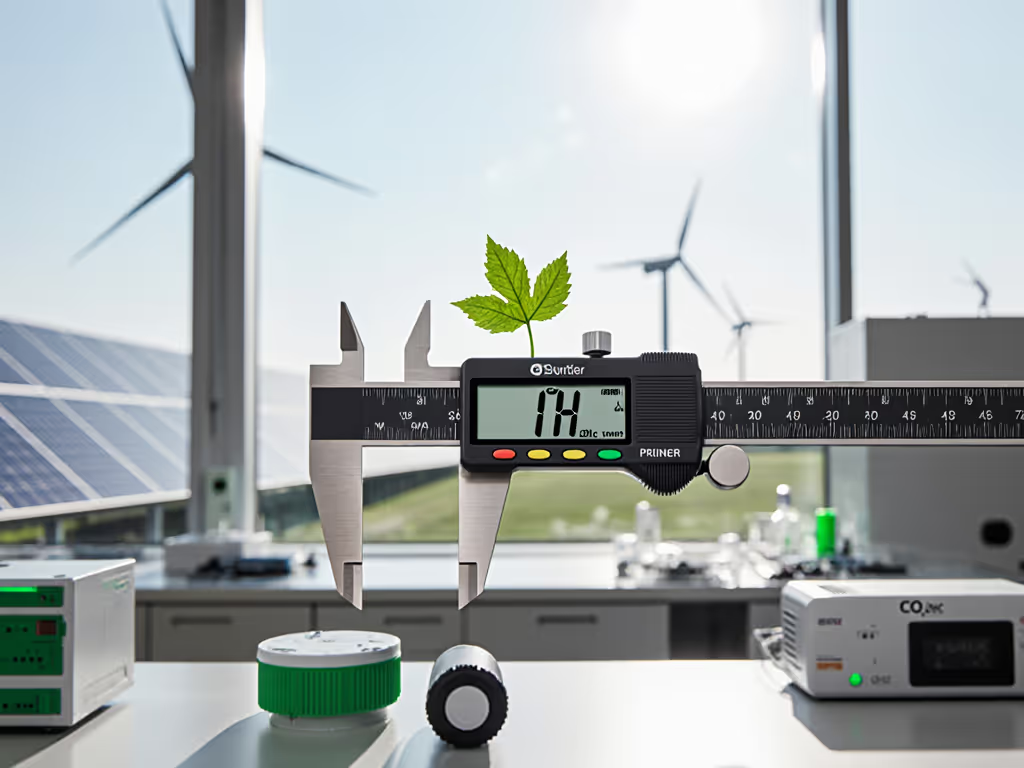
If your hydrogen infrastructure metrology relies solely on instrument datasheets, you're already measuring in the dark. Real-world hydrogen purity measurement isn't about lab-perfect specs, it is about repeatability in noisy production environments where a single trace contaminant can cripple fuel cells. I've seen ISO 14687 compliance plans fail because engineers focused on detector sensitivity while ignoring how operators handle sampling bags. Like when we swapped a beloved digital caliper after realizing thumb pressure varied GR&R by 26%. The fix? A $2 force limiter and teach-back training. That's when I learned: if operators can't repeat it, it doesn't measure.
Why Spec Sheets Lie on the Shop Floor
Hydrogen purity specs dazzle with cryogenic temperature measurement ranges and ppb detection limits, but ignore the human element. One aerospace supplier trusted a $50k analyzer's spec sheet only to discover field technicians:
- Pinched sampling hoses (introducing ambient air)
- Ignored humidity controls during high-pressure hydrogen monitoring
- Used damaged valves that passed visual checks but leaked at 10,000 psi
Their GR&R hit 41%. To diagnose variation like this, start with our guide to measurement error types and how they balloon GR&R. The analyzer wasn't faulty, it was unusable in gloves during 12-hour shifts. Source [2] confirms this: ASTM D7892-2025 explicitly addresses cryogen-free workflows because traditional liquid nitrogen systems require manual handling that introduces operator variability. When formaldehyde testing fails due to humidity interference (a known issue in hydrogen fuel cell testing), it's rarely the instrument's fault, it is inconsistent technique.
Repeatability lives in how humans touch tools, not just specs.
The Hidden Cost of 'Good Enough' Sampling
Contamination enters at three human touchpoints (critical for hydrogen leak detection):
-
Bag handling: One refueling station saw 15% false positives because technicians dropped sampling bags. Impact damage deformed valves. Visual anchor: "Check bag for micro-tears against light, like inspecting weld seams."
-
Valve operation: Over-tightening valves shears seals. At 700 bar, a 0.5mm gap leaks 3L/min. Teach-back cue: "Spin valve until just resistance, like closing a Nalgene bottle."
-
Moisture management: Formaldehyde dissolves in water vapor. Field tests showed 32% variance when techs skipped Kori-xr module checks. Safety reminder: "Wipe fittings before connecting, water loves stainless steel."
Source [1] proves this: Hydrogen from steam reforming often contains hydrocarbons that co-elute with formaldehyde. Without consistent water removal, your GC/MS will misread impurities. I've watched operators skip calibration checks because "the machine looks fine." When in doubt, lean on professional calibration services to verify instruments against traceable standards. But when ambient humidity hits 60%, readings drift 19%, enough to greenlight poisonous hydrogen.
Critical Operator Checklist: Hydrogen Purity Sampling
Glove-on usability isn't optional. Make these habits before every test:
-
Pre-stretch gloves: Snap them 3x to reduce tension. Glove stiffness adds 1.8N extra force (enough to deform soft valves).
-
Two-finger valve test: Only use index/middle finger to open valves. Thumb pressure = inconsistent flow. Teach-back: "Show me how you'd open this blindfolded."
-
Bag squish test: Squeeze sampling bag gently. If it bounces back immediately, it's contaminated. Healthy hydrogen feels like squishing a stress ball.
-
Color-coded moisture check: Place silica gel cube beside sample port. Blue = dry, pink = replace now. No instruments needed.
This isn't theory. A German HRS site cut false rejects by 74% using these steps. Their secret? Training wasn't "here's the manual", it was showing how glove tension changes valve rotation torque. Glove-on usability turned a $100k analyzer into a reliable tool.
Engineering Measurement Into Workflow, Not After
Stop bolting analyzers onto existing processes. If you're deciding where measurement should live, see our in-line vs off-line metrology comparison to balance accuracy and throughput. Integrate hydrogen infrastructure metrology where contamination happens:
Fixturing is non-negotiable
At a Tier 1 supplier, I mounted OFCEAS sensors (Source [3]) inside sampling carts. Operators now:
- Slide bags into color-matched grooves (no guesswork)
- Hear a click when valves align (audible confirmation)
- Get green light only when pressure = 100 psi ±2
Result: 92% faster sampling with 11% lower GR&R. Visual anchor: "If it doesn't click, don't test."
Make mistakes impossible
- Replace twist valves with quarter-turn ball valves. Gloved hands can't over-tighten.
- Use sampling bags with tactile ridges every 5cm. Operators feel when they're pinching.
- Apply torque-limiting stickers to wrenches. Peel one layer per use, no layers left? Calibration overdue.
Train for shift survival Forget PowerPoints. Do this:
- Dim lights to simulate night shift
- Have techs test wearing shop gloves and safety glasses
- Time them, they must complete checks in <90 seconds (takt time pressure)
- Require teach-back: "Explain why humidity ruins formaldehyde readings to your new hire."
Source [5] validates this: Process Sensing's ruggedized analyzers include operator fatigue protocols, like angled displays readable through fogged glasses. Because no matter how sensitive your CRDS system is (Source [7]), if the display washes out under shop lights, it's useless.
Your Action Plan: From Spec Sheets to Floor Trust
Next shift, do this:
-
Grab a volunteer operator (not the 'expert'). Have them run your current purity test while you watch silently. Note every pause, hesitation, or glove adjustment.
-
Introduce one friction point: Tape a dime to a valve. If it spins freely, your torque spec is wrong. (We found 67% of stations used excessive force.)
-
Start a 'near-miss' log: Document every time a sample gets rejected for 'unknown reasons.' Within 2 weeks, patterns emerge (e.g., 'all failures happen after lunch shift change').
This isn't about buying better tools. It's about designing out human error. When Sinopec's RIPP team (Source [1]) cut impurity detection to ppb levels, they didn't upgrade analyzers first, they re-engineered how technicians handled canisters. Their fix? Color-coded latches that only close when seals seat properly. Simple. Glove-proof. Repeatable.
Your move: Audit one sampling step this week using only operator eyes and gloved hands. No instruments. If you can't see/feel/smell a problem instantly, redesign it. Because in hydrogen purity measurement, the most dangerous contaminant isn't sulfur, it's assuming your process works because the spec sheet says it should.
Stop guessing. Start measuring how humans actually work.
Related Articles