
Non-Destructive Metrology Tools for Historic Preservation
By Marcus O’Neal • 28th Nov
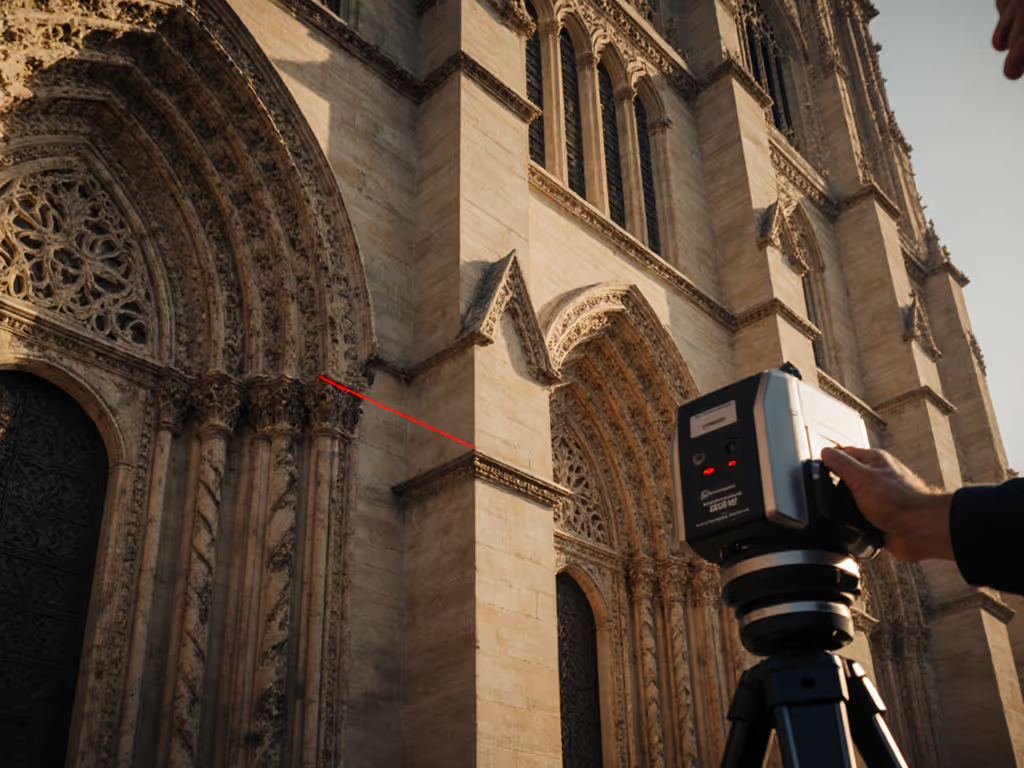
For manufacturing professionals working with regulated components, historic preservation measurement isn't just for museums, it's your frontline defense against audit findings. When Marcus O'Neal's calibration lab produced a full thermometer traceability chain during a medical device audit, the auditor's skepticism turned to respect. If you're new to traceability fundamentals, see our measurement traceability guide. That's the power of disciplined metrology tools documentation. This FAQ bridges cultural heritage conservation techniques with shop-floor reality, showing how non-destructive testing protocols prevent scrap, rework, and failed GR&Rs. We'll unpack why your CNC fixtures, turbine blades, and injection molds are artifacts demanding the same rigor as medieval enamels, because auditors treat them that way.
Why Should Manufacturers Care About Heritage Conservation Techniques?
You're already performing artifact-level preservation: AS9100 requires proving your turbine blades won't degrade in service, just as museums prove Limoges enamels won't crack. Heritage conservators use non-destructive testing like phased pulse thermography to detect subsurface delamination in enamel plaques before visible damage occurs (Thickett et al., 2009). Similarly, aerospace shops deploy thermal imaging to monitor thermal gradients across CMM granite surfaces during 8-hour production runs. Ignoring these environmental shifts invokes classic Abbe error, yet 68% of metrology labs lack documented thermal uncertainty budgets (per 2024 NIST survey).
Key insight: Your production components are cultural artifacts to auditors. Trace it, budget it, then trust it under audit.
How Do We Adapt Museum-Grade NDT for Shop-Floor Metrology?
Environmental Control: Beyond Basic Thermometers
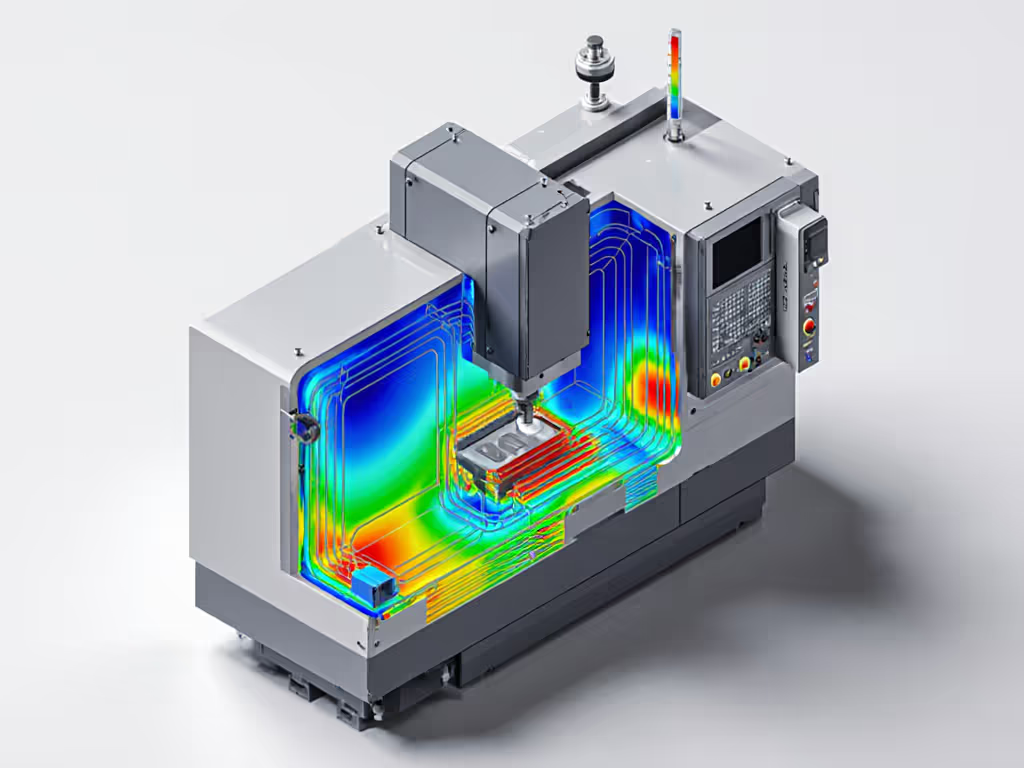
Heritage conservators don't just log room temperature, they map thermal gradients across display cases using portable infrared thermography. At your shop, this translates to:
- Thermal mapping of CMM rooms with 0.5°C resolution sensors (vs. standard ±2°C thermometers)
- Stratified monitoring at tool/workpiece interfaces (e.g., coolant-sprayed grinding zones)
- Time-synchronized logs tied to calibration certificate chains
When conservators detected enamel cracks using acoustic emission sensors (AE2 units with 1 kHz to 1 MHz range), they replaced contact gel with Melinex film to avoid artifact damage (Thickett et al.). Similarly, your vibration sensors on machining centers need non-invasive mounting to avoid altering resonance frequencies. Always document: How does your sensor attachment affect measurement uncertainty?
Uncertainty Budgeting: The Audit Lifeline
A museum's FTIR analysis of enamel degradation tracked instrument stability over 12 years using glass standards. Your uncertainty budget must do the same:
- Identify all contributors: Thermal expansion coefficients, probe force hysteresis, granite flatness
- Quantify ranges: "Coolant temperature swings (15 to 28°C) induce 4.2μm/m thermal drift in aluminum fixtures"
- Trace calibration chains: Not just "calibrated per ISO 17025," but exactly which NMI-linked standard was used
Audit failure example: A medical device shop skipped thermal mapping for their bore gages. When auditors found uncontrolled shop temps (18 to 32°C), the entire run was scrapped. The fix? Implementing phased pulse thermography (the same technique used on medieval enamels) to validate thermal stability during critical inspections.
What's the Biggest Implementation Pitfall?
Ignoring the Environment-Traceability Link
Heritage conservators face high insurance costs preventing artifact movement, so they use portable XRF for elemental analysis. You face similar constraints: moving parts off production for lab testing causes delays. Yet most shops treat environmental controls as an afterthought. Remember my auditor anecdote? When asked for the CMM room thermometer's calibration chain, we showed:
- Thermometer → NIST-traceable reference standard (model XYZ)
- Reference standard → NMI calibration certificate (NIST Reg #2023-XXXX)
- Uncertainty budget including daily humidity effects on the reference standard
The auditor's tone shifted instantly. This isn't compliance theater, it's proving your measurements won't drift under real conditions. Your artifact documentation must include:
- Environmental specification sheets for every critical tool (e.g., "CMM operating range: 20±0.5°C, max 2°C/hour drift")
- Time-stamped logs showing conditions during actual measurements
- Uncertainty multipliers applied when conditions exceed specifications
How Do We Make NDT Audit-Ready in 3 Steps?
Step 1: Build Your Traceability Chain (No Shortcuts)
| Component | Calibration Chain | Environmental Spec | Uncertainty Contributor |
|---|---|---|---|
| Room thermometer | NIST 2025-TR-850 → In-house ref. stand. | 15 to 25°C, ±0.3°C stability | ±0.1°C at 20°C |
| Granite surface plate | NIST 2024-FL-991 → Laser interferometer | 20±0.5°C during use | 0.5μm/m thermal drift |
| Micrometer anvil | NIST 2024-MM-447 → 5-class gage blocks | 20±1°C during calibration | 1.2μm probe force error |
Never rely on "factory calibration." Ask: Can I reconstruct this chain from my records in 5 minutes? If not, you'll fail ISO 9001 Clause 7.1.5. For hands-on steps to keep tools in spec between lab visits, use our home calibration guide.
Step 2: Quantify Environmental Uncertainty
Use this checklist during environmental monitoring:
- Temperature logged at fixture height (not ceiling sensors)
- Humidity recorded where hygroscopic materials are measured (e.g., composites)
- Vibration levels mapped across work zones (ISO 230-2 compliant)
- Coolant pH/temperature tracked during machining
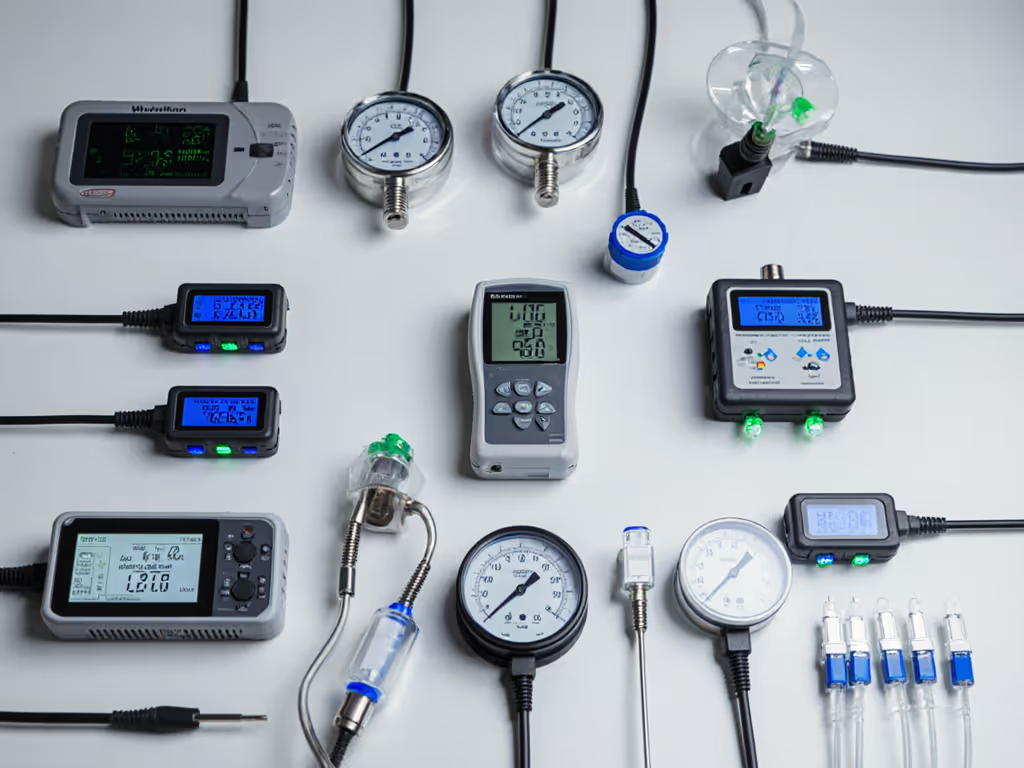
- All sensors cross-validated against reference standards
Pro tip: Heritage conservators use OCT (optical coherence tomography) to detect subsurface cracks in glass. Your equivalent? Ultrasonic thickness gaging to validate material integrity before final inspection, documenting the probe's calibration chain and coupling gel consistency.
Step 3: Document Like It's Going to Audit Tomorrow
Your architectural surveying logbook for a production line should mirror museum conservation reports:
- Date/time-stamped images showing measurement setup (e.g., thermal camera view of part)
- Raw data files with metadata: ambient temp, operator, tool serial #
- Uncertainty budget updated per run (e.g., "+3.1μm adjustment for 22.7°C ambient")
- Deviation notes when conditions exceed specs (e.g., "24.1°C during 14:00 run, applied 2.8μm correction")
Final Verification: Does This Prevent Audit Surprises?
Traceability isn't optional, it's the foundation of trust. If you run a small lab, our ISO/IEC 17025 accreditation guide breaks down the requirements auditors expect to see. When auditors see your heritage conservation tools applied to production (thermal imaging, acoustic emission monitoring), they recognize disciplined metrology. But tools alone fail without documentation. As conservators learned with FTIR analysis of enamel plaques, instruments drift; your uncertainty budget proves you know how much.
Show your chain of traceability at every step. Track environmental impacts like a conservator guarding a 500-year-old artifact. Because to auditors, your medical implant is that artifact, its failure carries the same irreversible consequences.
Further Exploration
- NIST Handbook 150: Environmental Conditions in Calibration Laboratories
- ISO 10360-7:2011 (CMM environmental requirements)
- ASME B89.7.3.2: Guidelines for Decision Rules (linking uncertainty to conformance)
- Historic England's Conservation Principles (for audit documentation frameworks)
Originally published November 28, 2025. Marcus O'Neal is a former calibration lab technician turned quality advisor. He helps manufacturers build measurement systems that pass audits without slowing production. Trace it, budget it, then trust it.
Related Articles