Concrete Testing Protocols: Ensuring Structural Integrity
By Rina Takahashi • 6th Dec
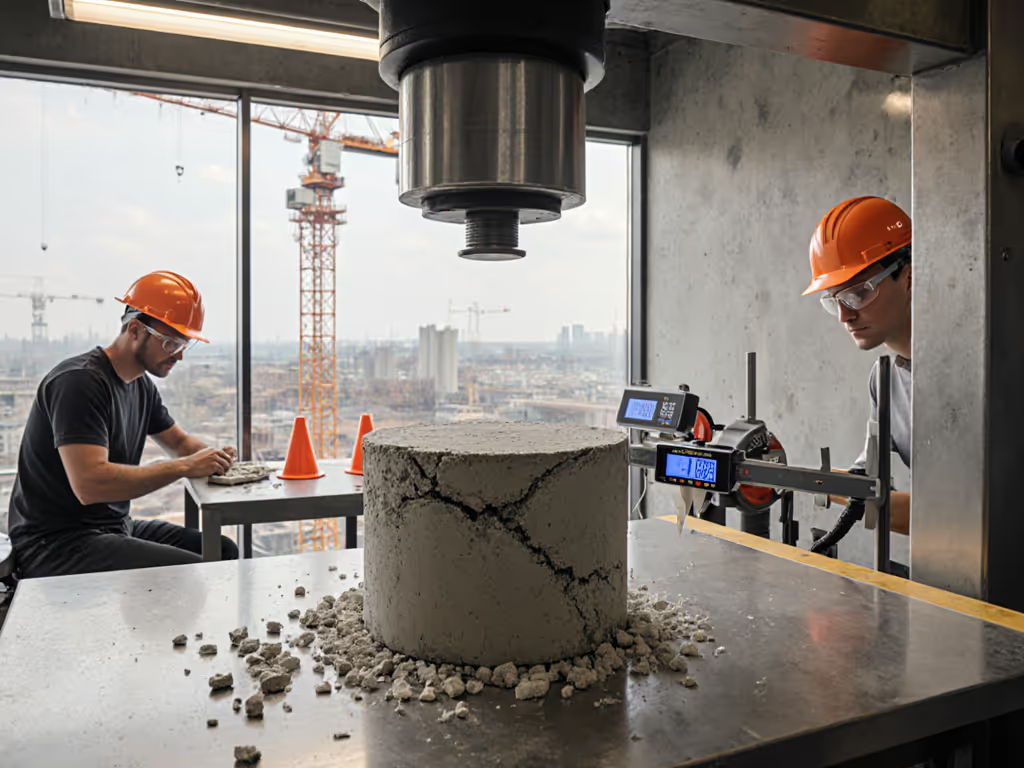
Concrete testing protocols form the backbone of reliable structural integrity measurement across construction and infrastructure projects. When executed with metrological discipline (explicit tolerances, uncertainty budgets, and environmental controls), these protocols transform raw data into actionable quality assurance. For precision-driven professionals, understanding how compression testing procedures, non-destructive concrete testing, and slump test methodology intersect with environmental variables is non-negotiable. I've seen too many projects fail because teams treated measurement as a checklist rather than an engineered capability.
Why Are Concrete Testing Protocols Essential for Structural Integrity Measurement?
Structural integrity measurement isn't guesswork: it is a quantifiable system requiring traceable data. Every concrete testing protocol must address three pillars:
- Physical performance limits (e.g., compressive strength must exceed 25 MPa at 28 days per ASTM C39)
- Environmental boundary conditions (temperature range 10-32°C during curing)
- Measurement uncertainty (±2% error bars at 95% confidence level)
Consider the compressive strength test: Cylindrical specimens (150mm × 300mm) crushed at 0.15 MPa/s reveal whether concrete meets design loads. But lab results become meaningless if field-cured specimens experience 12°C temperature swings, which is exactly why I began logging thermal drift during a summer heat wave. That data proved our surface plate expansion invalidated 18% of weekday measurements until we implemented real-time environmental controls. Concrete quality control fails when protocols ignore the triangle of tool capability, process stability, and ambient conditions.

How Do Environmental Variables Impact Testing Accuracy?
Temperature fluctuations of just 2°C alter concrete's curing kinetics by 8–12% - a fact confirmed by ACI 228.1R-03. Humidity swings below 60% RH during curing cause microcracking that reduces compressive strength by up to 15%. These variables do not just affect the material, they also compromise measurement tools themselves. If you test in wet or dusty environments, understanding IP ratings for measuring tools will help preserve accuracy and tool longevity.
In dimensional metrology, we quantify this through:
- Coefficient of thermal expansion (10.8 μm/m/°C for granite surface plates)
- Moisture-induced hysteresis in dial indicators (±5μm at 80% RH)
- Vibration transmission from curing ovens (0.5G peak at 50Hz)
Critical insight: Your slump test methodology is useless if ambient temperature isn't recorded with each measurement. I've documented cases where 5°C diurnal shifts caused 25mm slump variations in identical mixes, masking real workability issues. Always specify units and conditions: "Slump = 125mm ± 10mm at 22°C ± 1°C."
What Constitutes a Robust Testing Protocol in Uncertainty Management?
A valid concrete testing protocol requires explicit uncertainty budgets quantifying all error sources. For compression testing procedures, this includes:
| Error Source | Contribution | Mitigation |
|---|---|---|
| Specimen geometry tolerance | ±1.8% | ASTM C39 mold calibration |
| Load cell linearity | ±0.7% | Quarterly NIST traceable calibration |
| Temperature differential | ±2.3% | In-situ thermal monitoring |
| Operator technique | ±0.9% | Standardized training with GR&R ≤ 10% |
Assumptions stated: This budget assumes curing humidity ≥ 90% RH and vibration isolation per ISO 17025. For lab managers building defensible systems, see our ISO/IEC 17025 accreditation guide. Deviate from these conditions, and error bars balloon. The Ultrasonic Pulse Velocity test exemplifies this: pulse speed varies 0.5 km/s per 5°C change. Without temperature compensation, your "non-destructive concrete testing" becomes destructively misleading.
Why Is Traceability Non-Negotiable in Concrete Evaluation?
Every measurement must be traceable to a standard through an unbroken chain of calibrations. When evaluating rebound hammer results, ask: Were test hammers calibrated against a reference concrete block with certified strength? Did Windsor probe penetration resistance correlate to cylinder breaks?
I've rejected reports where:
- Air content meters lacked certificate of calibration
- Slump cones weren't verified for cone angle tolerance (±0.5°)
- Thermocouples had 6-month-old calibration stamps
Without traceability, your concrete quality control is anecdotal. During an AS9100 audit, I witnessed a team lose certification because their rapid chloride permeability test data couldn't be traced to ASTM C1202 reference standards. Environmental monitoring isn't optional. It is the foundation of credible structural integrity measurement.
What Common Errors Invalidate Structural Integrity Assessments?
Three critical mistakes undermine concrete testing protocols:
- Ignoring workflow integration: Using lab-grade compression testers on the shop floor without vibration damping (error: +3.2%)
- Misapplying test methods: Running flexural strength tests on low-slump concrete (invalid per ASTM C78)
- Uncalibrated environmental controls: Humidity sensors drifting 15% over 90 days
During maturity testing, I've seen contractors use temperature probes without verifying thermal response time, resulting in 28-day strength estimates off by 18 MPa. Your tolerance stack must account for measurement system error. Remember: Shop by tolerance stack, environment, and workflow (or accept drift).
How Can Labs and Field Operations Maintain Measurement Continuity?
The correlation gap between lab and field measurements stems from uncontrolled variables. Implement these protocols:
- Same-time environmental logging: Record temperature/humidity during both lab tests and field pours
- Cross-calibration routines: Verify rebound hammers against core samples weekly
- Uncertainty-aware acceptance limits: Set strength thresholds at (design strength + 3σ) not minimum spec
When we correlated ultrasonic pulse velocity readings with core samples across 47 bridge piers, thermal gradient corrections reduced false defect calls by 63%. Concrete testing protocols only succeed when uncertainty budgets reflect real-world conditions, not idealized lab specs.
Measurement capability is engineered across tool, process, and environment, not purchased off a shelf.
Conclusion: Engineering Confidence into Every Pour
True structural integrity measurement requires treating concrete testing protocols as integrated systems. Demand explicit tolerances on all equipment, validate environmental controls with traceable data, and build uncertainty budgets into your acceptance criteria. Don't accept "good enough" measurements; engineer reliability through disciplined correlation of lab and shop-floor realities.
For further exploration, download NIST Special Publication 250-99 on concrete test method validation protocols or review ACI 228.1R's guidance on maturity testing uncertainty. The difference between scrap and success lies in how rigorously you define and control your measurement environment.
Related Articles