Quantifying 3D Print Measurement Uncertainty for AM
By Greta Lund • 10th Nov
For quality managers in regulated manufacturing sectors, understanding additive manufacturing uncertainty isn't optional (it's foundational to audit readiness). When 3D printing measurement processes lack documented uncertainty budgets, you're not managing risk; you're gambling with compliance. In my decade implementing quality systems across aerospace and medical device suppliers, I've seen more audit failures stem from poorly characterized measurement uncertainty than from actual part defects. This article addresses the critical questions you need to answer before your next assessment, questions that separate documented processes from hopeful assumptions.
What is additive manufacturing uncertainty and why does it matter for quality systems?
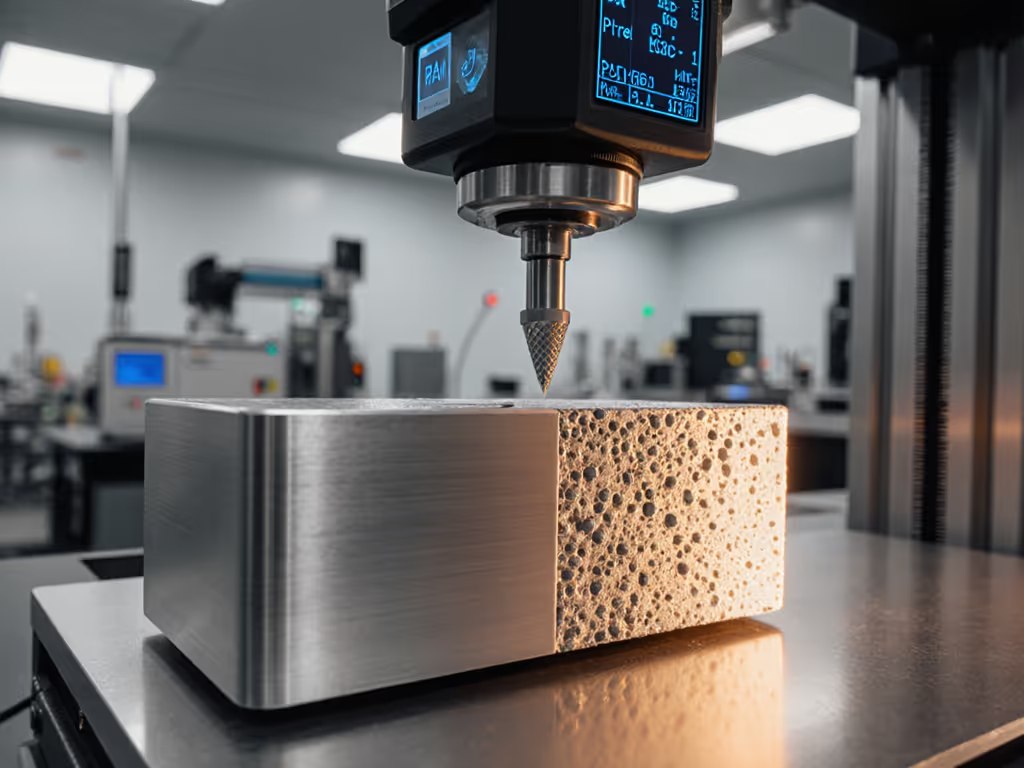
Additive manufacturing uncertainty represents the complete picture of potential errors in your measurement process: not just equipment accuracy but environmental factors, operator technique, material behavior, and post-processing effects. Unlike traditional machining where uncertainty sources are relatively stable, AM material characterization must account for anisotropic properties, thermal history, and process-specific artifacts. For a deeper dive into AM-specific measurement challenges, see our AM metrology fundamentals. During a recent supplier audit, I observed a team that had validated their printer's dimensional accuracy but hadn't quantified how cooling rates affected critical internal features. The parts passed CMM inspection but failed pressure testing, because their uncertainty budget excluded thermal contraction effects.
evidence beats memory when your auditor asks for proof of measurement capability.
Your quality system must treat measurement uncertainty as a documented process parameter, not a one-time validation. Without controlled language describing acceptance criteria for each measurement type, you're vulnerable to inconsistent interpretations during inspections. Remember: "If it isn't documented, it's hope, not evidence under pressure."
How do you quantify measurement uncertainty in 3D printed parts?
Quantification requires establishing a complete uncertainty budget that includes all contributing factors:
- Equipment uncertainty: Calibration certificate data
- Environmental factors: Temperature fluctuations, humidity effects
- Process-specific variables: Layer adhesion effects, residual stresses
- Operator influence: Measurement technique variability
- Part-specific considerations: Surface roughness, internal porosity
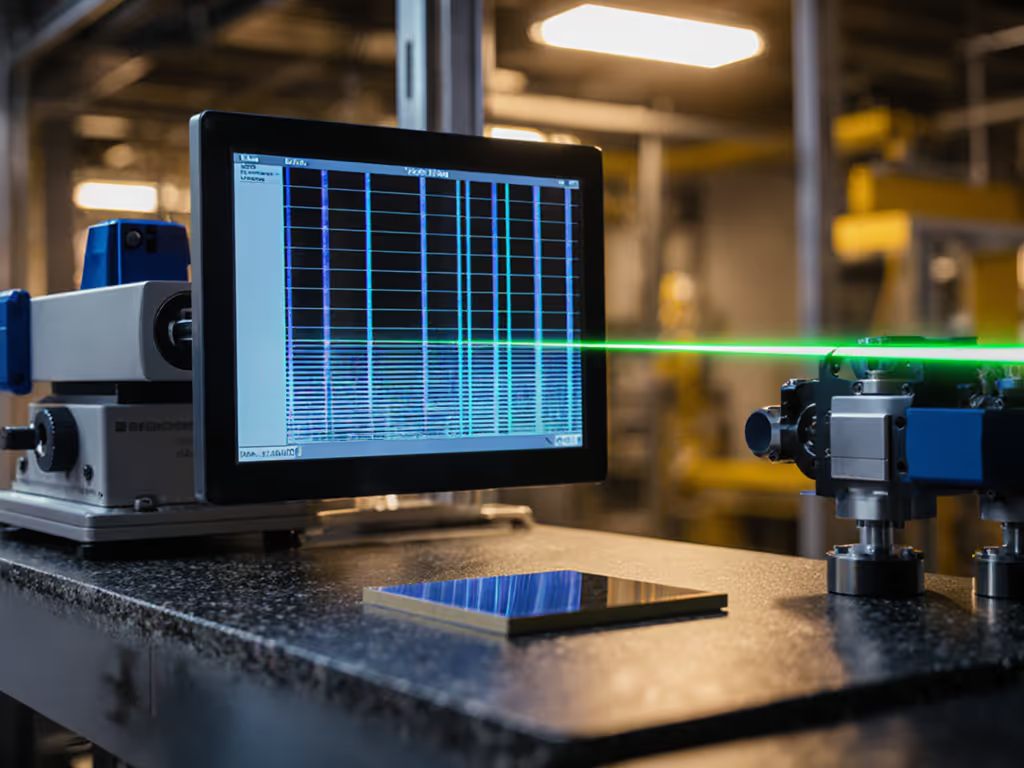
For powder bed fusion, metrology requires special attention to layer thickness effects and how they propagate through stacked measurements. I recommend creating evidence links between your measurement plan and the specific AM process parameters that affect dimensional stability. Documented risk notes should identify where uncertainty exceeds 25% of your tolerance band (that is your trigger point for additional controls).

Plustek ePhoto Z300 Photo Scanner
Effortlessly digitize photos fast, enhancing faded memories with ease.
$219.99
Scan Speed2 seconds for 4x6 photo
Scan Speed2 seconds for 4x6 photo
Pros
Rapid batch scanning of diverse photo sizes.
Integrated image enhancement restores old photos.
Cons
Specific software download required for full functionality.
Feed-through design limits scanning of delicate or irregular items.
Customers find the scanner easy to use and set up, taking just a couple of minutes to download and configure. Moreover, they appreciate its speed, with one customer mentioning scanning hundreds of pictures in no time, and its ability to handle multiple photos at once. Additionally, the scanner delivers excellent picture quality with outstanding resolution, and customers consider it well worth the price, noting it saves money compared to professional services.
Customers find the scanner easy to use and set up, taking just a couple of minutes to download and configure. Moreover, they appreciate its speed, with one customer mentioning scanning hundreds of pictures in no time, and its ability to handle multiple photos at once. Additionally, the scanner delivers excellent picture quality with outstanding resolution, and customers consider it well worth the price, noting it saves money compared to professional services.
What are the major sources of measurement error in AM that impact audit readiness?
During a supplier PPAP review, I've seen missing revision controls on measurement instructions trigger stop-ship actions (despite perfectly printed parts).
- Thermal effects: Material shrinkage during cooling causing internal stress
- Post-processing distortion from support removal or surface treatments
- Inconsistent measurement location selection (e.g., measuring at layer boundaries vs. solid areas)
- Inadequate surface preparation for optical measurement systems
- Environmental changes between build and measurement
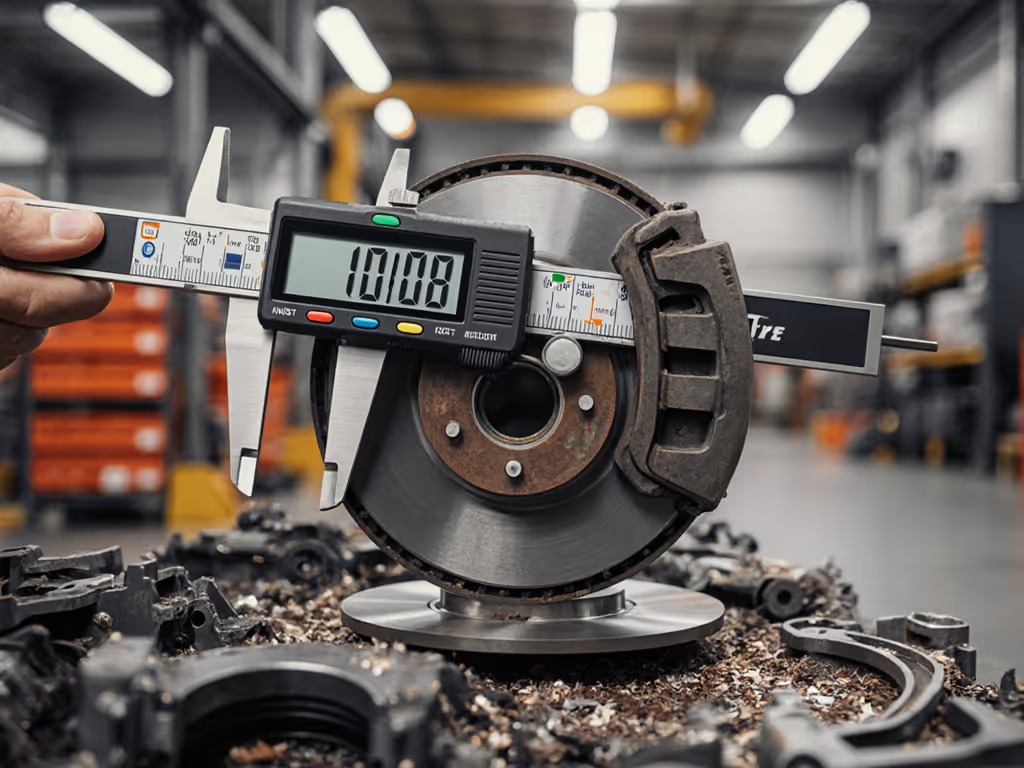
Critical measurement points require documented revision callouts that specify exactly where and how to measure, down to probe force and approach angle. If you're measuring to feature control frames, use our GD&T measurement guide to align inspection steps with design intent. Your measurement plan must acknowledge how layer adhesion measurement variations affect critical dimensions. For instance, Z-direction measurements on FDM parts often show greater uncertainty due to inter-layer bonding variability compared to X/Y measurements.
How should you document measurement processes for audit survival?
Audit-ready documentation requires more than calibration certificates. Your work instructions must include:
- Specific measurement locations with diagrams
- Required environmental conditions during measurement
- Acceptance criteria for measurement repeatability
- Documented uncertainty budgets for each critical dimension
- Revision-controlled procedures for all measurement equipment
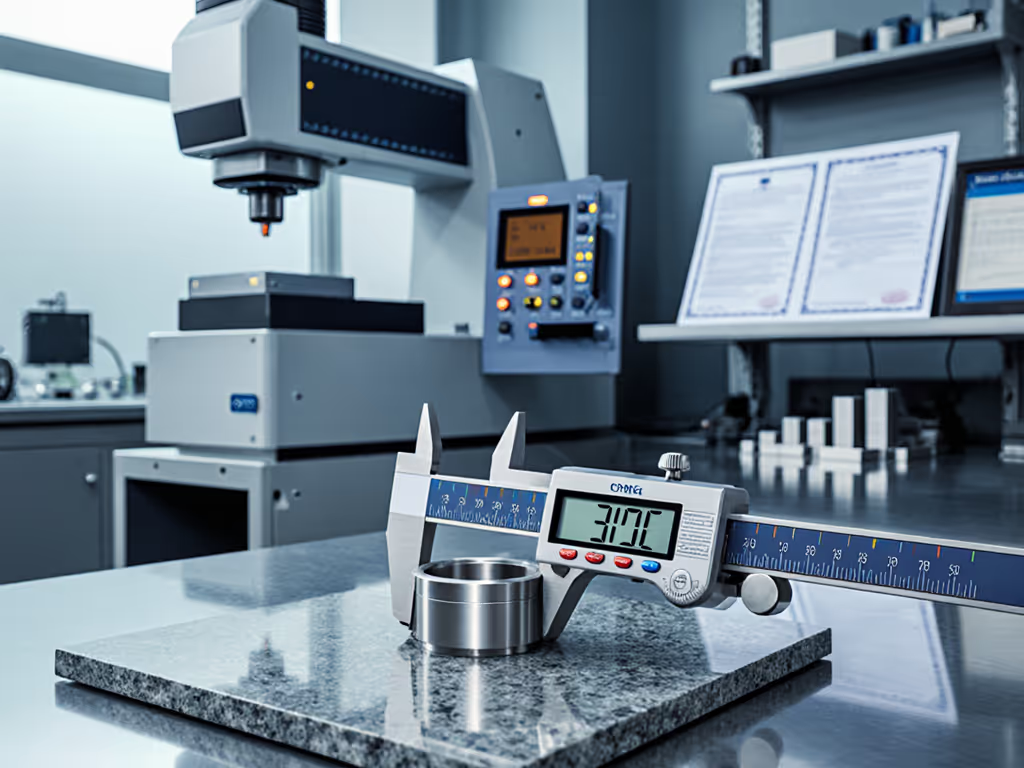
Create a measurement control plan that specifies exactly when operators should quarantine parts for re-measurement versus escalation. Also maintain a clear measurement traceability chain from national standards to shop-floor readings to support audit questions. I've found teams that document their measurement uncertainty sources with evidence links survive audits with minimal disruption, while those relying on memory scramble when questions arise. Control your measurement documentation as rigorously as your product specifications.
What role does post-processing play in measurement uncertainty?
Post-processing distortion remains one of the most underestimated sources of measurement uncertainty in AM. Support removal can introduce localized stresses that change dimensions by 50-100 microns, enough to fail tight tolerances. Chemical smoothing, thermal stress relieving, and surface coatings all introduce their own uncertainty bands that must be quantified.
During one medical device audit, we discovered that bead blasting had smoothed surface roughness but introduced dimensional changes in thin features. For practical techniques and parameters, see our guide to surface roughness measurement. Our corrective action included adding measurement points specifically for post-processed features and documenting the before/after uncertainty bands. Your measurement plan must account for how post-processing sequence affects final dimensions, and treat it as a documented process step with its own acceptance criteria.
How can you implement a sustainable measurement uncertainty program?
Begin with these three actionable steps:
- Map your critical dimensions to specific measurement methods with documented uncertainty budgets
- Create revision-controlled work instructions that include environmental controls and measurement location specifics
- Conduct regular uncertainty audits where you verify that documented processes match floor practice
Focus your efforts where measurement uncertainty approaches 30% of your tolerance band (that is your highest risk area). Implement controlled language throughout your documentation to prevent interpretation drift. Track measurement process capability with the same rigor as production capability.
Consistency and documentation convert good measurements into reliable decisions (this isn't theoretical). When you can demonstrate your measurement uncertainty is managed and documented, you're not hoping for audit success. You're building it into your system by design.
For further exploration, review ASME Y14.46-2019 (Metrology in Additive Manufacturing) alongside your existing ISO 9001 or AS9100 measurement system analysis requirements. Document your findings with evidence links to create an audit trail that demonstrates continuous improvement in your AM measurement capability.
Related Articles