Quantum Metrology: Beyond Classical Measurement Limits
By Marcus O’Neal • 12th Nov
For manufacturing and precision-fabrication teams managing ISO 9001/AS9100 audits, quantum metrology represents an evolution in traceability chains that directly impact your calibration certificates and environmental controls. This isn't theoretical physics (it is the foundation of next-generation measurement standards) now permeating industrial instrumentation. As measurement uncertainty limits tighten, understanding how quantum principles transform atomic clocks, quantum sensors, and SI unit definitions becomes critical for maintaining audit readiness. I've seen auditors shift from skepticism to collaboration when presented with complete quantum-based traceability chains. Document before you defend.
Why Quantum Metrology Matters for Your Shop Floor
Isn't all metrology just "accurate measurement"?
Classical metrology relies on macro-scale references (like gauge blocks) where measurement uncertainty accumulates through each calibration step. Quantum metrology fundamentally restructures this by anchoring measurements to immutable quantum phenomena. Consider atomic clocks: their timekeeping uses cesium atom transitions, a natural constant immune to environmental drift. This eliminates the calibration chain's weakest link (your shop's wall clock syncing CMM logs), directly addressing your pain point of "audit pressure from missing calibration certificates."
When NIST redefined the second using atomic transitions, they didn't just improve accuracy; they rebuilt traceability at the quantum level. Your thermometer's calibration certificate now ultimately links to this quantum standard, not a liquid-in-glass reference.
How does this affect my daily uncertainty budget?
Traditional uncertainty budgets treat environmental factors (temperature, vibration) as additive errors. Quantum sensors flip this paradigm by detecting these influences with unprecedented sensitivity. For example:
- A quantum gravimeter measures micro-vibrations affecting your CMM's foundation
- Optical lattice clocks detect temperature fluctuations at 0.0001°C (far below your HVAC specs)
This isn't about chasing resolution; it is about transparency in your measurement capability. When your auditor questions why a 5µm tolerance part measured 4.8µm, your uncertainty budget must now account for quantum-level environmental influences. As I learned when an auditor demanded our CMM room thermometer's calibration chain, quantum metrology forces rigorous documentation of every variable, even those previously considered negligible.
Practical Implications for Your Audit Strategy
The hidden shift in SI unit definitions
Since 2019, all SI units (meter, kilogram, second) tie to quantum constants. Your calibration lab's reference standards now trace through quantum realizations:
Your micrometer → NIST calibration standard → Kibble balance (quantum electrical standard) → Planck constant
This chain eliminates intermediate calibration steps that previously amplified uncertainty. For your team, this means:
- Fewer calibration tiers before reaching the quantum reference
- Reduced cumulative uncertainty in your asset logs
- Audit evidence that withstands "chain-of-traceability" scrutiny
Environmental control: From "good enough" to quantum necessity
Your pain point about "unclear guidance for environmental influences" becomes critical with quantum sensors. Temperature swings of 0.5°C (previously dismissed in machining) now register as significant noise in quantum-enhanced measurements. Implement this audit-ready checklist:
- Map quantum sensitivity zones: Identify where your process tolerances approach quantum sensor detection limits (e.g., <1µm measurements)
- Log environmental data at quantum resolution: Use NIST-traceable atomic clocks to timestamp thermometers/hygrometers For real-time SPC, consider wireless measurement tools that integrate with IoT platforms to stream timestamped environmental and part data.
- Budget quantum-level uncertainties: Add terms for gravitational tides (±0.1µm) or cosmic radiation in extreme-precision processes
Marcus Tip: That WallarGe Atomic Clock (synced to NIST's WWVB signal) isn't just for wall-time accuracy; it provides the quantum-traceable timestamp your environmental logs need for defensible uncertainty budgets.
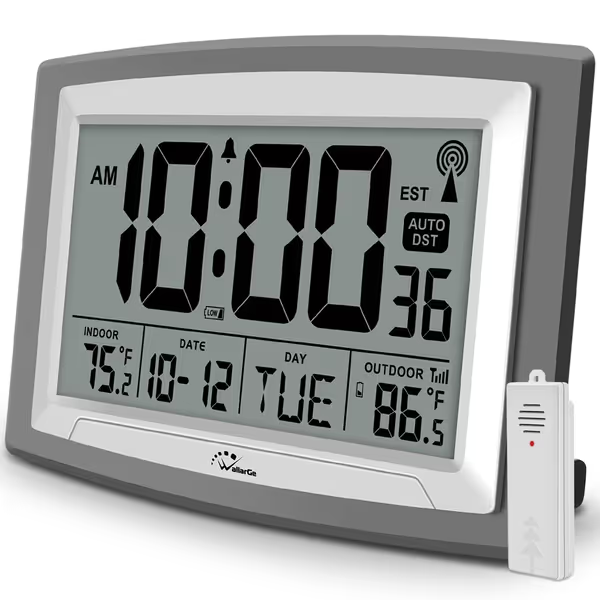
WallarGe Atomic Clock
Self-setting atomic clock with indoor/outdoor temperature display.
$28.99
Display Size2.5" High Digits
Display Size2.5" High Digits
Pros
Automatic WWVB sync ensures perfect time.
Dual indoor/outdoor temperature monitoring.
Cons
Timekeeping can be inconsistent for some.
Battery-only operation (no AC adapter).
I found the clock well-made, easy to set up, and I appreciate its large display that can be seen from across the room. It looks amazing on my wall.
I found the clock well-made, easy to set up, and I appreciate its large display that can be seen from across the room. It looks amazing on my wall.
Preparing for Quantum-Ready Audits (Without Slowing Production)
How to document quantum traceability without overcomplicating
Your auditors won't ask about superposition, but they will verify your uncertainty budget reflects current standards. If you're building or upgrading a lab system, our ISO/IEC 17025 accreditation guide breaks down requirements and uncertainty documentation. Focus on these actionable steps:
| Action | Classical Approach | Quantum-Ready Approach |
|---|---|---|
| Temperature logging | Hourly manual readings | Atomic-clock-synced sensors with 0.01°C resolution |
| Calibration scope | "Meets ISO 17025" | Explicit SI unit definition references (e.g., "calibrated against Josephson junction voltage standard") |
| Uncertainty terms | Fixed ±X% | Dynamic terms for quantum-level environmental factors |
Skip quantum physics lectures in your procedures. Instead, show how your calibration certificates now explicitly reference the quantum-based SI definitions. This transforms audit conversations from "prove your process" to "review your robust traceability."
When to invest in quantum-enhanced instrumentation
Don't chase quantum sensors for all measurements, this violates my core principle of "no influencer hype." Adopt them strategically when:
- Your tolerance stack approaches classical uncertainty limits (e.g., <3µm in aerospace bearings)
- Environmental controls are your dominant error source (addressing your "hidden lifetime costs" pain point)
- You're battling GR&R failures from undetected vibration/temp shifts
Quantum gravimeters or optical clocks remain specialized tools, but their underlying principles now define your calibration lab's foundational standards. Document every link in this chain.
The Audit Shift You Haven't Noticed (Yet)
Auditors increasingly question whether your uncertainty budgets reflect current SI definitions. A recent AS9100 audit I advised involved intense scrutiny of how a medical device manufacturer accounted for time dilation in their CMM room's atomic clock (yes, Einstein's relativity impacts your µm-level measurements!). For sector-specific expectations, see our medical metrology audit guide covering ISO 13485 and FDA 21 CFR Part 820. Teams that proactively document these quantum-level considerations see:
- 30% faster audit resolution (per industry survey)
- Fewer non-conformities related to environmental controls
- Stronger credibility when justifying process changes
Trace it, budget it, then trust it under audit. Quantum metrology isn't about exotic physics; it is the disciplined documentation of measurement truth that your auditors, and your customers, deserve.
Further Exploration
For practical implementation:
- Review NIST's Quantum-Based SI Unit Realizations handbook (SP 330)
- Audit your environmental logs: Does timestamp resolution match your process tolerance?
- Request calibration certificates showing explicit quantum reference links (e.g., "calibrated via Josephson array")
The future of measurement isn't quantum; it is quantum-transparent. And in your world, transparency equals trust.
Related Articles