Battery Recycling Tools: Lab Specs vs Shop Floor Reality
By Alejandro Ruiz • 16th Dec
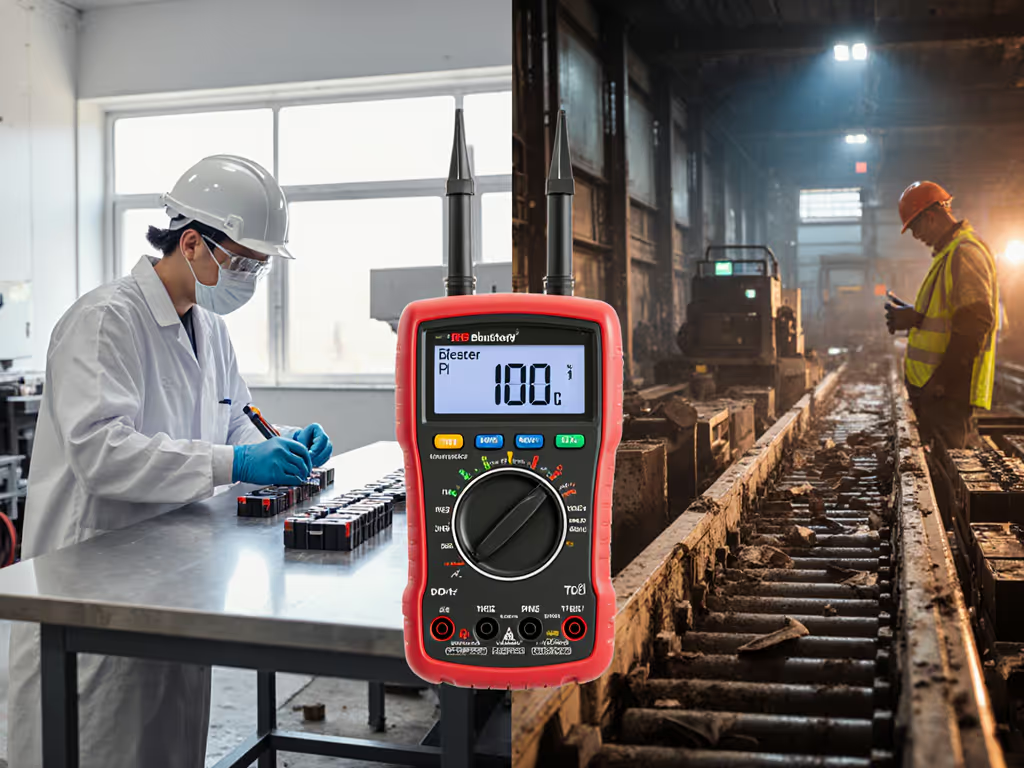
When evaluating battery recycling measurement systems and used battery testing tools, most engineers focus exclusively on lab-validated specs (precision, detection limits, and sample throughput). But on the production floor, these metrics tell only half the story. What truly matters is how tools perform when coolant sprays the sensor, when the shift changes without proper handover, or when a critical component fails three weeks before audit season. I've seen too many facilities dazzled by brochure promises only to discover the real cost of downtime and recalibration during peak production.
The Spec Sheet Mirage
Manufacturers love to showcase pristine laboratory conditions where their analyzers achieve perfect accuracy. But talk to any plant manager who's tried to run a state-of-the-art spectrometer near a 500V busbar, and you'll hear a different story. That "±0.1% accuracy" rating evaporates when ambient temperature swings 15°C between shifts or when graphite particulates build up in the sampling line. I've witnessed shops pay premium prices for equipment that meets ISO standards in controlled testing, but those same tools become unreliable when integrated into actual recycling workflows.
Remember my early career mistake: a "bargain" vision probe that saved $8,000 upfront. When it failed during a critical black mass separation run, we waited three weeks for a replacement part. The downtime cost us $220,000 in lost production, enough to have bought three properly supported systems. That experience taught me the hard lesson that value is capability sustained over time, not headline specs.
Shop Floor Realities vs Lab Promises
Battery recycling operations face unique challenges that lab specs never account for:
- Intermittent power quality from nearby arc furnaces introducing electrical noise
- Abrasive particulates clogging precise measurement ports
- Continuous operation requirements where "8-hour battery life" means midnight breakdowns
- Cross-contamination risks when handling multiple battery chemistries
Take material composition analysis as an example. Lab technicians might praise an ICP-OES system's ppm-level detection limits for lithium, cobalt, and nickel, but on the production line, you need results before the next batch enters the leaching tank. As documented in industry reports, the µDOES technology developed by Sensmet addresses this gap with real-time analysis that eliminates the hours-long delay of traditional lab testing. While both methods use optical emission spectroscopy principles, the industrial-grade µDOES creates plasma directly in the sample stream, removing the need for torches, carrier gases, and complex maintenance that plague lab equipment in production environments.
Pay for capability, not chrome, count the lifecycle costs.
Field testing reveals another critical factor: recycling efficiency metrics calculated from lab samples often overlook batch-to-batch variability. When technicians pull "representative" samples for off-site analysis, they miss the transient spikes in copper or iron concentration that trigger downstream quality failures. Real-world measurements require continuous monitoring, not periodic snapshots, to maintain consistent output quality. For a deeper look at when to build measurement in-line versus keep it off-line, see our in-line vs off-line metrology comparison.
The Hidden Costs No One Mentions
When evaluating tools for your battery recycling operation, move beyond the initial purchase price to calculate true TCO math. Consider these often-overlooked elements:
- Service terms that specify 24-hour response but exclude weekends/holidays
- Spares lists with components that take 6-8 weeks to ship from overseas
- Calibration frequency that doubles when exposed to production environments See when to keep calibration in-house versus rely on professional calibration services to reduce downtime and compliance risk.
- Training requirements for specialized operators who might leave the company
The Analytik Jena multi N/C analyzer demonstrates how thoughtful design translates to shop floor reliability. While both XRD and TIC methods can analyze lithium carbonate content in recycled materials, field comparisons show TIC determination saves significant time, critical when processing high-volume black mass streams. But crucially, the TIC system's robustness in industrial environments matters more than its theoretical precision. Systems that require painstaking sample preparation or special handling become bottlenecks nobody wants to manage during shift changes.
Consider battery disassembly safety equipment: a spec sheet might tout "advanced insulation" while failing to mention how quickly the coating degrades when exposed to electrolyte solvents. I've seen safety gloves that passed lab tests but became conductive after just three disassembly cycles. The right equipment accounts for not just initial performance but sustained protection throughout its operational life.
Making the Right Choice: Your TCO Checklist
Here's the framework I use when vetting used battery testing tools for industrial battery recycling:
- Downtime risk assessment: How long to repair? What's the backup plan?
- Operator dependency: Can a trained technician (not a PhD) maintain it daily?
- Spares availability: Are critical components stocked domestically?
- Cross-compatibility: Will it integrate with existing MES/SCADA systems? If real-time SPC is a goal, shortlist tools with wireless measurement tools that integrate with IoT/Industry 4.0 platforms.
- Environmental tolerance: How does it perform at 35°C with 80% humidity?
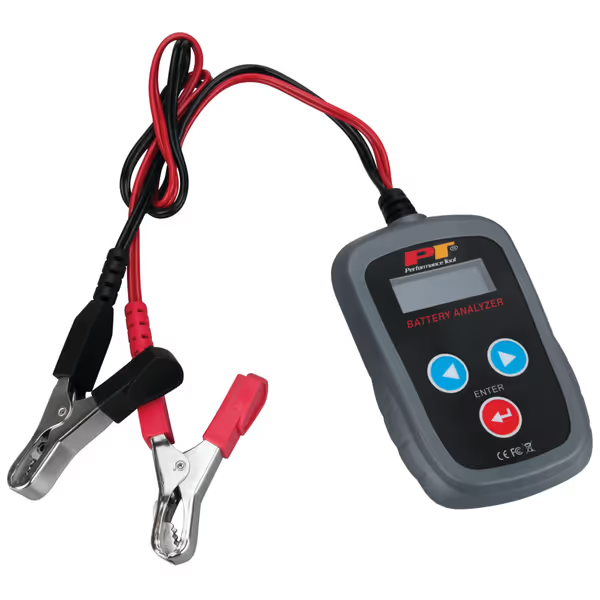
Performance Tool W2998 Digital 12 Volt Portable Battery Analyzer
Quickly assess 12V battery health for lead-acid, AGM, and VRLA types.
$33.4
Battery Types200-1200 CCA (LA, AGM, VRLA)
Battery Types200-1200 CCA (LA, AGM, VRLA)
Pros
Fast, accurate 12V battery diagnostics.
Easy to use for all battery types.
Cons
No specific mention of testing beyond 12V.
Customers find the battery filler works well, particularly for golf cart batteries, and appreciate its ease of use, with one noting it's easier than using a funnel. The product receives positive feedback for its quality and value for money, and customers like that it fills batteries to the proper level without spilling. However, the spout length receives mixed reviews, with several customers reporting that it falls apart during use. The leakage aspect also gets mixed feedback, with some customers reporting no spills while others experience leaks.
Customers find the battery filler works well, particularly for golf cart batteries, and appreciate its ease of use, with one noting it's easier than using a funnel. The product receives positive feedback for its quality and value for money, and customers like that it fills batteries to the proper level without spilling. However, the spout length receives mixed reviews, with several customers reporting that it falls apart during use. The leakage aspect also gets mixed feedback, with some customers reporting no spills while others experience leaks.
The Performance Tool W2998 Digital Battery Analyzer exemplifies practical design for field use. While not designed for industrial recycling lines, its automotive-grade durability demonstrates principles worth emulating: simple operation requiring minimal training, immediate pass/fail indication that reduces interpretation errors, and compatibility with multiple battery chemistries. Note how its design prioritizes actionable results over theoretical precision, exactly what shift workers need during 2AM troubleshooting.
Standardize Where It Helps
In my experience, the most successful recycling operations standardize where it helps, not where it's cheapest. Standardizing on analyzers with common service requirements, spare parts, and operator training dramatically reduces the hidden costs of maintenance. When every piece of equipment requires different skills and parts, you pay the price in downtime risk and training complexity.
The smartest facilities I've worked with build their tool selection around three pillars:
- Consistent measurement methodology across all production lines
- Pre-negotiated service coverage that includes loaner equipment
- Fleet-wide calibration schedules managed through integrated asset tracking
This approach transforms measurement from a cost center into a value driver. When you know exactly how much each hour of analyzer downtime costs, and have systems to minimize that risk, you shift from reactive firefighting to proactive quality control.
Your Action Plan
Next time you evaluate battery recycling measurement equipment, go beyond the spec sheet with these concrete steps:
- Require a downtime risk assessment: Ask vendors to quantify Mean Time To Repair (MTTR) for critical failures
- Verify spares inventory: Demand proof of domestic stocking for components with >2-week lead times
- Test under simulated conditions: Run the equipment near your actual production noise/vibration sources
- Calculate TCO for 5 years: Include calibration, training, and downtime costs, not just purchase price
- Standardize across your fleet: Where possible, select equipment that shares service requirements
The difference between a tool that works on paper and one that works on your floor comes down to anticipating real-world conditions. Don't just buy specifications: buy sustained capability. Because when production stops, no one cares about your analyzer's theoretical precision. They just want to know when the line will restart.
Remember: the most expensive tool is the one that breaks when you need it most. Choose equipment engineered for reality, not just for the lab report.
Related Articles