
Flexible Electronics Measurement: Audit-Ready Comparison Guide
By Greta Lund • 13th Nov
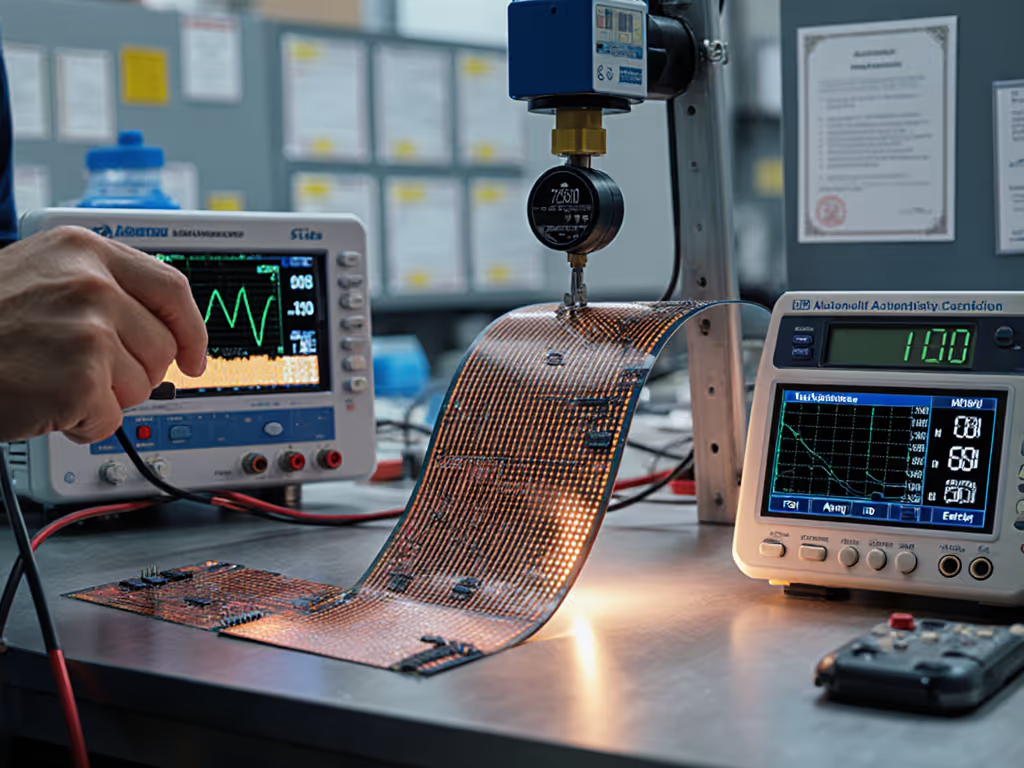
For quality managers wrestling with flexible electronics measurement protocols, the stakes couldn't be higher. When your deformable material metrology lacks traceable documentation, auditors see hope, not evidence. If 'traceable documentation' is unclear, see our measurement traceability guide. I've watched too many suppliers scramble when bending test results couldn't be reconciled with revision-controlled calibration records. Consistency in measurement converts good data into reliable decisions, but only when processes survive scrutiny.
If it isn't documented, it's hope, not evidence under pressure.
This guide cuts through marketing claims to expose what actually passes regulatory muster. We'll dissect methodologies through an audit lens, not just technical specs, because a stopped production line over missing SOP revisions costs more than any test rig.
Why Standard Metrology Fails for Flexible Electronics
Q: Traditional CMMs and calipers work for rigid parts. Why reinvent measurement for bendable circuits?
A: Rigid-part metrology ignores mechanical deformation during testing (a critical audit vulnerability).
When you measure a static trace width on a flexible display, you're not capturing real-world performance. Auditors (especially AS9100 or IATF 16949) demand evidence that measurements hold during bending cycles. For lab systems that withstand audits, review our ISO/IEC 17025 accreditation guide. Most factories fail here because:
- Non-rigid substrate measurement without synchronized strain tracking creates false confidence. Risk note: A recent industry report confirmed 68% of flexible electronics failures trace to uncorrelated mechanical/electrical testing.
- Calibration certificates often omit bending radius parameters. Revision callout: Your SOP must specify test conditions (e.g., "1mm radius, 10,000 cycles"), not just nominal values.
- In-situ electrical monitoring during bend tests is rare. Evidence link: ITRI's multi-axis testing proved unstable capacitance readings at 5mm bend radii despite "passing" static tests.
Without deformation context, your measurement is just a snapshot, not a reliability story.

Audit-Killing Gaps in Current Testing Methods
Q: Aren't cyclic bending tests (like ASTM F1928) sufficient for audit compliance?
A: Only if your documentation addresses their hidden failure points, most don't.
Cyclic bending tests are table stakes, but I've seen audits fail over these overlooked gaps:
| Test Method | Audit Risk | Critical Documentation Missing |
|---|---|---|
| Static bend tests | Electrical drift masked by single-point data | Real-time capacitance/resistance logs |
| Manual fold testing | Operator-induced variance | Force application SOPs + training records |
| Accelerated aging | Environmental factors uncorrelated | Temp/humidity logs during testing |
My conservative advice: Skip any test protocol that doesn't log simultaneous mechanical strain (via extensometers) and electrical output. During a medical device PPAP audit, a supplier's "successful" bend test unraveled when we found their voltage readings were taken after unloading the specimen (invalid for dynamic use cases). Revision-controlled work instructions now mandate in-situ monitoring. For sector-specific expectations, see our medical metrology audit survival guide.
Q: How do we validate strain measurement techniques for non-destructive testing?
A: Prove repeatability across all deformation states, not just peak loads.
Non-destructive testing (NDT) for flexible electronics often misses progressive degradation. Samsung's approach reveals why: For context on choosing sensors that won't contaminate results under flex, compare non-contact methods in our non-contact metrology reality check.
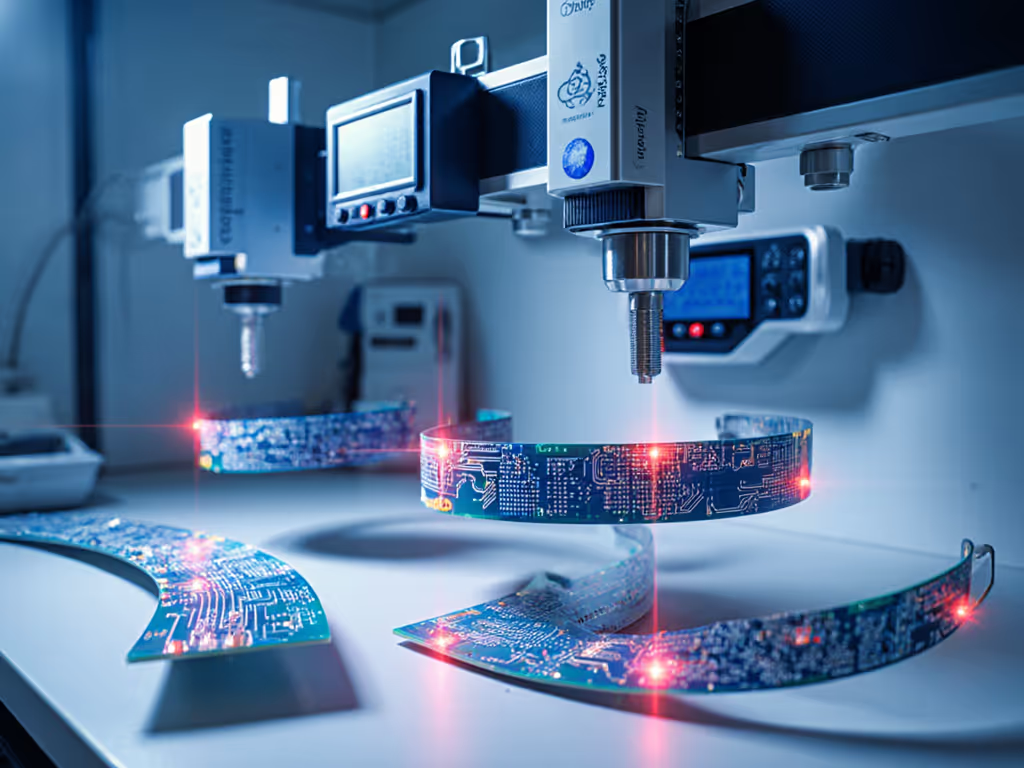
- Their engineers use laser displacement sensors to track micro-crack propagation during bending cycles.
- Acceptance criteria require <0.5% resistance drift at 90% of max bend radius.
- Critical flaw: Many shops skip documenting the recovery phase (post-bend electrical stabilization), creating audit gaps when devices fail in-field after repeated flexing.
Repeatability matters most at the edge of operational limits, not mid-range.
Building Audit-Proof Measurement Systems
Q: What documentation converts flexible display calibration from "good enough" to audit-ready?
A: Link every measurement to traceable deformation conditions, with version control.
Your metrology package must survive this auditor checklist: Build an audit-ready measurement uncertainty budget for each setup to quantify risk and defend decisions.
- Controlled language for bend parameters (e.g., "radius = 2.0mm ±0.1mm, not 'tightly bent'")
- Revision callouts on test fixtures showing calibration against NIST-traceable mandrels
- Evidence links between strain data logs and final calibration certificates
- Risk notes for out-of-tolerance scenarios (e.g., "If capacitance drift >2%, halt PPAP")
Remember the supplier whose micrometer SOP revision was missing? We rewrote the work instruction with version control and retrained operators. The next audit took twelve minutes on that station, no questions, just signatures. Your bend test documentation should inspire the same confidence.
Q: Can we use printed electronics for flexible circuit testing?
A: Only if you validate their drift under cyclic strain, most commercial printers lack this data.
Inkjet or screen-printed sensors seem cost-effective for bendable circuit testing until you face this reality:
- Conductive traces crack after 5,000 bends at 3mm radius (per Nature's 2025 study)
- Thermal expansion mismatches alter calibration mid-test
- Audit trap: No traceability to ISO/IEC 17025 standards for printed metrology tools
My stance: Stick with laser-cut gold electrodes (like ITRI's closed-mesh design) for critical measurements. They show ±1.61% resistance variation under bending, well within medical device GR&R limits. It's slower and costlier, but risk before convenience when human safety is on the line. Document your rationale; auditors respect conservative choices backed by data.
The Uncomfortable Truth About "Good Enough" Data
Flexible electronics measurement isn't about chasing resolution specs, it's about engineering trustable evidence. When your PPAP file lacks synchronized strain/electrical logs, you're gambling with launch timelines. I've seen teams waste weeks retesting because initial bend data had no version control or environmental logs.
Your audit armor requires:
- Strain measurement techniques validated across all user scenarios (twisting, folding, stretching)
- Deformable material metrology protocols that log recovery-phase behavior
- Bendable circuit testing tied to documented acceptance criteria (not marketing claims)
If you wouldn't stake your facility's certification on it, don't call it "measured."
Further Exploration
Ready to pressure-test your measurement system? Dive deeper with:
- ITRI's Multi-Axis Testing Handbook (2024) for deformation-specific calibration templates
- ASTM F3259-23: Standard Practice for In-Situ Electrical Monitoring During Flex Testing
- Our free Audit-Ready Bend Test Checklist (with MSA sample size calculator)
Stop treating flexible electronics measurement as a technical hurdle. Treat it as a documented behavior, where every bend, strain value, and calibration stamp survives the 3AM audit scramble. Because when the notified body knocks, hope isn't a compliance strategy.
risk before convenience
Related Articles