
PEM Fuel Cell Metrology: Contact vs. Non-Contact Methods
By Rina Takahashi • 23rd Mar
Introduction
Hydrogen fuel cell metrology demands precision, but the path to reliable measurement is not straightforward. Across manufacturing floors building proton exchange membrane (PEM) stacks, bipolar plates, and membrane electrode assemblies, engineers and quality leaders face a recurring question: which measurement method (contact or non-contact) delivers traceable results within their tolerance stack and operating environment? The answer hinges not on which sounds more advanced, but on what your process can afford to lose, what your environment will do to your baseline, and which measurement path ties your uncertainty budget to shop-floor reality.
This guide dissects that choice by examining both approaches through the lens of dimensional metrology, stated assumptions, and the explicit tolerances that govern fuel cell assembly.
Why Measurement Method Matters in Fuel Cell Manufacturing
PEM fuel cells are precision electrochemical engines. A 12 micrometer membrane thickness difference can shift performance; bipolar plate flatness drift causes uneven gas distribution and premature degradation. Yet many shops treat fuel cell component inspection as a casual afterthought, reaching for the first available tool rather than engineering a measurement system that matches the tolerance and the workplace.
The root issue: contact and non-contact methods trade speed, risk, and accuracy in ways that are rarely quantified upfront. Neither is universally superior. Each has explicit failure modes tied to material properties, environmental stability, and the assumptions you anchor to when you pick it up on Monday morning.
Contact Methods: Where Mechanical Certainty Meets Wear
How Contact Metrology Works in Fuel Cell Inspection
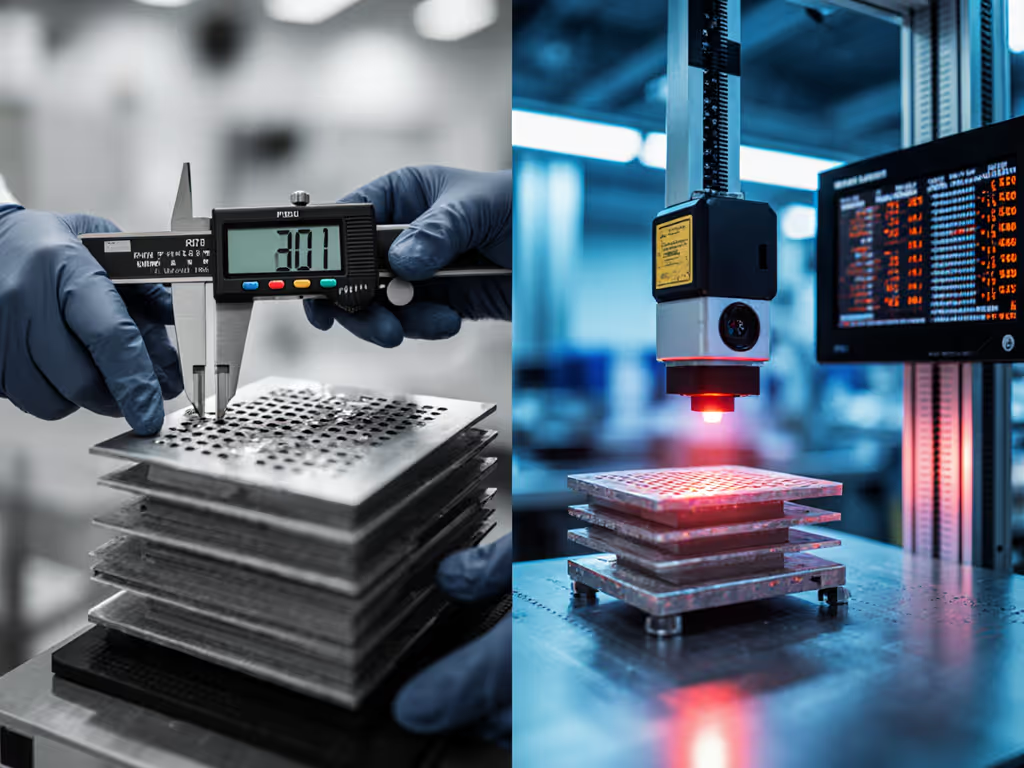
Contact methods (dial indicators, micrometer gauges, bore gage sets, and automated CMM probes) apply a small force to the part surface, record the displacement, and infer the dimension. The appeal is tactile: you know you've touched the part, you see the needle move or the digit appear. For bipolar plate thickness, membrane edge geometry, and seal-land flatness, contact methods remain the industry standard.
But contact is not cost-free. The uncertainty budget expands when you account for probe force variation, material compliance, surface finish, and thermal drift of the measuring device itself. A 0.5 mm diameter carbide probe on a carbon-composite plate will indent slightly; a hardened steel ball on a soft polymer shifts with temperature; coolant residue and aluminum dust cling to the contact point and skew repeatability.
Practical Limitations and Environmental Sensitivity
I discovered this the hard way during a heat wave several years ago. Our surface plate, the foundation for all contact-based dimensional work in the lab, drifted measurably over a summer afternoon. Hourly temperature and humidity logs paired with direct plate expansion measurements showed deviation of roughly 0.002 inch between morning and 4 p.m. By logging the data and re-baselining our gauge blocks, we traced the problem to HVAC failure and inadequate environmental control in the adjacent machining area. Management invested in environmental conditioning, and our CMM micrometers finally agreed on Monday morning.
That experience reinforced a principle: contact methods are stable only when the measurement environment (temperature ±2 °C, humidity 45-55%, vibration isolation) is engineered, not assumed. When your fuel cell assembly floor experiences seasonal swings or abrupt coolant spray, contact probes and fixturing expand and contract. The error is silent.
When Contact Methods Shine
Contact metrology excels in controlled settings:
- Seal-land flatness on bipolar plates (±0.0005 inch), verified with calibrated flat plates and dial indicators
- Membrane thickness at clamping positions, using precision calipers with force-limiting anvils
- Pin-hole and post diameters in fuel cell stacks, measured with bore gages and verified against gage block chains
- Edge geometry and step heights on composite components, using height gages and electromagnetic inductive probes
The certification path is clear: gage blocks traceable to NIST, probe calibration certificates, documented environmental conditions, and documented assumptions in the inspection plan. For fundamentals on establishing a defensible chain, see our measurement traceability guide.
Non-Contact Methods: Speed and Risk
Optical, Thermal, and Electromagnetic Approaches
Non-contact techniques (laser triangulation, structured light, infrared thermometry, eddy current, and ultrasonic thickness) avoid mechanical coupling. No probe force, no wear, no coolant buildup. For complex geometries (flow-field channels, gas diffusion layer porosity variation) and production speed, non-contact methods are increasingly attractive.
Real-World Uncertainties in Non-Contact Measurement
Yet non-contact introduces its own error bars. Laser triangulation depends on surface reflectivity and angle of incidence; black composite absorbs light differently than anodized aluminum, and if your probe beam hits at 30° instead of 0°, you've introduced cosine error. Structured light systems require calibration for each geometry and material; shadow zones and undercuts become blind spots. Eddy current thickness gauging assumes material conductivity and permeability; PEM components often use composites or laminated stacks that violate that assumption.
Thermal imaging for temperature-dependent degradation is valuable but requires emissivity correction, distance-to-target verification, and environmental background subtraction, all assumptions that must be stated and audited.
When Non-Contact Methods Add Real Value
Non-contact shines when:
- Flow-field channel depth and uniformity across a bipolar plate (structured light 3-D scan, ±0.001 inch), without contact probe deflection
- Membrane swelling and moisture gradients during operation (eddy current conductivity mapping, no physical contact stress)
- Real-time stack assembly alignment before seal compression (laser triangulation, high-speed feedback for automated fixturing)
- Surface finish and texture on gas diffusion layers (white-light interferometry, non-destructive)
- Hydrogen purity verification in feed gas streams (thermal conductivity detector, non-contact measurement of gas composition)
The tradeability: speed and automation versus environmental sensitivity and material-specific calibration.
Comparative Framework: Tolerance, Environment, and Workflow
Neither method is inherently superior. The choice depends on explicit tolerance, expected environmental variation, and production cadence. For a deeper look at optical, laser, and ultrasonic tradeoffs, read our non-contact metrology reality check.
| Factor | Contact Methods | Non-Contact Methods |
|---|---|---|
| Tolerance Stack | ±0.0005 - ±0.005 inch (ideal) | ±0.001 - ±0.010 inch (typical) |
| Environmental Drift | High risk (temperature, plate stability) | Moderate risk (emissivity, calibration thermal shift) |
| Probe/Material Interaction | Force-dependent, wear risk, surface finish sensitive | Optical property/conductivity dependent, material-specific correction |
| Setup/Fixturing | Repeatable, but labor-intensive | Faster, less manual, higher automation potential |
| Traceability Path | Clear (gage blocks, CMM standards) | Complex (sensor calibration, software model validation) |
| Operator Skill | High (technique, pressure control, flatness interpretation) | Moderate (fixturing, software interpretation) |
| Production Volume | 1-20 parts/day; job-shop inspection | 100+ parts/day; continuous assembly line |
Integration: How Real Shops Combine Both
The shops that achieve both speed and confidence don't pick one method and abandon the other. They shop by tolerance stack, environment, and workflow (or accept drift). In practice, this looks like:
-
Incoming material (membrane, carbon fiber fabric): Non-contact (structured light, thickness scan) for fast accept/reject; spot-check with calipers (contact) for audit trail.
-
Bipolar plate machining (feature position, flatness): Contact method (CMM probe or dial indicator on stable plate) in temperature-controlled inspection area; non-contact scan (laser triangulation) of flow fields for traceability.
-
Stack assembly (stack height, seal compression): Contact gauge (compression load cell, documented deflection) at point of assembly; non-contact laser measurement of final stack height before sealing.
-
Electrolyzer component measurement (electrode spacing, membrane seating): Non-contact where speed matters; contact verification at sample intervals.
-
Hydrogen purity verification in feed: Non-contact (thermal conductivity or gas chromatography) as the primary method; mass spectrometry cross-check quarterly.
This stacked approach costs more upfront but reduces the audit surprise, minimizes scrap from silent measurement drift, and builds team confidence that the numbers on Monday match the numbers on Thursday.
Uncertainty Budgets: The Silent Arbiter
Whichever method you choose, frame your selection around an explicit uncertainty budget. Document:
- Instrument repeatability (Type A uncertainty): Repeated measurements of the same part under identical conditions.
- Calibration uncertainty (Type B): From your calibration certificate, traced to NIST or equivalent national standard.
- Environmental variation: Temperature, humidity, vibration. Quantified from data logs over the last month.
- Technique and material effect: Probe force variation, surface finish influence, material compliance, optical property shifts.
- Assumption drift: If your contact probe assumes zero deflection on carbon composite, or your laser assumes 0.95 emissivity on anodized aluminum, state it. Test it.
When your combined uncertainty is less than 10% of the tolerance (the "10:1 test accuracy ratio"), you're safe. When it approaches or exceeds 30%, you're operating blind, and you're one environmental shock away from scrap.
Selecting Your Path Forward
For tight, material-stable tolerances (±0.0001 - ±0.0005 inch) in a controlled lab or metrology room: Contact methods (precision calipers, bore gages, CMM) with rigorous environmental control and documented assumptions. Cost: higher initial time and fixturing investment, but lowest uncertainty and highest legal defensibility.
For moderate tolerances (±0.001 - ±0.005 inch) with high production volume and variable shop-floor conditions: Hybrid approach: non-contact for speed and automation (structured light, laser), spot-checked with contact methods (calipers, gauges) on a statistical sampling plan. Cost: tool variety, but operational efficiency and reduced audit friction.
For real-time process feedback (in-process measurement during assembly): Non-contact (laser, eddy current) for speed; establish contact verification at setup and shift intervals to anchor drift. If you're building automated feedback into assembly, start with our closed-loop manufacturing guide.
Conclusion and Further Exploration
PEM fuel cell metrology is not a single decision but a system. Contact and non-contact methods each bring precision and risk. Your tolerance stack, your environment, and your production rhythm together dictate which tool class earns the role, and whether you can afford to rely on one method alone.
Before you commit to either approach, work backward from your tolerance and forward from your environment. Log your temperature and humidity for a full season. Quantify your probe force and its effect on your material. Establish your uncertainty budget in writing. Then pick the method (or combination) that keeps your error bars inside your tolerance, your audit trail clean, and your team confident that Wednesday's measurement will agree with Tuesday's.
Start by requesting calibration data and uncertainty documentation from your current tool suppliers. Compare their stated accuracy against your tolerance (use a 10:1 or 4:1 test accuracy ratio as your baseline). If the numbers don't support either contact or non-contact alone, that's your signal to design a hybrid measurement system. And if your environment is drifting, that's not a measurement problem, it's an engineering problem worth fixing first.
Related Articles