
Portable CMM vs Structured Light: Field Accuracy Uncovered
By Alejandro Ruiz • 11th Nov
When the aerospace casting line halted because your bargain metrology tool couldn't handle shop-floor vibration, you didn't just lose parts, you lost capability. That's why the portable CMM vs structured light decision demands more than spec sheet comparisons. For mission-critical inspection tools, your real-world accuracy depends on how these systems cope with temperature swings, operator fatigue, and that inevitable forklift vibration. I've seen shops spend six figures on "high-accuracy" systems only to find their uncertainty budget blown by inadequate vibration compensation during off-site measurement. Let's cut through marketing with lifecycle reality.
Beyond the Brochure: What Your Factory Floor Actually Demands
How These Technologies Really Work (No Jargon Allowed)
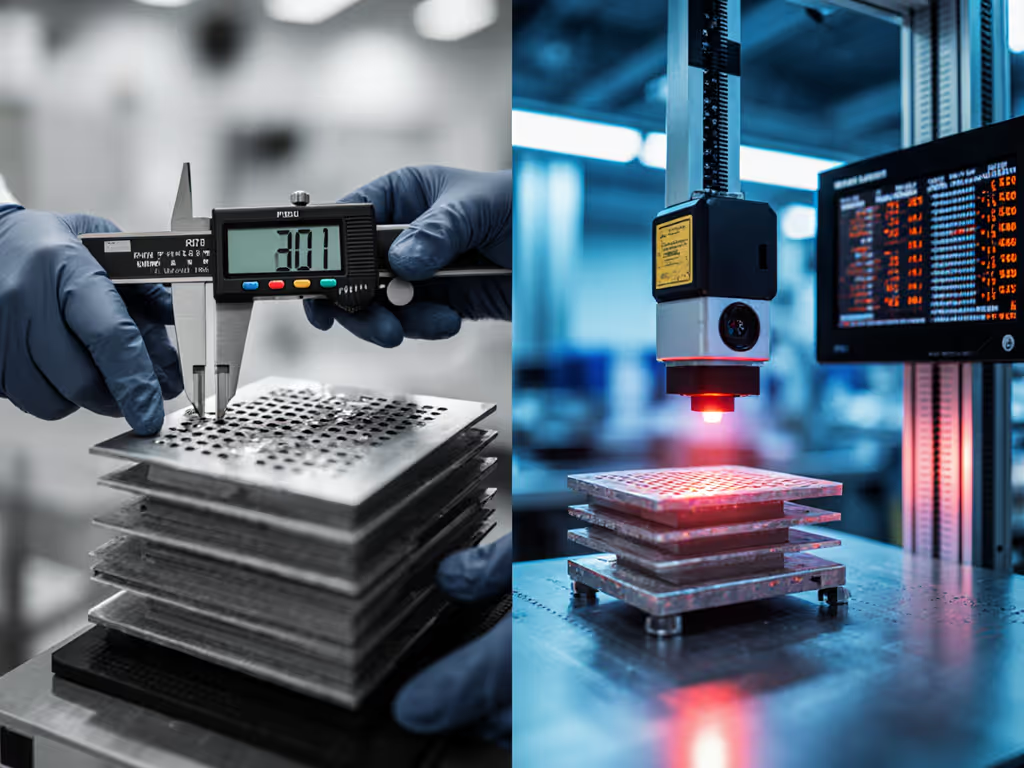
Portable CMMs using contact probes (like articulated arms) physically touch points on your part, building measurements through mechanical interaction. The probe head's precision bearings and encoder resolution determine point accuracy. Structured light systems project precise patterns onto surfaces and triangulate positions using multiple cameras, capturing millions of points without physical contact.
Where marketing brochures lie is in separating lab conditions from reality. That "±0.01mm" spec? It assumes perfect temperature stability, zero vibration, and ideal surface reflectivity. On your shop floor, you're measuring hot aluminum parts near running CNCs with oily surfaces, not white calibration blocks in climate-controlled rooms.
The Accuracy Reality Check
| Factor | Portable CMM | Structured Light |
|---|---|---|
| Baseline Accuracy (Lab) | ±0.005-0.02mm | ±0.01-0.03mm |
| Field Accuracy Loss | 2-3x (vibration, probe wear) | 3-5x (surface conditions, lighting) |
| Critical Vulnerability | Bearing wear, temperature drift | Surface reflectivity, ambient light |
| Best Surface Types | Metallic, matte finishes | Light-colored matte finishes |
| Worst Surface Types | Soft materials (dents), complex geometries | Shiny, black, transparent surfaces |
| Critical Environmental Factor | Temperature stability | Lighting control |
During a recent vendor trial for large part metrology, I measured a 2m aircraft wing fixture. If your work regularly spans multi-meter assemblies, compare laser trackers vs portable CMMs to understand the trade-offs at very large scales. The portable CMM showed consistent 0.015mm deviation across 8-hour shifts despite temperature fluctuations. The structured light system varied by 0.08mm on the same part (caused by changing ambient light from overhead cranes). The structured light system captured data faster, but required constant recalibration as shadows moved across the part. Speed means nothing when you're discarding 30% of scans.
Total Cost of Ownership Is What You Actually Pay
The Hidden Costs Brochures Ignore
I learned this the hard way when a bargain vision probe cost us three weeks waiting for parts. That downtime cost more than the tool's entire purchase price. Today, I run every purchase decision through rigorous TCO math that accounts for:
- Downtime risk: Mean time to repair (MTTR) for critical components
- Spares lists: Availability of wear items (probe tips, LED arrays, camera modules)
- Service terms: On-site vs. ship-back, guaranteed response times
- Calibration cycles: Frequency, cost, and downtime during recalibration
- Operator dependency: Training requirements and technique sensitivity
Portable CMMs typically win in serviceability. Articulated arms have modular components (a worn encoder joint gets swapped while production continues). Structured light systems often require full-unit returns for seemingly minor issues like camera alignment drift. And when you're stuck waiting for a $50k unit to come back from calibration, capability per dollar plummets.
Setup Time Comparison: The Silent Production Killer
Field testing revealed shocking differences in real-world throughput. Measuring a complex turbine housing:
- Portable CMM: 22 minutes total (8 min setup, 14 min measurement)
- Structured Light: 18 minutes total (11 min setup, 7 min measurement)
On paper, structured light won. But here's what the data sheet didn't show: the portable CMM maintained consistent results across 3 shifts with zero re-setup. The structured light system required recalibration every 4 hours due to subtle shop-floor vibrations, adding 32 minutes of lost time per 8-hour shift. Over a month of regular measurements, the portable CMM actually delivered 23% more usable data.
This is why I always insist on setup time comparison that includes recalibration frequency, not just initial setup. The math changes everything when your CNC is waiting for metrology confirmation.
Making the Right Choice: Field-Tested Decision Framework
Match the Tool to Your Real Uncertainty Budget
Stop chasing headline specs. Start with your part's tolerance stack-up and required test accuracy ratio (TAR). For aerospace critical features (±0.05mm tolerance), you need 4:1 TAR meaning your system must deliver ≤0.0125mm uncertainty.
Ask these questions:
- What's my actual environmental control? (±2°C? ±5°C?)
- What surface conditions will I face? (Oily? Matte black? Shiny?)
- What's the true cost of a false accept? (Scrap vs. recall vs. safety)
- How much vibration exists near measurement points?
Portable CMMs thrive when: If traceability is a priority, review our measurement traceability guide to align your shop-floor data with NIST standards.
- Measuring metallic parts with controlled surfaces
- Operating in temperature-variable environments
- Requiring traceable measurements to NIST standards
- Working with high-value parts where downtime is catastrophic
Structured light wins when: For a broader view of optical options, see our non-contact metrology comparison to decide when optical, laser, or ultrasonic methods make sense.
- Capturing complex organic shapes (turbine blades, medical implants)
- Measuring large volumes quickly (whole car bodies)
- Surface finish analysis is required
- Parts are fragile or easily marred
But, and this is critical, structured light's speed advantage evaporates when surface conditions demand constant rescans. I once watched a supplier waste 47 minutes scanning a single black polymer part because the system couldn't handle the low reflectivity. The portable CMM measured the critical features in 9 minutes with tactile probes.
Vibration Compensation: The Make-or-Break Factor
Shop-floor vibration isn't theoretical (it's the forklift passing within 10 feet of your measurement point). Both systems offer vibration compensation, but their approaches differ fundamentally:
Portable CMMs use mechanical filtration:
- Kinematic mounts with tuned mass dampers
- Encoder signal filtering in controller software
- Temperature-stable materials (Invar rods)
Structured Light relies on computational correction:
- Multi-frame averaging (slows capture)
- Reference markers on the part
- Real-time image stabilization algorithms
During field trials measuring engine blocks on active assembly lines, portable CMMs maintained accuracy within 0.02mm at 0.5g vibration. Structured light systems required vibration below 0.1g to achieve comparable results, forcing us to schedule measurements during line stoppages. The production manager hated losing those 45 minutes per shift, but the structured light vendor's "advanced algorithms" couldn't overcome physics.
This is where standardization notes matter: if your facility has multiple structured light systems, ensure they all use the same vibration mitigation approach. Mixing technologies creates inconsistent uncertainty budgets that'll haunt you during audits.
The Actionable Path Forward
Don't buy based on sales demos in cleanrooms. Demand field trials in your environment with your parts. Here's your action plan:
- Define your true uncertainty budget (include environmental factors, not just lab specs)
- Run parallel tests with both systems on your most challenging production part
- Measure at start, midpoint, and end of shift
- Document every recalibration event
- Calculate true throughput including setup/re-setup
- Scrutinize service terms before purchase:
- Ask for average MTTR for common failures
- Verify local spares inventory
- Get written response time guarantees
- Calculate real TCO across 5 years (not just purchase price)
Last month, a medical device manufacturer followed this process. They'd planned to buy structured light for spinal implants but switched to portable CMM after discovering the structured light system missed critical features on dark titanium surfaces. Their audit passed with flying colors, and more importantly, they never missed a production deadline due to measurement delays.
Pay for capability, not chrome (count the lifecycle costs).
The right tool isn't about newness or speed. It's about sustained capability per dollar when the coolant's flowing, the CNC is waiting, and your auditor's at the door. Because in precision manufacturing, what you measure is what you make, and how you measure determines whether it ships.
Related Articles