Hydrogen Fuel Cell Metrology: Recommended Tools & Specs
By Marcus O’Neal • 28th Apr
The Challenge Nobody Wants to Discuss
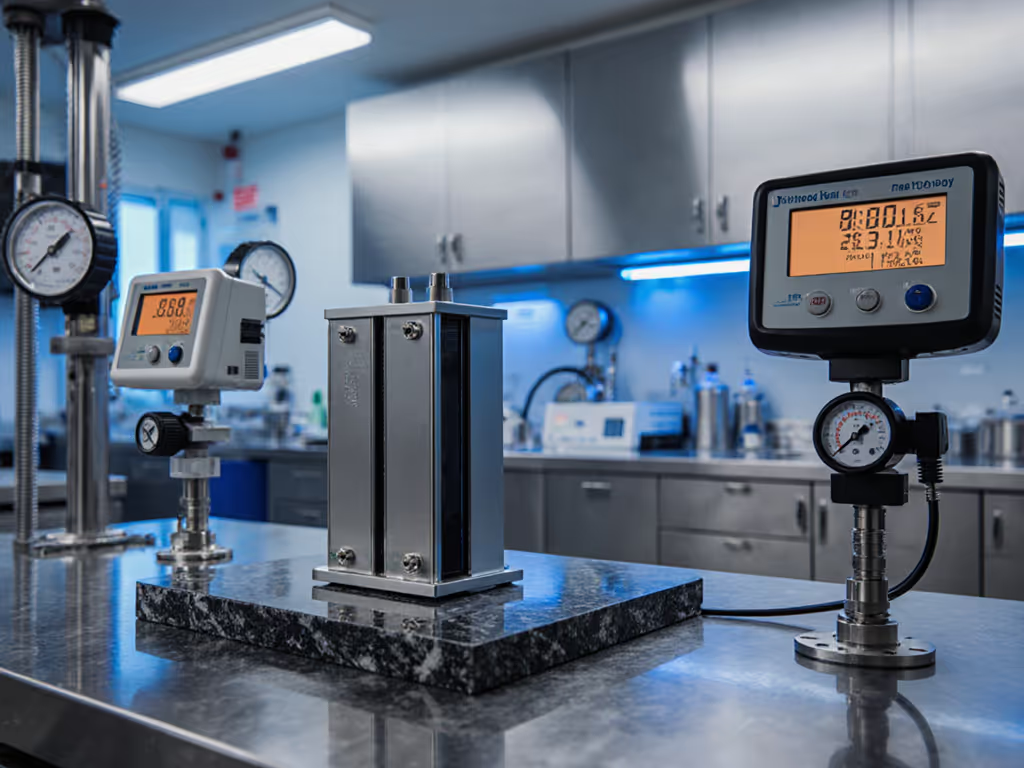
You've invested in fuel cell manufacturing or testing, and your team is producing components with tight tolerances. Then an auditor asks to see the calibration chain for the instruments used to verify hydrogen fuel cell metrology tools and your fuel cell component measurement equipment. You pull up certificates, and realize they don't quite connect back to a recognized standard. The conversation stalls. Trust evaporates. Suddenly, compliance becomes expensive.
This scenario plays out in shops across North America and Europe. Hydrogen fuel cell technology is advancing rapidly, and so are the dimensional and material demands on components like bipolar plates, membrane electrode assemblies (MEAs), and gas diffusion layers (GDLs). Yet the metrology guidance lags. Product spec sheets advertise resolution and accuracy, but they rarely address the real-world traceability chain that auditors (and your own quality system) depend on. If your team needs a refresher, review our concise overview of measurement traceability fundamentals to see what auditors expect to find.
You need measurement tools that work, that pass scrutiny, and that integrate cleanly into your workflow without slowing production.
Why Fuel Cell Metrology Matters - and Why It Fails
Hydrogen fuel cell development hinges on performance and durability targets set by the U.S. Department of Energy and industry consortia[2]. These include power density above 1 W/cm², system efficiency exceeding 60% under real-world conditions, and durability exceeding 5,000 hours for automotive applications[2]. Each of these targets is directly traceable to component dimensional tolerances and material properties.
Consider a bipolar plate thickness measurement: a variance of 0.1 mm can shift pressure drop across flow channels and degrade efficiency by 2-5%. The search results show that manufacturers are already using well-defined flow field channel dimensional variations to correlate performance[1]. But if your measurement system drifts 0.05 mm over three months and you don't catch it, you're shipping parts that appear compliant on paper while degrading actual fuel cell performance in the field.
The stakes cascade:
- Performance loss: Subtle dimensional drift compounds across multicell stacks, reducing real-world efficiency and lifespan.
- Warranty and liability: Field failures trace back to your manufacturing data, triggering recalls and erosion of customer confidence.
- Audit failure: Calibration certificates that don't form an unbroken chain to a national metrology institute (NMI) create compliance gaps that audit bodies flag as major nonconformances.
- Cost overruns: Scrap, rework, and unplanned recalibration cycles pile up when measurement tools lack documented uncertainty and environmental controls.
Many shops approach this reactively. They buy a tool, use it for a year, then discover it's out of spec during an internal audit. Others accept vendor calibration cycles without questioning whether the lab itself is ISO/IEC 17025 accredited and traced to NIST or equivalent. For a practical breakdown of scopes, proficiency testing, and records auditors want, read our ISO/IEC 17025 accreditation guide. The result: a fragmented measurement ecosystem with gaps that auditors exploit.
The difference between struggling teams and leaders? Leadership documents the chain before it's needed under audit pressure.
Building Your Metrology Foundation: A Structured Approach
Step 1: Map Your Tolerance Hierarchy
Before selecting tools, understand what you're actually trying to hold. Hydrogen fuel cell manufacturing involves multiple measurement domains:
- Bipolar plate thickness measurement: Typically ±0.05 mm to ±0.1 mm, depending on flow channel design and material (graphite or injection-molded polymer composites).
- MEA alignment verification: Positional tolerance relative to seal lands, often ±0.1 mm or tighter.
- GDL porosity measurement: Material property verification, sometimes performed off-line via imaging or mercury intrusion porosimetry.
- Sealing surface flatness: Critical for leak prevention; typical targets of 2-5 µm total indicated runout (TIR).
For each tolerance, apply the 10:1 test accuracy ratio rule: your measurement system uncertainty should be no more than 10% of the tolerance band (or 4:1 if the application is risk-controlled and documented). This means a ±0.1 mm tolerance demands a measurement system with combined uncertainty ≤ 0.01 mm under your operating conditions.
Step 2: Select Tool Classes and Environmental Controls
Three tool categories typically serve fuel cell metrology:
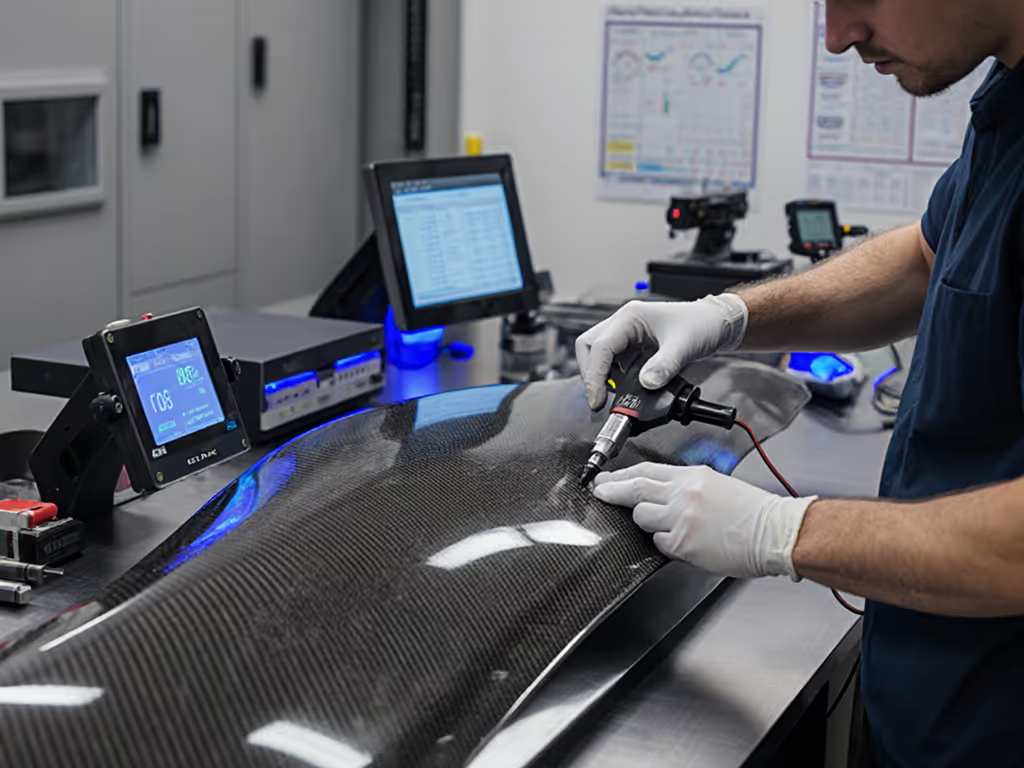
Handheld Precision Calipers and Micrometers
- Best for: Quick in-process thickness checks on bipolar plates; operator-intensive but shop-floor-ready.
- Typical accuracy: ±0.02-0.05 mm (depends on quality class and user technique).
- Critical control: Calibration interval (typically 12 months for handheld precision tools), storage in climate-controlled gage cabinet, user training on probe force and parallax error.
- Traceability anchor: Gage blocks (ISO 3650 certified to NIST) used to verify tool accuracy at least annually. For scheduling and risk-based intervals, see our guide to gauge block calibration intervals.
Optical and Laser Measurement Systems
- Best for: Automated MEA alignment verification and sealing surface flatness scanning; non-contact measurement reduces probe force errors and enables imaging data capture for audit records.
- Typical accuracy: ±0.01-0.05 mm depending on standoff distance, surface reflectivity, and environmental drift.
- Critical control: Temperature stability (±2°C ideally), vibration isolation, regular optical alignment checks, software-recorded calibration histories.
- Traceability anchor: Certified reference standards (e.g., precision grid targets or reference artifacts) measured alongside production parts.
Coordinate Measuring Machines (CMMs) and Fixed Gage Fixtures
- Best for: Final dimensional audits, complex multifeature verification, and establishing the gold standard for your production tolerance stack.
- Typical accuracy: ±0.01-0.03 mm over useful working volume (depends on machine class per ISO 10360).
- Critical control: Controlled environment (ISO 16 air class or better, temperature ±0.5°C fluctuation per 8 hours), vibration isolation, regular parametric tests, documented probing strategies.
- Traceability anchor: Master reference parts (certified by an ISO/IEC 17025 lab) and traceable calibration artifacts (e.g., gage ball sets) measured on an annual calibration cycle.
Step 3: Document Your Environmental Limits
A thermometer calibration certificate hanging in your CMM room means nothing if temperature swings 8°C during a shift. I learned this lesson when an auditor asked for the thermometer calibration behind our dimensional logs. We had it, but we also had to produce the environment control spec: what temperatures and humidity bands we actually maintained during measurement, and how we verified them. The tone shifted. From that day, I documented measurement environments as carefully as the instruments themselves.
For hydrogen fuel cell metrology:
- CMM and optical systems: Maintain ±1 to ±2°C around your reference temperature (typically 20°C per ISO 1), and log hourly. Use data-logging thermometers certified against NIST.
- Shop-floor handheld tools: Store in climate cabinets (ideally ±3°C, ±10% RH). If measuring in uncontrolled areas (near ovens, coolant sumps), note the measurement time and post-adjust to a reference temperature.
- Vibration isolation: For optical and CMM systems, isolate from machine tool vibration. A simple test: place a level on the measurement surface and watch for drift over 5 minutes. If the bubble moves, you need isolation.
Step 4: Build an Uncertainty Budget
This is where discipline meets audit readiness. For each measurement task, estimate combined uncertainty from:
- Instrument repeatability: From calibration data and your own GR&R testing (Gage Repeatability and Reproducibility).
- Environmental drift: Based on your logged temperature and humidity during the measurement window.
- Operator technique: Probe force, alignment, parallax (estimated from user training data and MSA studies).
- Surface finish and fixturing effects: Influenced by the part itself and how you're holding it.
Sum these components (root-sum-square or worst-case, depending on risk) to get total measurement uncertainty. Document this in a one-page form tied to each measurement procedure. If you need a template and step-by-step math, use our measurement uncertainty budget guide. When an auditor asks, "How do you know that ±0.05 mm reading is fit for your tolerance?" you show the budget and prove the chain. Trust rebuilds instantly.
Step 5: Establish Calibration and Service Roadmaps
Tools don't stay accurate by hope. Build a documented schedule:
- Handheld calipers and micrometers: Annual calibration to gage block reference standards. Before critical production runs, users perform a 5-point spot check against in-house reference artifacts.
- Optical systems: Semi-annual parametric tests (geometric accuracy, alignment, focus); annual recalibration at an ISO/IEC 17025 lab.
- CMMs and fixtures: Annual dimensional audit per ISO 10360; parametric testing after any service or environmental upset.
- Reference standards: Annual certification; retire gage blocks and master parts after 10–15 years or if they show visible wear.
- Environment monitors: Monthly accuracy verification; replace batteries and sensors per manufacturer guidance.
Capture all dates and certificate numbers in your QMS. Link them to the production runs they supported. Show your chain of traceability.
Practical Implementation: A Phased Rollout
Phase 1: Audit your current state (Week 1–2)
- Inventory all measurement tools, locate calibration certificates, identify gaps.
- Cross-check certificates against the issuing lab's ISO/IEC 17025 scope.
- Note which measurement points lack documented procedures and environmental controls.
- Identify highest-risk dimensions (those closest to tolerance limits).
Phase 2: Strengthen traceability (Week 3–6)
- Acquire certified reference standards (gage blocks, reference artifacts) for your most critical measurements.
- Source calibration services from ISO/IEC 17025 accredited labs and establish standing annual calibration contracts.
- Document environmental specs for each measurement location; install data-logging thermometers.
- Create a one-page uncertainty budget for each measurement procedure.
Phase 3: Train and validate (Week 7–10)
- Conduct GR&R studies (Gage Repeatability and Reproducibility) on key measurement tasks; involve your shop floor operators.
- Run parallel measurements on production parts using your tool and a reference standard (e.g., CMM), and compare results to verify agreement within budget.
- Train operators on technique, calibration checks, and the importance of environmental controls.
- Generate a team checklist for pre-shift measurement validation.
Phase 4: Document and audit (Week 11–12)
- Assemble a measurement system file: all procedures, certificates, environmental specs, uncertainty budgets, training records, GR&R reports.
- Simulate an audit: have a peer or external consultant walk through the measurement procedure, certificates, and documentation. Are they satisfied?
- Refine any gaps; update procedures.
Real-World Hydrogen Fuel Cell Metrology Checklist
Use this checklist to validate your readiness before an audit or major production decision:
Instrument Selection & Documentation
- ☐ Each measurement tool has a documented procedure (part, feature, tolerance, method, environment, acceptance criteria).
- ☐ Calibration certificates are on file and traceable to NIST or equivalent NMI.
- ☐ Certificates show date, accuracy, uncertainty, and issuing lab's accreditation scope.
- ☐ Tools are inspected for damage or drift at least monthly; issues logged.
Environmental Controls
- ☐ CMM/optical systems are in temperature-controlled rooms (logs available).
- ☐ Shop-floor handheld tools are stored in climate cabinets when not in use.
- ☐ Data-logging thermometers and hygrometers are in place; data reviewed weekly.
- ☐ Vibration isolation for sensitive systems is documented and tested.
Traceability Chain
- ☐ Reference standards (gage blocks, master parts) are certified and tied to NIST.
- ☐ Measurement procedures document how reference standards are used to verify tool accuracy.
- ☐ Production measurement records link to the calibration certificates valid at the time of measurement.
- ☐ Any out-of-spec measurement triggers a product disposition and traceability investigation.
Measurement System Analysis (MSA)
- ☐ GR&R study completed for each critical measurement; Gage R&R ≤ 10% of tolerance (or risk-controlled if higher).
- ☐ Uncertainty budgets are documented for high-risk dimensions (uncertainty ≤ 10% of tolerance per 10:1 rule).
- ☐ Operator training records are on file; retraining triggered if GR&R drifts or after tool maintenance.
Calibration Management
- ☐ Annual calibration contracts in place with ISO/IEC 17025 labs.
- ☐ Calibration intervals are justified in your quality plan (e.g., 12 months for precision handheld tools, 6 months for critical optical systems).
- ☐ Out-of-calibration tools are flagged, removed from service, and reported via CAPA if they were used on product.
Audit Readiness
- ☐ Measurement system documentation is organized and accessible (digital or physical).
- ☐ Team can walk an auditor through a measurement from procedure to certificate to uncertainty justification in under 10 minutes.
- ☐ Environmental logs and GR&R reports are current (within 12 months for annual reviews).
Looking Forward: Hydrogen Fuel Cell Quality in a Regulated Market
Hydrogen fuel cell technology is transitioning from R&D labs to regulated production environments (automotive, stationary power, aerospace). As it does, metrology will become a visible compliance point for original equipment manufacturers (OEMs) and Tier 1 suppliers. The teams that establish traceable, audit-ready measurement systems now will avoid costly compliance surprises later.
Your measurement strategy is not a checkbox. It's a competitive capability. Teams with disciplined metrology achieve tighter Cpk scores, faster audit cycles, and stronger customer relationships. They also train faster, reduce scrap, and build team confidence because their tools earn trust on the shop floor, not just on paper.
The auditor's question will come. When it does, show your chain of traceability. You'll be ready.
Your Next Steps
This week:
- Audit your current measurement tools and calibration certificates. Identify which ones lack clear traceability to NIST or an equivalent NMI.
- List your critical hydrogen fuel cell metrology tools and fuel cell component measurement equipment (e.g., bipolar plate calipers, flatness checkers, MEA gages).
- For each tool, confirm its calibration interval and the issuing lab's ISO/IEC 17025 accreditation scope. If the lab isn't accredited or the scope is vague, flag it for replacement.
Next 2–3 weeks: 4. Establish environmental controls: install data-logging thermometers in your CMM room and gage cabinet, and set target temperature bands (±1-2°C for critical systems). 5. Acquire or certify reference standards appropriate for your tolerances. Start with gage blocks for handheld tool validation. 6. Engage an ISO/IEC 17025 calibration lab to schedule your first reconciliation audit and establish a standing annual contract.
Next month: 7. Conduct a GR&R study on your three highest-risk measurements (e.g., bipolar plate thickness measurement, MEA alignment verification, sealing surface flatness). Use the results to validate that your tool accuracy meets the 10:1 rule. 8. Document one complete measurement procedure with uncertainty budget and environmental specs. Use it as a template for the rest. 9. Train your team on the updated procedures and the importance of calibration and environmental control. Make it clear: measurement is a capability to be engineered, not a tool to buy on impulse.
You've already chosen to invest in hydrogen fuel cell manufacturing or testing. Your metrology foundation is the next logical step, one that protects your investment, passes audits, and builds the trust your customers and your team deserve.
Related Articles