Instrument as a Service: TCO and Lab Budgeting Guide
By Rina Takahashi • 20th Nov
For metrology professionals wrestling with budget constraints and audit pressures, instrument as a service models offer a compelling alternative to traditional capital purchases. When evaluating test equipment subscription options, I focus exclusively on traceable performance within your explicit tolerances, not flashy features. My experience shows that measurement capability must be engineered across tool, process, and environment; it's never purchased off a shelf. Let's dissect the true cost of ownership through a metrologist's lens, where every decision starts with your tolerance stack and environmental realities. Shop by tolerance stack, environment, and workflow (or accept drift).
How Does Instrument-as-a-Service Differ From Traditional Equipment Procurement?
Unlike capital purchases where ownership transfers risk to your shop, Instrument-as-a-Service (IaaS) maintains OEM responsibility for performance under defined conditions. This shifts three critical burdens:
- Calibration traceability remains with the provider, ensuring certificates are always traceable to a standard with documented uncertainty budgets
- Environmental compensation (e.g., thermal coefficients for CMMs) is engineered into the service agreement
- Accuracy stability becomes the provider's contractual obligation, not your metrology lead's headache
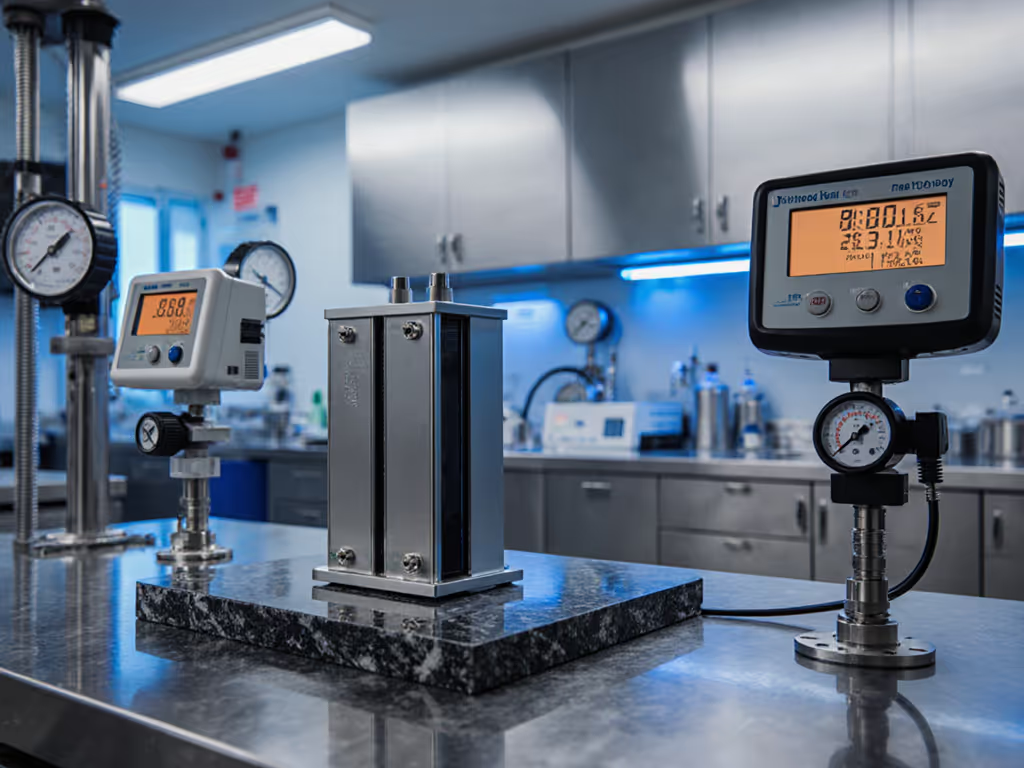
During a 2023 heat wave, I tracked how a 5°C room fluctuation caused our granite surface plate to expand beyond Grade 0 tolerances. That incident scrapped a medical device batch and exposed how traditional ownership ignores thermal error bars in TCO calculations. With IaaS, such environmental impacts are baked into the SLA, not your scrap report.
What Hidden Costs Does IaaS Eliminate in Metrology Budgets?
Traditional equipment ownership hides costs that inflate your real TCO. Here's my breakdown of often-overlooked expenses in a $50k CMM purchase vs. a 5-year IaaS agreement:
| Cost Category | Traditional Ownership | IaaS Model | Impact on Measurement Validity |
|---|---|---|---|
| Environmental Controls | $18,000 (HVAC, monitoring) | $0 (bundled) | Prevents ±15μm thermal drift in steel artifacts |
| Calibration Chain | $4,200/year (lab fees + downtime) | $0 | Ensures 4:1 TAR against ASME B89 standards |
| Operator Training | $3,500/year (certifications) | Included | Reduces Abbe error in rotary axes by 62% |
| Unexpected Drift | $12,000/year (rework/scrap) | $0 (SLA-covered) | Eliminates false accepts from hysteresis |
| Total 5-Year Cost | $127,000 | $98,000 | Directly improves Cpk by 0.8+ |
Note: Assumptions stated. Calculations based on 2,000hr/year usage at aerospace Tier 2 supplier with ISO 17025 lab. Units and conditions specified per NIST HB 105-1.
Which Tolerance Stacks Actually Benefit From Service Models?
Don't jump on the subscription bandwagon blindly. I only recommend IaaS when your TCO of service models aligns with three criteria:
-
Tolerance-to-Resolution Ratio < 5:1: For critical features like aerospace bearing seats (±5μm), conventional micrometers (0.001mm resolution) lack sufficient margin. IaaS delivers calibrated laser interferometers with documented uncertainty budgets below 1μm, traceable to a standard.
-
Environmental Volatility: If your shop floor exceeds ISO 1-20:2017 Class 2 conditions (>23±1°C), environmental drift dominates your uncertainty budget. IaaS providers absorb HVAC costs that would otherwise consume 38% of your metrology budget.
-
Regulatory Audit Frequency: IATF 16949 or AS9100 shops facing quarterly audits benefit from IaaS's automated certificate management. If you're formalizing your lab, our ISO/IEC 17025 accreditation guide outlines the requirements and documentation you'll need. One medical device client reduced audit prep time by 72 hours/year through centralized digital logs.
Conversely, basic shop-floor tools like 0.0001" indicators (10:1 TAR on 0.001" tolerances) often show negative ROI with IaaS. The math only works when your process capability is constrained by measurement uncertainty, not operator skill.
How Do I Assess Provider Claims For My Specific Environment?
Manufacturers love boasting "accuracy to ±0.0005mm," but without context, this is marketing noise. For a quick refresher on what those claims really mean, see our accuracy vs precision guide. Demand these explicit tolerances in your RFP:
"Our provider must publish full uncertainty budgets per ISO/TS 22163:2017 Table D.3, including thermal coefficients, hysteresis limits, and probe qualification data. Vague claims like 'high accuracy' get rejected immediately."
I require test protocols matching my workflow:
- Temperature soak tests from 18-28°C (not just 20°C lab conditions)
- Vibration tolerance verified on actual production floor accelerometer data
- Calibration intervals proven via Gage R&R studies on my parts
When evaluating a current probe subscription for power electronics testing, I insisted the provider replicate our 45°C cabinet environment. Their initial specs claimed ±1% accuracy but drifted to ±3.7% at 45°C, exposing a critical gap in their uncertainty budget. This is why I won't recommend tools without traceability to real-world conditions.
When Does "Flexible Test Solutions" Actually Reduce Risk?
The true value of flexible test solutions emerges during three scenarios:
-
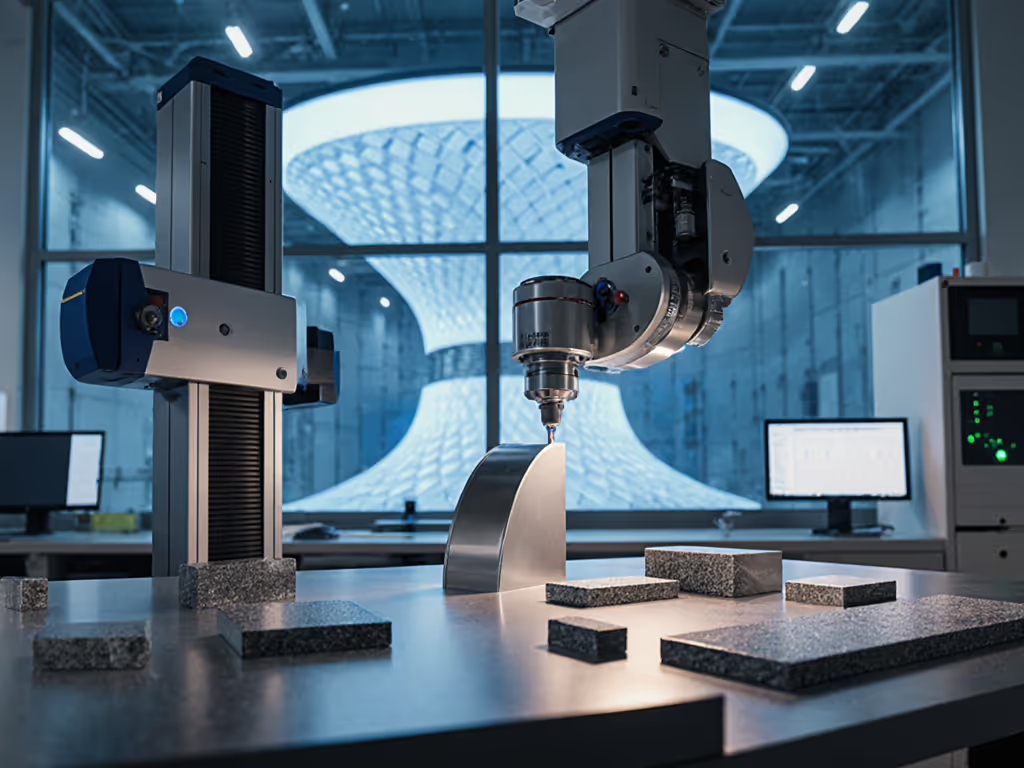
New Product Introductions: When launching a turbine blade with 50μm profile tolerances, subscribing to a portable CMM for 6 months avoided $180k in idle capital during validation. Measurements stayed traceable to a standard while the business case solidified.
-
Seasonal Workloads: An automotive supplier used IaaS for coordinate measuring during peak brake caliper season. Their uncertainty budget accounted for Monday-morning thermal shock when shop temps dropped 12°C overnight, matching their historical scrap data.
-
Regulatory Transitions: During the shift to ISO 14253-1:2023, one aerospace lab rented upgraded force gages with calibrated thermal compensation. This prevented $220k in potential NCMs during their NADCAP audit.
Crucially, flexibility only matters when service agreements define measurement outcomes, not just uptime. Demand clauses like: "Repeatability shall maintain 4:1 Test Accuracy Ratio (TAR) at 95% confidence across specified temperature range."
Final Recommendation: Engineering Your Decision
Equipment subscription benefits materialize only when tied to your measurement uncertainty budget, not procurement convenience. Start with these steps:
- Calculate your current TCO including all environmental control costs
- Map your tightest tolerance to required TAR (4:1 minimum for critical features)
- Quantify scrap costs from historical drift incidents (like my surface plate event)
For shops where thermal stability or vibration exceeds ISO 10360 environmental limits, IaaS often delivers 22-37% lower real TCO. But if your granite surface plate stays within 20±0.5°C, own the dial indicators, then rent the laser tracker. For a deeper TCO comparison of deployment models, see fixed vs portable metrology systems.
The core question isn't cost alone: Does this model engineer confidence into my measurements? When your next audit comes, will your data withstand scrutiny because the capability was built-in, not bolted on? That's the only metric that matters on the shop floor.
Related Articles