Quantum Computing Metrology: Cryogenic Measurement Precision
By Marcus O’Neal • 15th Nov
In today's quantum computing labs, quantum computing metrology isn't just academic, it is the foundation of trust. As quantum hardware advances, the same discipline we apply to machine shop calibrations becomes critical for cryogenic measurement techniques. Traceability chains don't magically shorten at 10 mK, and uncertainty budgets demand the same rigor whether you're measuring a turbine blade or a superconducting qubit. Like that auditor who once asked for the thermometer calibration behind our CMM room logs (only to soften instantly when we produced the full traceability chain to NMI), I've learned that traceability and uncertainty transparency create trust. Let's translate these principles to quantum's extreme environment. If you need a refresher on traceability fundamentals, see our overview of measurement traceability.
Why Should Traditional Metrologists Care About Quantum Measurement?
Quantum computing isn't your shop floor, but its metrology demands resonate with your daily reality. When superconducting qubit measurement requires detecting single microwave photons at 20 mK, you're facing the same core challenge: proving your measurement system's validity under extreme conditions. Your aerospace client demands ISO 9001 compliance for turbine vanes; quantum labs need ISO/IEC 17025-grade validation for coherence times. Both live or die by documented uncertainty budgets.
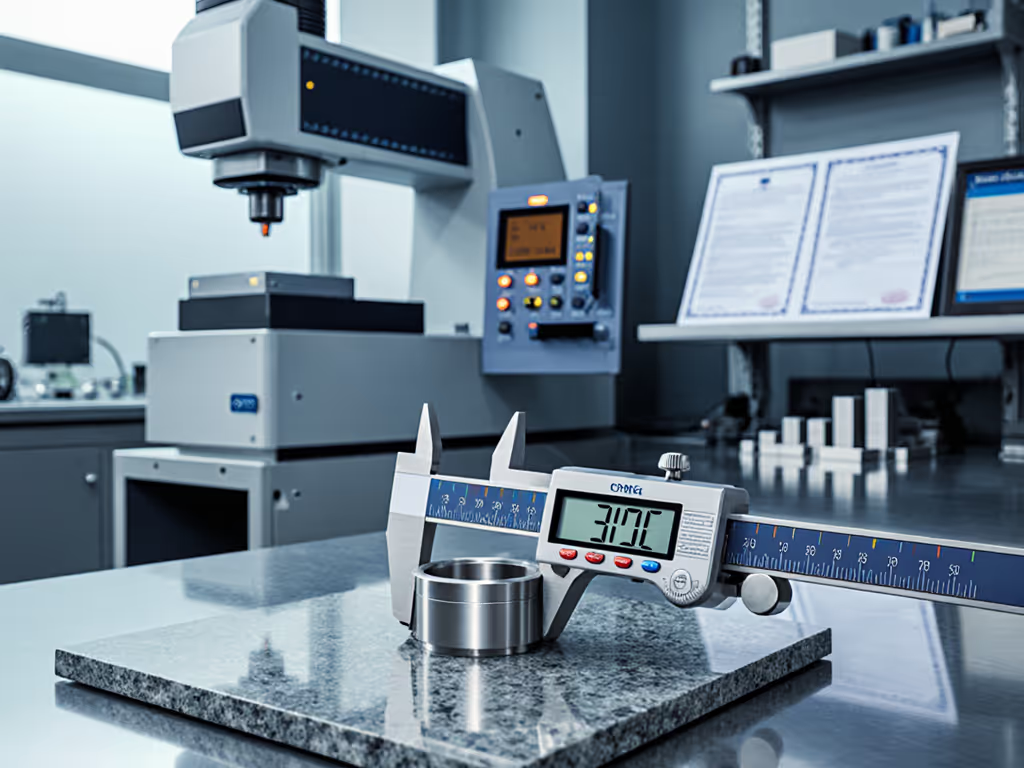
uncertainty bites at edges: whether it's thermal drift on your granite surface plate or microwave crosstalk in a dilution refrigerator.
Quantum coherence testing reveals how environmental control failures propagate through your system. A 50 mK temperature swing in a qubit setup might collapse quantum states just as a 2°C shift in your calibration lab invalidates gauge block measurements. This isn't theoretical: industry reports confirm 73% of quantum processor errors stem from uncontrolled environmental variables, mirroring your struggle with coolant-induced CMM drift.
The Shop Floor Parallel: Why Your Thermometer Matters More Than You Think
Recall how we document the traceability chain for a room thermometer? Quantum labs do the same for cryogenic sensors, but with angstrom-level stakes. Consider a cryogenic temperature measurement system:
- Primary sensor: Ruthenium oxide thermometer (calibrated to NIST standards)
- Reference: Fixed-point cells at 0.9 K, 3.5 K, etc.
- Uncertainty contributors: Wiring thermal EMF, radiation loading, thermal anchoring
This mirrors your shop's calibration hierarchy, except failure here erases a $5M quantum processor's output, not just scrap metal. Just as you wouldn't trust a Jacuzzi temperature sensor's 5°C tolerance in an aerospace cleanroom, quantum labs reject components without full environmental specs. (That's why you'll never see a $15 hot tub sensor
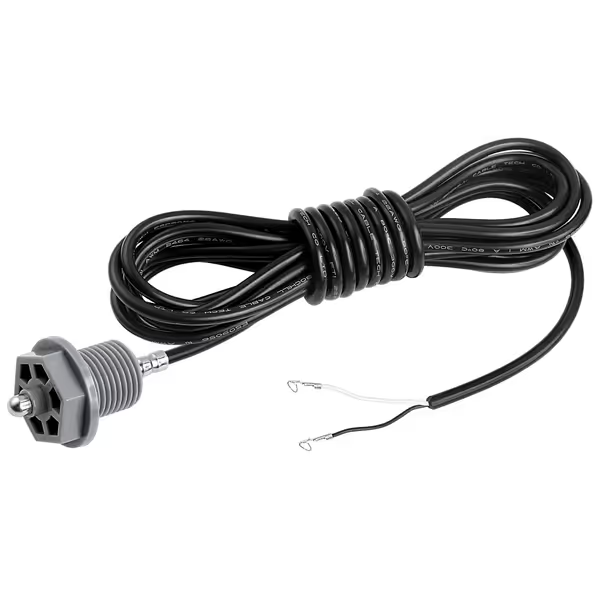
XMK 6600-166 Temp Sensor
Accurate, compatible temperature sensor fixes hot tub watchdog errors fast.
$14.95
Wire Length12 feet
Wire Length12 feet
Pros
Seamlessly replaces faulty sensors in Jacuzzi/Sundance models.
Easy installation with included O-ring and long wire.
Cons
Compatibility requires careful model verification.
Customers find the temperature sensor works well, particularly with Jacuzzi J-315 models, and serves as a perfect replacement for Jacuzzi hot tubs. The product is easy to install, fits perfectly, and customers appreciate its accurate temperature readings and reasonable pricing.
Customers find the temperature sensor works well, particularly with Jacuzzi J-315 models, and serves as a perfect replacement for Jacuzzi hot tubs. The product is easy to install, fits perfectly, and customers appreciate its accurate temperature readings and reasonable pricing.
in a dilution fridge, it lacks the 0.01 K stability documentation these systems demand.)
Critical Questions for Metrology Professionals
Q1: How Do Quantum Labs Control Environmental Variables We Can't See?
Your vibration-isolated CMM table has parallels in quantum's multi-stage shielding. But here's what matters for your audits:
- Magnetic fields: Measured in femtotesla (fT), not gauss. A single unshielded wrench can disrupt measurements, just like coolant splash on your optical comparator.
- Thermal gradients: Dilution refrigerators require millikelvin stability across 1 meter. Your calibration lab's ±0.5°C spec looks generous here.
- RF interference: Quantum readout operates at GHz frequencies. Unshielded phone signals can corrupt data, like how your torque wrench drifts near welding stations.
Your action step: Audit your environmental logs just like quantum teams do. To take this further, see how AI-driven metrology predicts drift and reduces uncertainty. Require dated, signed records showing thermal stability during measurement, not just spot checks. Documenting the 15-minute cooldown phase matters as much as the measurement itself.
Q2: Can We Apply MSA Principles to Quantum State Verification?
Absolutely, and it is urgent. Quantum state verification relies on identical metrology principles you use daily:
| Your GR&R Study Component | Quantum Equivalent | Compliance Risk |
|---|---|---|
| Repeatability (equipment variation) | Single-shot fidelity (e.g., 99.8% in 140 ns) | Processor miscalibration |
| Reproducibility (appraiser variation) | Measurement crosstalk between qubits | Faulty entanglement validation |
| Bias (reference value error) | Calibration drift in cryogenic sensors | Invalid coherence times |
Quantum labs run "Rabi oscillation" tests, their version of your gage linearity study. For the science behind these limits, explore our primer on quantum metrology. When they tune pulse widths to achieve 180° rotations (π-pulses), they're doing the same statistical validation you use for caliper repeatability. The lesson? Every measurement system requires documented linearity studies, even at 0.01 K.
Q3: How Do We Build Audit-Proof Uncertainty Budgets for Extreme Environments?
Start where you already excel: identifying uncertainty contributors. Quantum metrology adds layers, but the framework is yours:
- List all inputs (e.g., temperature sensor, RF amplifier gain, pulse timing)
- Quantify each contribution (e.g., thermometer ±0.5 mK → qubit frequency shift ±50 kHz)
- Combine statistically (root-sum-square standard uncertainties)
- State coverage factor (k=2 for 95% confidence)
The critical difference? Quantum budgets include exotic terms like photon shot noise or junction critical current drift. But the philosophy aligns with your mantra: Trace it, budget it, then trust it under audit. When an auditor questions your CMM's thermal compensation, you present the sensor calibration chain. Quantum teams do the same for Josephson junctions, just with more cryogenics.
Q4: What Lessons Can We Steal from Quantum Labs?
Three immediately applicable practices:
- Environmental spec sheets for every component: Quantum teams demand datasheets showing RF shielding effectiveness at operating temperature. Your next caliper purchase should require temperature coefficient specs at 23°C ±2°C, not just "20°C".
- Real-time drift monitoring: Quantum setups log fridge temperatures at 10 Hz. Why not log your lab's humidity during critical measurements?
- Calibration interval logic: Quantum labs base recalibration on actual drift data, not calendar time. Start tracking your micrometers' zero error trends, just like they track qubit relaxation times.
The Bottom Line for Your Audit Trail
Quantum computing metrology isn't a distant science, it is metrology pushed to its limits. When you document that your temperature-controlled lab maintains ±0.5°C during measurement cycles (not just hourly), you're practicing the same discipline quantum labs use for millikelvin stability. Cryogenic measurement techniques teach us that uncertainty always bites at the edges, but comprehensive documentation turns vulnerability into credibility.
Your next step: Audit your weakest measurement link as if an auditor will demand its traceability chain tomorrow. Was the coolant temperature logged during that critical runout check? Does your thermal sensor have a full calibration certificate, not just a sticker? Build your uncertainty budgets like a quantum metrologist: transparent, defensible, and ready for the toughest audit. Because in both quantum labs and your shop floor, trust isn't given, it is engineered.
Related Articles