
Sustainable Metrology: Reduce Waste With Precision Measurement
By Marcus O’Neal • 22nd Jan
As manufacturing professionals battling scrap rates and audit anxiety, you've heard the buzzwords ("sustainability", "green manufacturing"). But let's cut through the noise. Sustainable metrology isn't about carbon credits or PR campaigns. It's the practical application of precision for sustainability: using traceable measurements to slash waste, optimize resources, and build audit-proof confidence. When your measurements stand up to scrutiny, you stop guessing whether parts meet specs, and start trusting your data to protect both your bottom line and the planet. I've seen teams transform scrap bins into profit centers by treating measurement not as a cost, but as a waste reduction engine.
Why Sustainable Metrology Isn't Just Another ESG Trend
How does precision measurement actually reduce waste?
Waste isn't just material; it's time spent reworking out-of-tolerance parts, energy burned by inefficient processes, and credibility lost during audits. Consider this: a medical device shop machining titanium hip implants. If their calipers lack traceable calibration, a 0.002" error might pass a non-conforming part. One rejected batch costs $18k in scrap, labor, and delayed shipments. Now scale that across 100 parts/week. Waste reduction through measurement starts with understanding your true uncertainty. For a step-by-step approach, use our measurement uncertainty budget guide.
I once audited a job shop where poor bore gauge traceability caused a 7% scrap rate on hydraulic fittings. After mapping their measurement chain (probes to NIST standards, with documented thermal drift), they cut waste by 83% in 6 months. Precision became their profit lever.
Doesn't energy efficiency measurement just add compliance overhead?
Absolutely not, if you engineer it right. Energy efficiency measurement isn't about logging kilowatt-hours for reports. It's actionable intelligence for your shop floor. Monitor spindle motor power draw during CNC milling with calibrated sensors, and you'll spot tools dulling before surface finish degrades. One automotive supplier used this to:
- Reduce coolant consumption by 22% (by optimizing feed rates)
- Extend tool life by 15 shifts
- Cut energy per part by 9%
This isn't theoretical. It's resource optimization metrics that pay for your metrology lab in under a year. Think of it as your hidden profit center, where every watt saved and chip recycled flows directly to your P&L.

The Circular Economy Connection Most Shops Miss
How does metrology enable the circular economy?
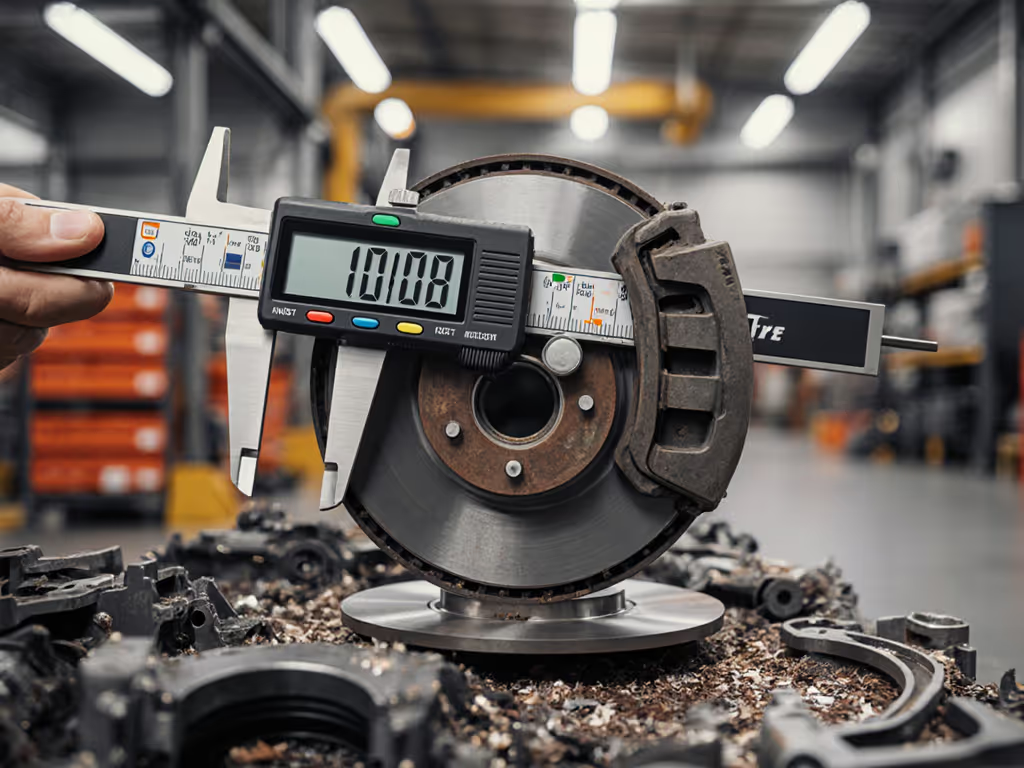
"Circular economy metrology" sounds academic, but it's shop-floor pragmatism. When you remanufacture aircraft turbine blades, precise measurement of residual coating thickness and geometric wear determines if a part can be refurbished, or must be scrapped. Without traceable roundness measurements and thermal expansion budgets, you risk:
- Over-grinding (wasting $2k+ in nickel superalloy)
- Under-grinding (causing premature engine failure)
I've seen teams leverage circular economy metrology to:
- Achieve 95% reuse rates on high-value components
- Document material flows for auditors (proving compliance with EU Circular Economy Action Plan)
- Turn scrap metal into billable material credits
The key? Treat every measurement as a data point in your resource chain. Traceability isn't just for calibrations, it's for proving your material's lifecycle.
Why do environmental conditions ruin our sustainability gains?
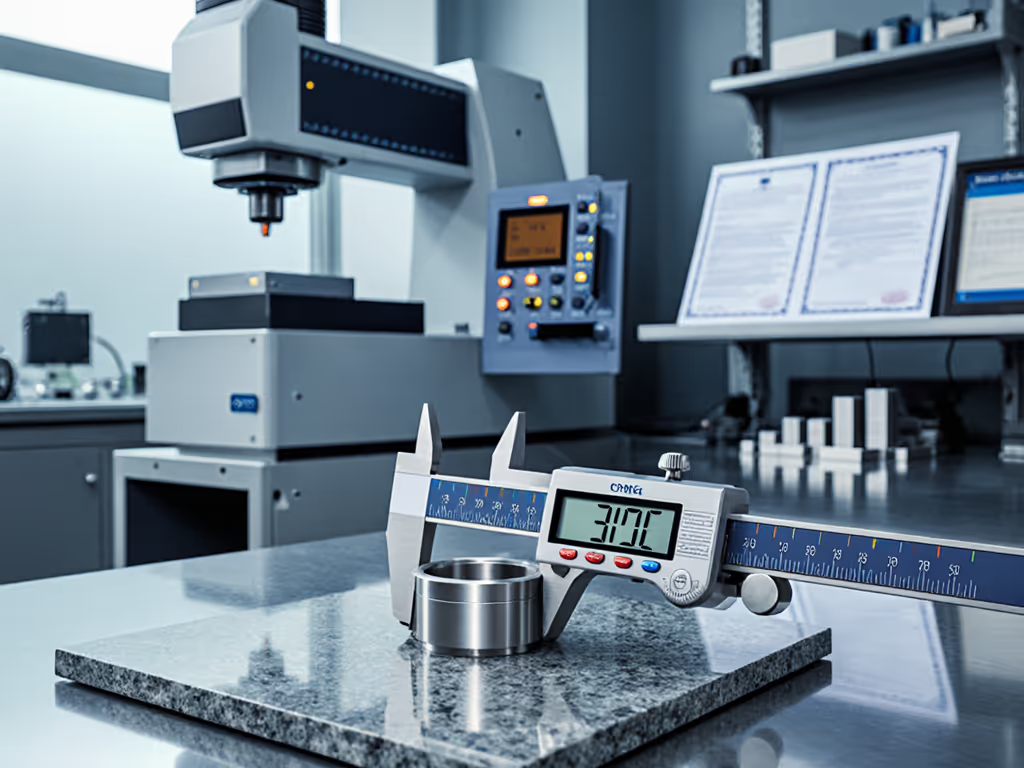
Here's where uncertainty bites at edges. You might boast a CMM with 1.5μm accuracy until shop temperature swings by 5°C. Thermal expansion alone can introduce 6μm error in aluminum parts. I recall an auditor asking for the thermometer calibration behind our CMM room logs. When we produced the full chain (thermometer to reference standard, reference to NMI, with combined uncertainty), we didn't just pass the audit. We changed the conversation.
Environmental control isn't optional for precision for sustainability. It's the bedrock of credible data. Track these three in every critical area:
| Factor | Audit Risk If Uncontrolled | Mitigation |
|---|---|---|
| Temperature | 73% of dimensional errors | NIST-traceable sensors + 15-min interval logs |
| Humidity | Corrosion, electronic drift | 45-55% RH range; log with hygrometer calibration certs |
| Vibration | False form errors | ISO 10137 compliance; isolate CMMs/granite tables |
Skip this, and your "sustainable" process is just wishful thinking. Document it, and you turn measurements into trust.
Your First Steps Toward Audit-Ready Sustainability
How do we start without slowing production?
Forget grand overhauls. Sustainable metrology thrives on small, disciplined wins. Begin here:
- Map one waste stream where measurement errors cause scrap (e.g., out-of-round bearings)
- Build its uncertainty budget: Include temperature drift, gage repeatability, and calibration stability
- Control the critical environment: Even a $200 calibrated thermometer beats guessing
- Trace the chain: Document every step from tool to NMI standard
- Quantify the ROI: Track scrap reduction monthly ($/part saved)
This isn't extra work, it's replacing reactive firefighting. When you trace measurements end-to-end, you eliminate surprise rework. One job shop implemented this for their lathe setups. Result? 31% fewer first-article rejections and ISO 9001 audit time cut by half.
What's the biggest mistake shops make?
Ignoring documented uncertainty. You can't manage what you don't measure, and you can't prove sustainability without proof. An auditor once asked me, "How do you know your energy savings are real?" Not "Show me your report," but "Show me your watt-meter calibration chain." That's the moment traceability became your armor. If you outsource calibration to reduce risk and cycle time, see our calibration services value guide.
The Bottom Line: Precision Builds Trust
Sustainable metrology isn't about chasing ESG scores, it's about using measurement as your waste radar. When you reduce scrap through tighter uncertainty control, you're not just saving material. You're conserving energy, reducing landfill burden, and building data that auditors trust. Remember: trace it, budget it, then trust it under audit.
Your next move? Pick one process where scrap or rework hurts most. Apply these steps. The savings, and the audit confidence, will follow. Because in manufacturing, sustainability starts not with promises, but with precision.
Want to dive deeper? Explore NIST's Handbook 150 (ILAC G19) for environmental control protocols, or the EURAMET cg-21 guide on uncertainty for resource efficiency. The tools exist, you just need to trace them.
Related Articles