
Traceable Solid-State Metrology vs Li-Ion Measurement Standards
By Marcus O’Neal • 17th Jan

As solid-state battery production scales, metrology teams face a critical question: How do we adapt proven lithium-ion measurement standards when traceability chains fracture across new materials and architectures? This isn't just about swapping instruments; it is about rebuilding uncertainty budgets for interfaces and environments where thermal stability testing, dendrite detection methods, and solid electrolyte interface verification operate under fundamentally different physics. I recall a recent audit where the discussion shifted instantly when we presented the full chain of traceability for solid-state cell impedance data. Trace it, budget it, then trust it under audit. Let's dissect where traditional metrology frameworks hold, and where they fail, using an FAQ framework grounded in production reality.
Why Can't We Apply Li-Ion Electrode Thickness Measurement Standards to Solid-State Cells?
The core issue isn't resolution, it is context. In slurry-cast Li-ion electrodes, 1-2 µm thickness tolerance suffices because porosity and binder distribution self-compensate during formation. But solid-state electrolytes (e.g., sulfides, oxides) demand sub-500 nm uniformity across square meters. Why? Because a single protrusion exceeding 300 nm can puncture the anode-electrolyte interface, creating dendrite nucleation sites.
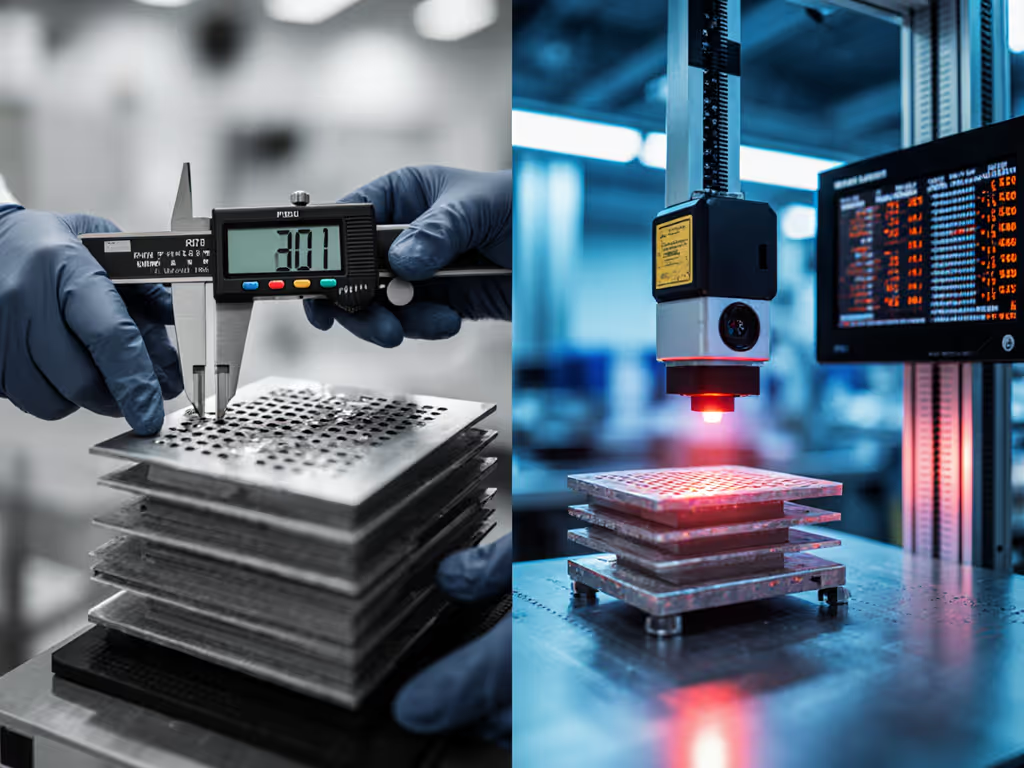
Traditional beta-ray or X-ray gauges (calibrated against NIST-traceable shims) fail here. If you're reassessing sensor principles, compare the tradeoffs in our non-contact metrology guide. They measure average density, not localized defects. For solid-state battery metrology, you need:
- Spatially resolved LIBS (Laser-Induced Breakdown Spectroscopy) for elemental depth profiling (e.g., tracking Li-PON layer transitions)
- Multi-beam optical interferometry for nanometer surface topography mapping
- Strict environmental control (±0.5°C, <10% RH) during measurement; variations of 2°C cause thermal expansion shifts exceeding 200 nm in ceramic electrolytes
Critical insight: Your uncertainty budget must now include material-specific coefficients of thermal expansion (CTE). For Li₆PS₅Cl, it is 18 ppm/°C versus 12 ppm/°C for aluminum current collectors. Ignoring this? Uncertainty bites at edges when cells swell during cycling.
How Do We Verify Solid Electrolyte Interfaces When Traditional XPS Fails?
X-ray Photoelectron Spectroscopy (XPS) works for Li-ion SEI layers because they are organic, low-density films. But solid electrolytes form inorganic interfaces (e.g., Li₃N on Li metal) with near-identical binding energies. XPS lacks the sensitivity to distinguish them at <5 nm thicknesses. Instead, you must:
- Use dual-beam FIB/SEM with cryogenic transfer to preserve reactive interfaces
- Cross-correlate with electrochemical impedance spectroscopy (EIS) where interfacial resistance appears as a distinct semicircle in Nyquist plots
- Document traceability chains for every EIS parameter (e.g., reference electrode calibration to NMI-issued Ag/AgCl standards)

During a recent audit, we survived a 45 minute deep dive on SEI verification because our uncertainty budget explicitly called out:
- Instrument resolution limits (±1.2 nm for TEM)
- Environmental vibration control (<0.5 µm/s²)
- Operator-induced hysteresis (±0.3 mΩ in EIS measurements)
The auditor's relief was palpable when he saw the full chain, not just "XPS done." This is why traceability creates trust: it exposes where uncertainty hides.
What's Different About Dendrite Detection Methods in Solid-State Systems?
Li-ion dendrite detection relies on indirect metrics like sudden voltage drops or impedance spikes. But solid-state cells fail catastrophically at dendrite penetration; there is no gradual warning. Real-time metrology requires:
| Metric | Li-Ion Approach | Solid-State Requirement |
|---|---|---|
| Spatial Resolution | 10 µm (optical microscopy) | <500 nm (in-situ TEM) |
| Temporal Resolution | Seconds (voltage logging) | Microseconds (ultrafast XRD) |
| Traceability Anchor | NIST voltage standards | Quantum Hall resistance standards |
Thermal stability testing becomes critical here. For a deeper look at quantum references like the Hall effect used for resistance, read our quantum metrology primer. A dendrite might only propagate above 60°C, so your metrology system must correlate nanoindentation data with simultaneous local temperature mapping. Miss this linkage? You'll miss the failure mode entirely.
Why Does Thermal Stability Testing Demand New Uncertainty Budgets?
In Li-ion cells, thermal runaway onset is measured at the cell level (e.g., ARC testing at 1 ton pressure). But solid-state cells fail at interface hotspots (a 50 µm lithium dendrite can generate 150°C locally while the bulk stays at 40°C). Traditional thermocouples lack the spatial resolution (±1°C over 1 mm²). Instead, you need:
- Infrared thermography with 5 µm resolution (calibrated against blackbody radiators)
- Embedded micro-thermocouples (Type E, ±0.1°C) at strategic interfaces
- Uncertainty components for emissivity variations (±5% error if unchecked)
I once audited a line where environmental control failed during testing. Room temperature drifted 8°C during a 72 hour stability run, but because their calibration chain included the room's HVAC sensor (traceable to NIST thermometers), they could adjust data retroactively. This is disciplined documentation in action.
How Do We Audit-Proof Solid-State Metrology Systems?
Follow this five point checklist, tested in 12+ audits across automotive and medical battery lines:
- Map every instrument to its calibration chain (e.g., LIBS spectrometer → NMI-certified spectral lamps)
- Define environment zones with real-time monitoring (record humidity/temperature during each measurement)
- Quantify interface-specific uncertainties (e.g., ±3 nm for laser interferometry on rough oxide surfaces)
- Validate in-line systems against destructive gold standards (e.g., compare optical thickness data to SEM cross-sections)
- Document drift rates for each parameter (e.g., "EIS phase error increases 0.5°/month without recalibration")

When auditors see you have budgeted uncertainties for dendrite detection methods or thermal stability testing, not just copied Li-ion templates, they stop asking questions. They start taking notes. To formalize your system, use our ISO/IEC 17025 accreditation guide as a checklist for documentation and uncertainty evidence.
Conclusion: The New Rules of Trust
Transitioning from lithium-ion measurement comparison to solid-state battery metrology isn't a technical upgrade; it is a philosophical shift. You're no longer measuring tolerances; you're measuring interfaces. Every nanometer of thickness variation, every micro-degree of thermal gradient, every unseen dendrite path becomes a potential traceability gap.
Build your systems as if an auditor will stand beside you tomorrow: document environmental conditions relentlessly, trace every sensor to NMI standards, and budget uncertainties for material-specific failure modes. Do this, and you'll find that same auditor now asking for your methods to share with other suppliers. After all, in the world of solid-state batteries, trust isn't granted; it is measured, verified, and documented. Because when the pressure mounts, uncertainty bites at edges, and only disciplined traceability lets you sleep at night.
Further Exploration
- Dive into NIST's Framework for Solid-State Battery Metrology (2025) for instrument classification guidelines
- Study Sandia National Lab's Dendrite Detection Protocol using correlated EIS and micro-CT
- Download my Uncertainty Budget Template for Solid Electrolyte Interfaces (ISO-compliant, pre-filled examples)
Related Articles